By : Capt. Man Mohan Sagg
For decades, the world's leading maritime nations have operated a quiet but powerful tool of economic statecraft — the offshore or international ship registry. The UK does it through the Cayman Islands, the Isle of Man, and Bermuda. The US does it through the Marshall Islands and Liberia. The Netherlands uses Aruba; Portugal, Madeira; and China, Hong Kong. These are not loopholes — they are deliberate, strategically designed instruments that allow nations to retain fleet influence and regulatory reach without being trapped by the constraints of domestic labour, tax, and political frameworks.
India has watched this playbook from the sidelines for too long. It is time to write its own chapter.
The Problem
Why national flags are losing the race
Since the 1970s, globalisation has relentlessly eroded nationally flagged tonnage across traditional maritime nations. The reasons are structural and well understood: national flags impose wage levels, nationality requirements, and social security contributions that make large ships commercially uncompetitive on world markets. Strong trade unions and employment protection frameworks restrict operational flexibility. Corporate taxation, seafarer income tax, and social charges add to the burden. And when maritime casualties occur, national flags attract judicial review, political scrutiny, and intense media attention in ways that open registries simply do not.
When national flags become commercially rigid, rational shipowners do what markets always predict — they move to Panama, Liberia, or the Marshall Islands.
India is no exception. Indian-owned and Indian-controlled ships are increasingly registering under foreign flags to remain competitive — a quiet but significant erosion of India's maritime strategic depth.
Global Models
What the world's maritime powers figured out
The solution adopted globally is the second registry or offshore registry model — a distinct registration framework that separates commercial flexibility from domestic regulatory constraints, while keeping ships within the parent nation's legal, financial, and strategic ecosystem.
United Kingdom
Balances dual flags through tonnage tax, flexible crewing, and training obligations. Owners switch registers easily. Focus on ownership, skills, and maritime services — not just fleet size.
United States
Protects the national flag through cabotage, subsidies, and cargo preference. Accepts foreign flags for international trade — but lacks a true international register, forcing permanent exits.
China
State-orchestrated dual-flag system. Combines commercial flexibility with strong state control over ownership, finance, and cargo. Ships shift between registers with administrative ease.
The common thread? Ships registered in these offshore or international frameworks remain within the parent nation's legal, financial, and strategic orbit. Ship finance, insurance, arbitration, classification, and maritime consultancy continue to gravitate towards the parent country. Quality and safety are preserved by following parent-country legal traditions and maintaining strong Port State Control performance.
India's Opportunity
The case for an Indian International Registry
India's current constraints are well documented: high operating costs, rigid crewing policies, procedural delays, and limited fiscal incentives weaken the Indian flag's attractiveness to shipowners who have genuinely global choices. An Indian offshore or international register — ideally structured through the IFSC framework — would change this calculus fundamentally.
Such a registry would retain Indian tonnage under Indian legal and strategic influence. It should be built on a common-law framework, with fast administrative procedures and strict PSC benchmarks. The registry should offer tax neutrality and commercial autonomy, while remaining anchored to Indian ownership and control, and to IFSC-based finance, leasing, or insurance.
On the critical question of manning, India has a rare advantage: it is already one of the world's largest suppliers of seafarers. Mandatory Indian manning on international registry vessels — unless suitably qualified technical manpower is unavailable — is both feasible and commercially acceptable. Many open and international registries already employ Indian crew extensively. Wages and service conditions aligned with best international practices would keep Indian seafarers competitive, not disadvantaged.
~240K Indian seafarers globally
#5 India's rank in seafarer supply
2 flags National + International
The Dual-Flag Framework
Not one flag or the other — both, working together
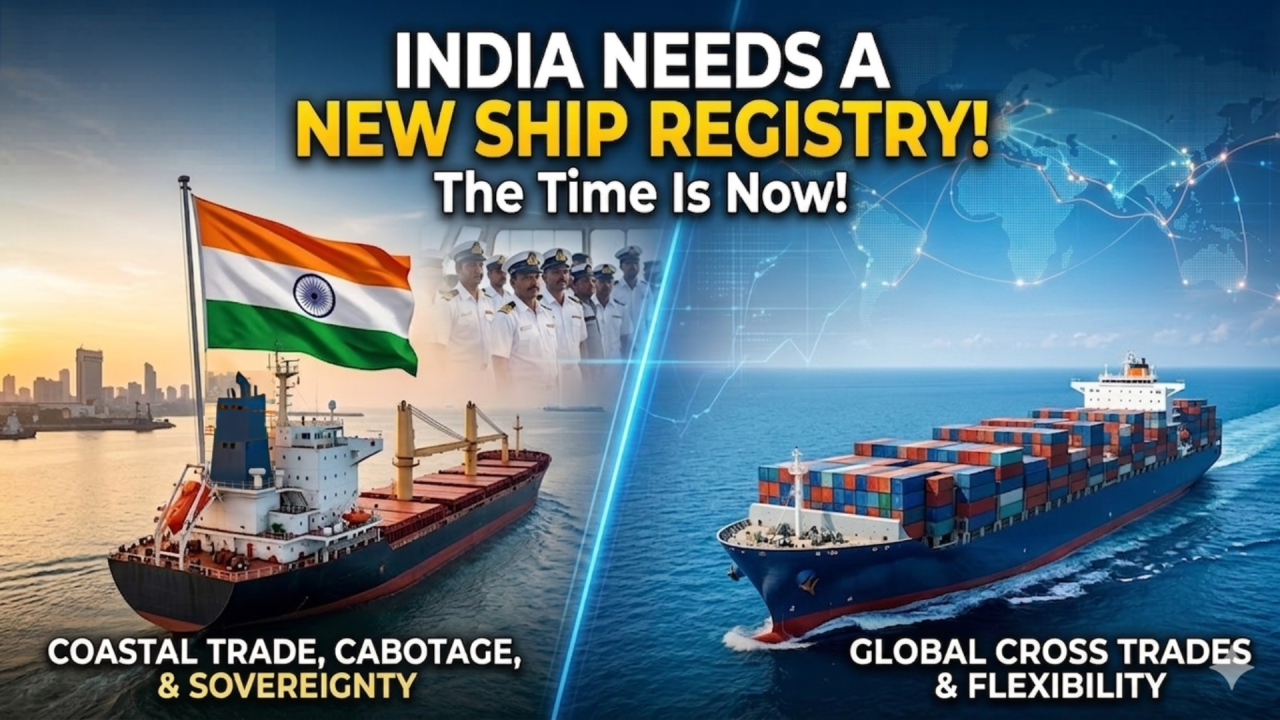
The critical design principle is functional separation, not replacement. India's national flag should continue to serve cabotage, coastal trade, offshore energy, defence logistics, and emergency response. These are sovereign functions, and the national flag is the right instrument for them.
The international register serves a different purpose entirely: participation in global cross trades, where flag neutrality, cost efficiency, and acceptability to global charterers are non-negotiable. Long-term expansion of Indian shipping depends primarily on these cross trades, not India-origin cargo alone.
Ships must be allowed to move freely between the two registers as trade patterns evolve — without fiscal or regulatory penalty. This flexible interchange principle is what makes the UK and Chinese models work in practice. Incentivising the national flag through reduced port charges, preferential access to cabotage, PSU cargoes, offshore contracts, and government charters — rather than compulsion — is the right approach to keep the national flag commercially relevant alongside an international register.
One additional, non-negotiable provision: all Indian-owned ships, irrespective of flag, must be legally callable during war, sanctions, or emergencies. Strategic control is not surrendered — it is preserved by design.
Weighing the Trade-offs
Honest assessment of pros and risks
Strategic benefits
- Fleet retention under Indian influence
- Enhanced maritime ecosystem growth
- Employment generation for Indian seafarers
- Strategic control retained via call-up clauses
- Ship finance, insurance & arbitration anchored in India
- Global cross-trade participation enabled
Risks to manage
- Reputational damage if safety standards slip
- Potential misuse if oversight is weak
- Resistance from labour and political stakeholders
- Requires a robust legislative and administrative framework
The risks are real but manageable. They are the risks of implementation, not of concept. Every maritime nation that has built a successful international registry has navigated these same pressures — and the ones that got the design right have reaped sustained strategic and commercial dividends for decades.
Conclusion
A strategic necessity, not a sovereignty compromise
India is a maritime civilisation with global ambitions, a world-class seafarer workforce, a growing shipbuilding base, and increasing geopolitical weight in the Indo-Pacific. Yet its shipping industry operates without one of the most powerful policy instruments available to maritime nations — a well-structured international registry.
A carefully designed Indian International Registry, anchored in Indian ownership, staffed significantly by Indian seafarers, financed through IFSC, and governed by robust legal and safety standards, is not a retreat from sovereignty. It is an exercise of it.
The doctrine is clear: prioritise Indian control, scalability, and resilience — and use both flags as complementary instruments of maritime power.
India's maritime policy must evolve from protecting the flag to projecting maritime influence. The two are not the same thing — and confusing them has cost Indian shipping enough time already.
This article is authored by Capt. Man Mohan Saggi, Former Nautical Advisor to the Government. of India
You Might Also Like

08 May 2026
Recommendation News

Yachts&Cruises
MSC Cruises ships has begun the first of two major refits of in Malta. 01 November 2025
Marine Tech
IMO : Mexico prepares for green shipping future 14 October 2025
Shipping Lines
GEODIS : Laura Ritchey a President & CEO of Americas Region 15 October 2025
Incidents
New details : Electrical fire that broken out on cargo ship at Port of Los Angeles 23 November 2025
Shipping Lines
Sea-Intelligence : Red Sea and East Med ports face “sharp correction” risk as Suez routings restart 23 January 2026