The Italian company posted a 3.2% increase and operates in the US through the Fincantieri Marine Group.
The U.S. Navy's new shipbuilding programme is faltering. Consequently, the U.S. may turn to foreign shipyards for support, following the model established by the 2025 Memorandum of Understanding (MoU ) with Finland regarding a series of icebreakers for the Coast Guard.
America’s Shipbuilding Industrial Base'
This is the thrust of a new memorandum titled 'Rebuilding the United States Navy and America’s Shipbuilding Industrial Base', signed by US President Donald Trump on 13 August. The memorandum's release caused the stock prices of Fincantieri and Hanwha, the two most active foreign shipbuilding groups in the U.S., to rise.
A series of setbacks across six different U.S. Navy shipbuilding programmes
The document, addressed primarily to the Secretary of Defense, acknowledges a series of setbacks across six different U.S. Navy shipbuilding programmes. These setbacks are the result of 'overly complex designs' and modifications that have caused 'cost overruns, delays and cancellations'. It also states that a lack of production capacity and competition among builders has made the global commercial shipbuilding sector uncompetitive.
In accordance with the memorandum,
In accordance with the memorandum, the Department of War is now obliged to confront these critical issues by leveraging "proven, reliable, and cost-effective naval technologies and designs". Moreover, in the short term, it is mandated to procure "up to three classes of ships" from foreign suppliers. Although no specific designs have been chosen yet, the vessels will include surface combatants, underway replenishment tankers (Consolidated Cargo Replenishment at Sea), and roll-on/roll-off (Ro-Ro) ships for military sealift.
Acquiring or otherwise securing a US shipyard
However, this is conditional upon the foreign operator in question simultaneously acquiring or otherwise securing a US shipyard in which to build the units following the first two of each programme. The document further clarifies that the facility must be staffed by US citizens—whom the operator is committed to training—and that a US-based supply chain must be utilised.
A progressive path of industrial transfer
In short, the outlined approach is a progressive path of industrial transfer. According to the US administration, it is structured similarly to the 'Finland model', which was established in 2025 for procuring US Coast Guard Arctic Security Cutter (ASC) icebreakers. Specifically, this framework has resulted in contracts being awarded to Rauma Marine Constructions (RMC) in Finland for the construction of two ASCs, with the first due to be delivered in 2028, and to Bollinger Shipyards in the US for up to four additional units, with deliveries set to begin in 2029. The publication of the memorandum caused the share prices of both Fincantieri and South Korea’s Hanwha Group, major players in the US shipbuilding sector, to rise immediately.
Related: Fincantieri has teamed up with a Japanese specialist in high-tech bulkheads.
The Italian company,
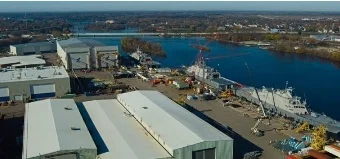
Notably, the Italian company, which posted a 3.2% increase, operates in the country through the Fincantieri Marine Group. This entity oversees four facilities, including Fincantieri Marinette Marine, a military shipyard which will build the Medium Landing Ships (LSM) for the new US Navy programme, among other projects. Commenting on the half-year results, Group CEO Pierroberto Folgiero highlighted that Fincantieri would play an “integral role in revitalising US shipbuilding”. He added that the group’s US shipyards would also be involved in launching other programmes under the strategy that the US administration is developing to make use of the small number of experienced shipyards in the United States.
Source: Shipping Italy
#Italian company #Fincantieri Marinette Marine #Pierroberto Folgiero #US shipyards #Hanwha # Trump #Finland #U.S. Navy shipbuilding
You Might Also Like
Recommendation News
Marine Tech
ABC Delivers 50th DZ Engine for Damen’s CF3850 Short-Sea Freighter 18 March 2026
Incidents
Resurgence of Somali Piracy as Three Vessels and 44 Crew Members Held Captive 28 May 2026
Marine Tech
ABB to build over 100 MVA shore power capacity for Rotterdam Shore Power terminals 06 January 2026
Marine Tech
EU : A new project to cybersecurity in the maritime and port sectors has been launched. 26 January 2026
Shipping Lines
Maersk appoints Scott Elliott as Regional President, Asia Pacific 29 June 2026