Amendments to Appendix IX of MARPOL Annex VI, mandating increased granularity in DCS fuel oil reporting, were adopted at MEPC 81
The recent sessions of the IMO’s Marine Environment Protection Committee (MEPC) introduced new statutory requirements for the IMO DCS. These changes will impact the Operational Vessel Data (OVD) standard and the reporting obligations for DNV’s GHG verification and compliance services – IMO DCS, EU MRV, UK MRV, FuelEU. This statutory news outlines the key regulatory updates and their implications for ship owners and operator
Below is a summary of the key requirements decided by recent MEPC sessions:
Applicability
Amendments to Appendix IX of MARPOL Annex VI, mandating increased granularity in DCS fuel oil reporting, were adopted at MEPC 81. Additionally, the SEEMP Guidelines were revised, supporting the MARPOL amendments. The new requirements will take effect from 1 January 2026 for most ships1. However, for newbuilds delivered on or after 1 August 2025, the requirements will apply immediately from delivery date.
SEEMP Part II
A revised and approved SEEMP Part II, along with a new Confirmation of Compliance (CoC) confirming compliance with the 2024 SEEMP Guidelines, must be on board by 1 January 2026.
Enhanced granularity in fuel consumption reporting
Vessels must now report fuel consumption split by consumer groups as defined in the SEEMP Part II2. While this practice has been part of the OVD standard and already implemented by many operators, it will now become mandatory for all vessels. In addition, fuel consumption must be divided into “Underway” and “Not underway” legs of the route.
Defined consumer groups are:
Main engine (ME)
Auxiliary engine (AE)
Boiler
Others
Revised definition of “underway” and reporting implications
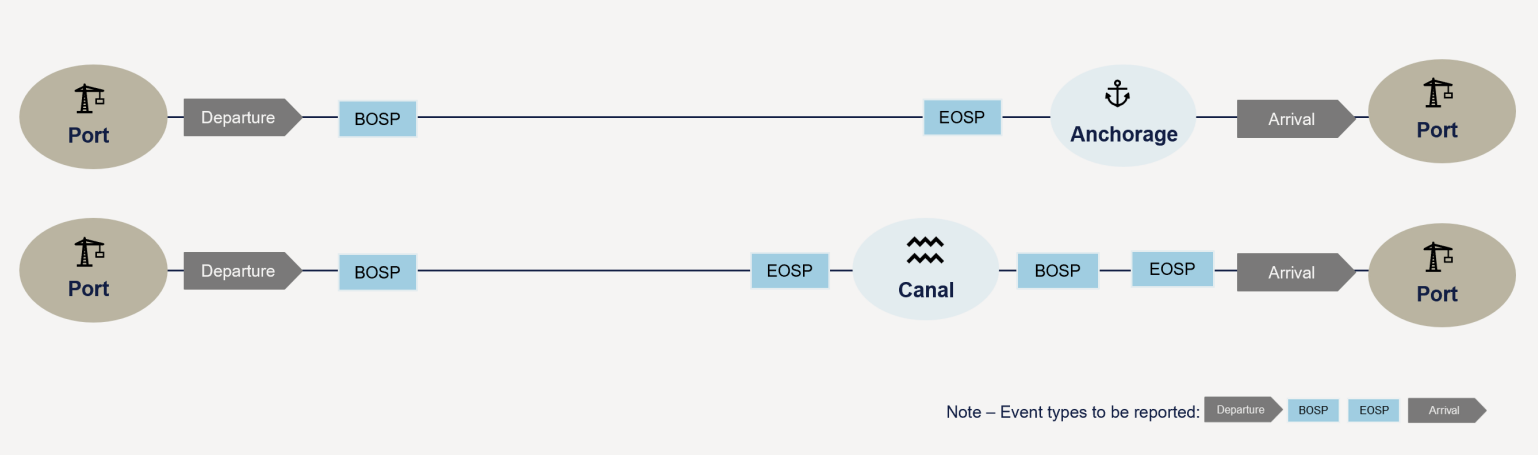
At MEPC 83, amendments to the definition of “underway” were adopted, requiring the reporting of BOSP (Begin of Sea Passage) and EOSP (End of Sea Passage) events. DNV interprets BOSP as the point at which transit speed is reached, and EOSP as the start of deceleration from transit speed.
Key implications:
Start of operation such as anchoring, ship-to-ship (STS) transfers, and canal passages which require deviation from transit speed must be indicated with an EOSP event. Resuming the voyage after such an operation must be indicated with a BOSP event.
For short voyages without a sea passage distinction in the reporting, the berth-to-berth methodology will apply.Noon-events-only reporting will be deprecated; berth-to-berth reporting will be required for all vessels.
Using event names
To indicate the start or end of the underway period, use event names (in their exact spelling):
BOSP / BeginOfSeaPassage,
FAOP / FullAheadOnPassage,
EOSP / EndOfSeaPassage.
1) The entry-into-force date of the revised Appendix IX of MARPOL Annex VI is 1 August 2025. MEPC.1/Circ.913 clarified that for ships flying the flag of an administration implementing the amendments on the entry-into-force date, data will be collected with the existing level of granularity throughout the entire year of 2025.
Resolution MEPC.395( 82 )
2) Prior to collecting data following the enhanced granularity level, each ship should revise their SEEMP II, considering the 2024 Guidelines for the development of a Ship Energy Efficiency Management Plan (SEEMP) (Resolution MEPC.395(82)). DNV offers the revised SEEMP II online form now in line with the new guidelines
The following figure illustrates the new reporting requirements for two typical trading scenarios, port–anchorage–port and port–canal–port:
two typical trading scenarios, port–anchorage–port and port–canal–port
In case nitrogen (N2) deduction is applied, it must be accurately allocated across the voyage. This can be done per event or aggregated and reported at EOSP and arrival events.
Cargo reporting enhancements
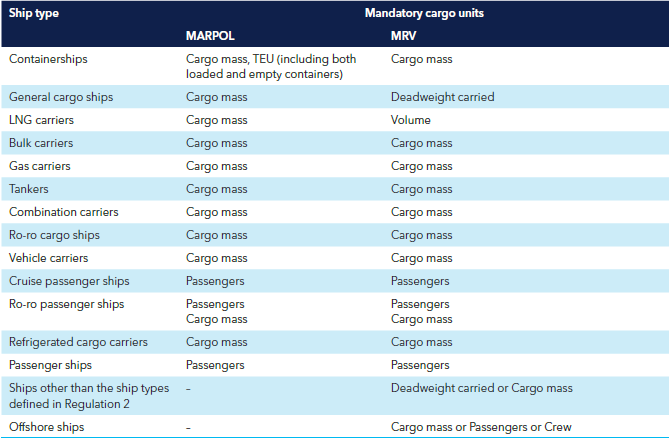
The revised Appendix IX also introduced a requirement for explicit cargo reporting to support the calculation of transport work. The cargo unit definitions have been aligned with both the IMO and the EU regulatory frameworks. Applicable cargo units are as following:
Reporting of received shore power
The revised Appendix IX to MARPOL Annex VI also requires reporting the total amount of onshore power supplied within the reporting period (in kWh). Similar reporting requirements apply from 1 January 2025 to voyages within the scope of the FuelEU Regulation (Regulation (EU) 2023/1805) and are covered in a dedicated reporting guidance.
Introduction of port-call purpose reporting
To enhance EU port-of-call reporting, a new reporting element, “Purposes_Of_Call”, will be introduced. This will replace the current method of inferring the port-call purpose from cargo changes.
Effective from 2026, operators must explicitly report the purpose of each port call using the IMO Compendium’s “Primary purposes of call” (IMO0172). Multiple purposes may be reported (e.g. “CargoOperations”, “TakingBunkers”).
The full list of port-call purposes is available in the Veracity OVD interface description.
GHG Fuel Intensity (GFI) standard – reporting requirements
At MEPC 83, the IMO agreed on the Net Zero Framework technical element (see separate communication from DNV here), which will introduce several new reporting requirements from 1 January 2028.
The OVD standard was extended in 2023 as a future-proof concept covering all reporting schemes, including the GHG Fuel Standard. For a gradual introduction to this scheme, we encourage ship owners or managers to start reporting the fuel pathway code in the OVD bunker report column “IMO_Fuel_Pathway_Code”, following the defined codes in the LCA Guidelines.
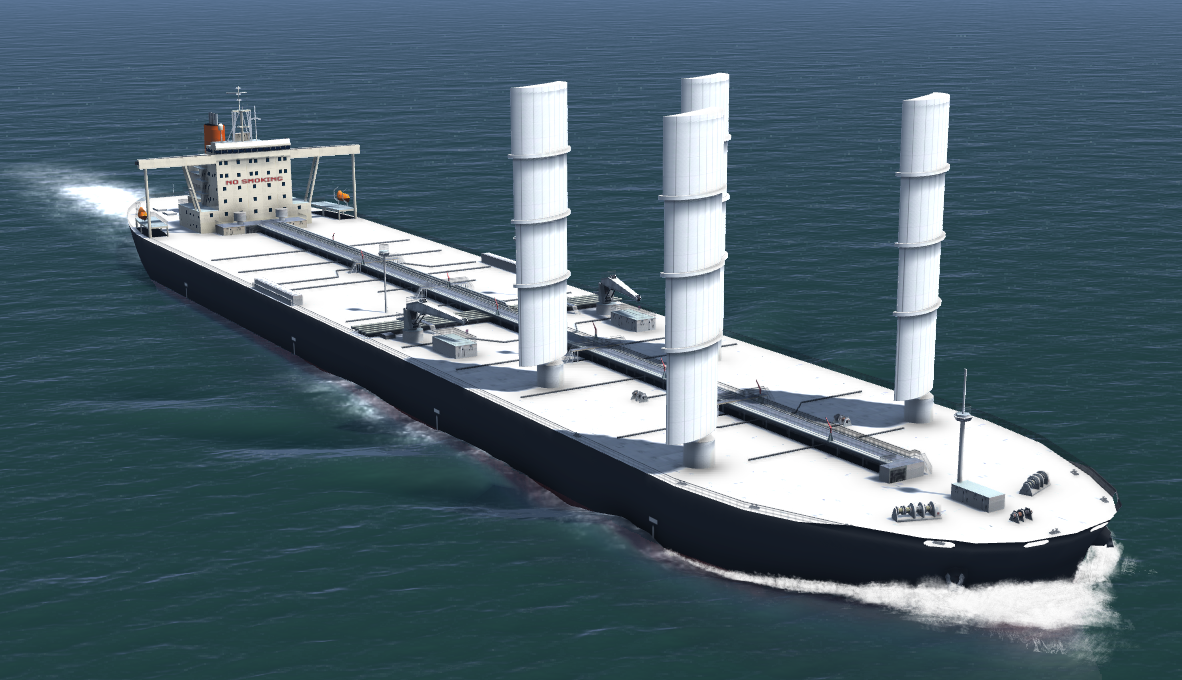
Wind-assisted ship propulsion
It is to be noted that at this point, it is uncertain how the use of some technologies, such as wind-assisted ship propulsion, will be reflected in the GHG Fuel Intensity (GFI) standard. The OVD standard will be extended once the relevant details are known.
Related : DNV Grants AiP for Shell and Brevik Engineering’s LCO2 Carrier
Source : Press – Release
You Might Also Like

18 October 2025

19 October 2025
Recommendation News

Marine Tech
Europe’s ports: Ready for the market uptake of new shipping fuels 10 October 2025
Shipping Lines
CMA CGM expands rail network linking Adriatic ports to Central Europe 11 November 2025
Marine News Room
ON LinkedIn : Gavin Allwright : We definitely face a major challenge, but headwinds to change are nothing new 03 November 2025
Shipping Lines
The U.S. Senate Confirms FMC and MARAD Appointments 20 December 2025
Marine Tech
(ADMA)A premier initiative by AD Ports Group for the advancement of the maritime industry 16 November 2025