AASTMT launches Marlog 15 Maritime and Logistics conference
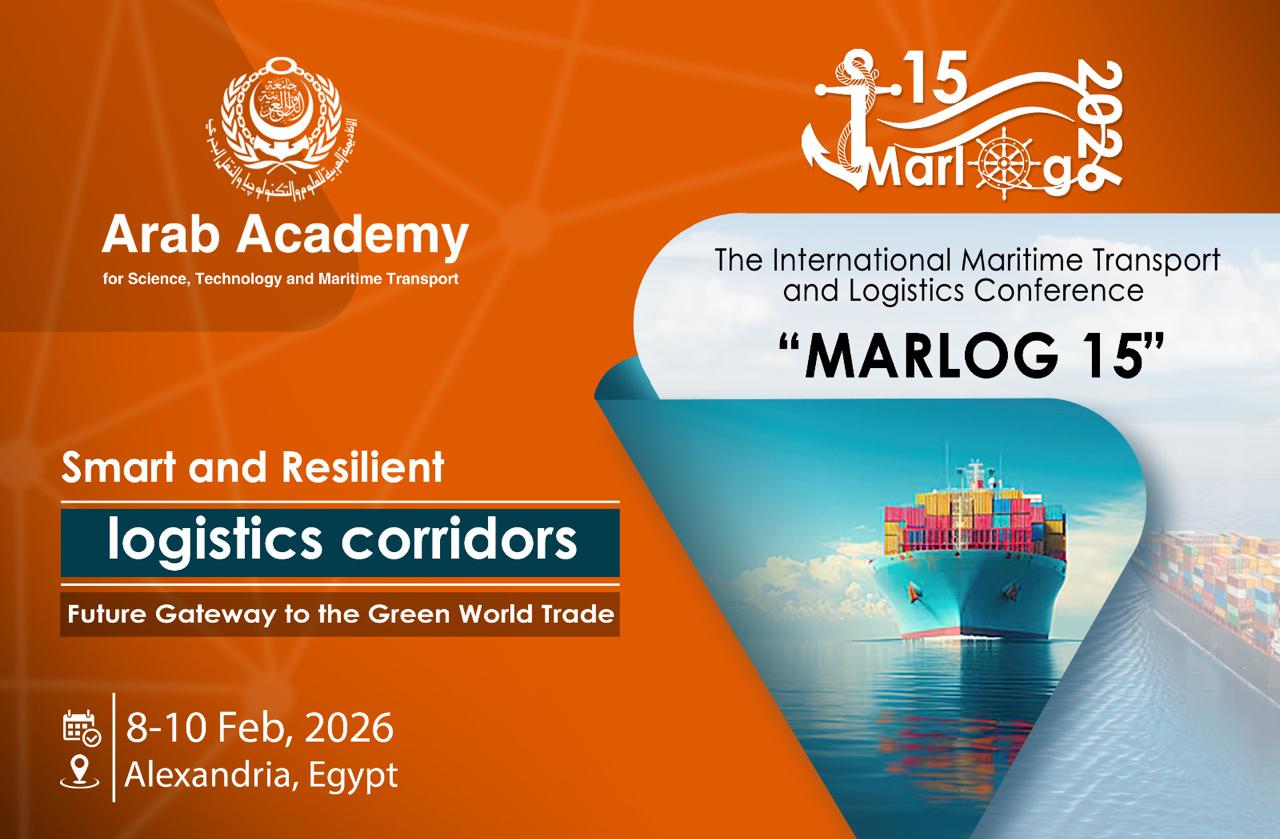
International Maritime Transport and Logistics Conference - Marlog15, from 8th to 10th of February, held under this year’s theme: Smart & Resilient Logistics Corridors, Future Gateway to the Green Trade.”
The adoption of smart multimodal transport systems, including electric vehicles, railways, and inland waterways, plays a key role in reducing carbon emissions and minimizing the environmental impact of freight transport. Through seamless connectivity and collaborative partnerships between governments, logistics providers, and technology firms, Smart Green Logistic Corridors pave the way for more resilient, sustainable, and future-ready supply chains.
The 15th MARLOG Conference sheds light on the pivotal role of Smart Green Logistic Corridors in enhancing and maximizing global trade flows. The conference explores key pillars that form the foundation for developing strategies in the establishment and management of logistic corridors, with the ultimate goal of achieving operational and service optimization.
The Arab Academy for Science, Technology & Maritime Transport (AASTMT) will open the MARLOG International Maritime Transport and Logistics Conference in Alexandria on Sunday, the 15th.
The event, organized by the Ports Training Institute, is held under the theme “Smart & Resilient Logistics Corridors: Future Gateway to the Green Trade.”
For his part, Arab Academy President Ismail Abdel Ghaffar described the conference as a global platform for policy dialogue and experience exchange, supporting Egypt’s ambition to become a regional and international hub for transport and logistics.
The opening will host high-level officials, including Deputy Prime Minister and Minister of Industry and Transport Kamel el Wazir, Jordanian Minister of Transport Nidal Qatamin, Mauritanian Minister Mokhtar Ahmed Bousif, Sudanese Transport Minister Saif Al-Nasr Al-Tijani Haroun, and Cyprus Deputy Minister of Shipping Marina Hadjimanolis, along with port authorities, the Suez Canal Authority, and members of the diplomatic corps.
The conference agenda will address global transport trends, green logistics corridors, AI and IoT applications to reduce emissions, and supply chain resilience.
Participants include academics and experts from 10 countries, including the US, China, Italy, Greece, Australia, Norway, Romania, France, South Korea, and Spain.
It is noteworthy that the MarTech 2026 International Maritime Technology Exhibition will run alongside the conference, showcasing innovations in virtual reality, simulation systems, maritime cybersecurity, renewable energy solutions, and vessel design.
Global supply chains are undergoing rapid transformation, driven by technological developments, sustainability requirements, and the growing demand for efficient, synchronized deliveries. This evolution has led to the emergence of integrated logistic corridors, designed to optimize the flow of goods while maintaining high operational standards. Smart Green Logistic Corridors represent a cornerstone approach to enhancing supply chain efficiency, sustainability, and digital transformation. By integrating advanced technologies such as IoT, AI, blockchain, and big data analytics, these corridors enable real-time monitoring, process automation, and data-driven decision-making.
The adoption of smart multimodal transport systems, including electric vehicles, railways, and inland waterways, plays a key role in reducing carbon emissions and minimizing the environmental impact of freight transport. Through seamless connectivity and collaborative partnerships between governments, logistics providers, and technology firms, Smart Green Logistic Corridors pave the way for more resilient, sustainable, and future-ready supply chains. The 15th MARLOG Conference sheds light on the pivotal role of Smart Green Logistic Corridors in enhancing and maximizing global trade flows. The conference explores key pillars that form the foundation for developing strategies in the establishment and management of logistic corridors, with the ultimate goal of achieving operational and service optimization.
SSMR Vol. 09: Overall positive development of global freight traffic
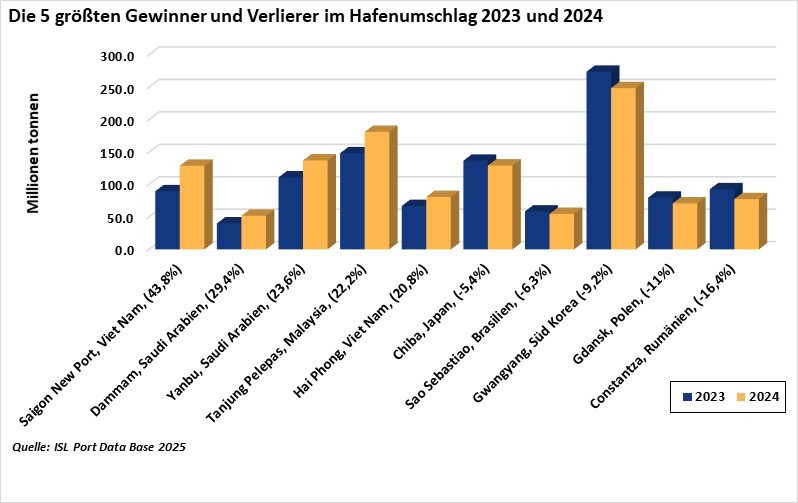
The total cargo throughput of the 470 ports recorded in the ISL Ports Database increased by 3.4% in 2024, following a 0.5% increase in 2023. This translates to an average growth rate of 1.7% over the past ten years, with significant differences between continents. Global container throughput reached a record high of 792 million TEU in 2024, representing a 7.5% increase compared to 2023 and an average growth rate of 2.6% since 2014. The highest growth rates for total and container throughput were recorded in Africa and South America.
More than half of the world's 23 billion tons of cargo handled in Asia were processed through ports. The four largest port countries – China, South Korea, Japan, and India – accounted for two-thirds of the Asian market, with shares of 42.3%, 10.9%, 6.5%, and 5.7% respectively, recording a combined throughput of 8 billion tons in 2024.
Cargo throughput in the leading East Asian markets developed differently. While China, India, and South Korea increased by 3.2%, 2%, and 0.9% respectively, Japanese ports declined by 0.3% and 0.3% respectively.
In Europe, the 146 ports listed in the ISL port database handled 3.4 billion tonnes of goods in 2024, an increase of 1.7% compared to 2023, slightly above the 2014 figure. This represents an average annual growth of 0.1% over the last ten years, while disruptions along the routes through the Suez Canal and the Red Sea caused schedule fluctuations and interruptions to feeder networks.
In Africa, the 69 ports recorded in the ISL port database handled 1.3 billion tons of cargo, representing 5.3% of the total throughput of all 470 ports recorded worldwide. This represents a 7.2% increase compared to 2023. In North America, the 69 recorded ports handled 2.61 billion tons of cargo, a 10.6% increase compared to 2023.
The total cargo volume of 1.4 billion tons handled in the 50 South American ports was four times higher than in Central America, reflecting the dominance of large export ports for dry bulk cargo in South America. Transshipment plays a significant role in the Central American market, which experiences regular shifts in market share. In 2024, Lazaro Cardenas saw a 28.8% increase to 2.40 million TEU, following a 7.8% decrease in 2023.
SEA-EU Collaboration Between the University of Split and the University of Brest Results in a High-Impact Publication

A successful collaboration within the SEA-EU Alliance between the University of Split School of Medicine (UNIST) and the University of Brest (UBO) has resulted in a publication in the Journal of Clinical Epidemiology, one of the leading international journals in the field of clinical research methodology.
The collaboration began in the summer of 2023, when Glenn Goasdoué, a medical student from the University of Brest, spent one month at the Center for Evidence-Based Medicine at the University of Split School of Medicine. His stay was carried out within the framework of SEA-EU cooperation and was supervised by Prof. Ana Marušić, MD, PhD, with scientific leadership provided by Prof. Marija Franka Žuljević, MD, PhD, from the Department of Medical Humanities.
During his research stay in Split, the student contributed to a study examining the consistency of reporting protocols and adverse events in clinical trials of two psychedelic substances currently being investigated as potential psychiatric treatments. The research team compared data reported in the ClinicalTrials.gov registry with corresponding scientific publications.
The analysis revealed that a substantial proportion of clinical trials modified their primary outcomes and inclusion criteria after participant enrolment, often without transparently reporting these changes in published articles. In addition, many trials failed to publish their results in a timely manner, and the reporting of adverse events frequently differed between trial registries and journal publications.
The authors conclude that such inconsistencies undermine the credibility of research findings and hinder reliable safety assessments of psychedelic therapies. The study highlights the urgent need for greater transparency and stricter reporting standards in clinical research.
The results of this SEA-EU collaboration have now been published in the Journal of Clinical Epidemiology, confirming the scientific value of student mobility and cross-institutional cooperation within the alliance.
This collaboration illustrates the core mission of the SEA-EU Alliance by creating valuable opportunities for young researchers through international cooperation and student mobility. At the same time, it represents a highly rewarding experience for academic staff, enabling mentors and supervisors to engage in meaningful cross-institutional collaboration, exchange expertise, and jointly contribute to high-quality, impactful research across Europe.
You Might Also Like

06 December 2025

Recommendation News
More
Opportunities : Crew for W2W Vessel (North Sea) 31 October 2025
Marine Tech
Allianz : New risks and challenges are facing for marine insurers 14 October 2025
Seafarers
Wartsila and Sinocrew partner to establish an international training centre for seafarers in China 08 November 2025
Marine News Room
Strengthening cooperation between Egypt and FONASBA in London 01 December 2025
Yachts&Cruises
Gulf Craft Underscores Brand Momentum And Infrastructure Growth At Qatar Boat Show 14 November 2025