Bermudez : We recognize the challenge the company has taken in this unprecedented process, yet we remain fully committed to Panama
APM Terminals has commenced temporary operations at the Port of Balboa on the Pacific side of the Panama Canal, marking the definitive end of CK Hutchison’s nearly three-decade presence at the strategic waterway. The handover, which took effect on 23 February after the Supreme Court’s January ruling was published in the official gazette, was accompanied by a presidential decree authorising the Panama Maritime Authority to take possession of all terminal assets — including cranes, vehicles and IT systems. MSC subsidiary Terminal Investment Limited simultaneously assumed control of the Cristobal terminal on the Atlantic side.
The transition proceeded despite sustained legal pressure
The transition proceeded despite sustained legal pressure from CK Hutchison, which has initiated ICC arbitration, invoked investment treaty protections and warned Maersk of legal recourse. Beijing’s Hong Kong and Macao Affairs Office had cautioned Panama would face consequences. Panama Ports Company described the takeover as “illegal” and “confiscatory.”
Panama maintains the continuity and reliability of its logistics hub

APM Terminals CEO for Panama, Marliz Bermudez, said the priority during this initial stabilization phase, our responsibility is to ensure that Panama maintains the continuity and reliability of its logistics hub, while safeguarding cargo and protecting the safety of all the workforce. This process requires speed and precision so that the port can progressively resume operations once the system installation is completed, along with other operational, audit, training, and verification tasks that our team will be carrying out at the Port of Balboa starting today,”
Related :Hutcheson warns Maersk if it acquires the Balboa and Cristobal terminals in Panama.- Details
She added :“We recognize the challenge the company has taken in this unprecedented process, yet we remain fully committed to Panama. We will work closely with our customers, authorities, and employees to ensure they receive clear and timely information on the progress of this stabilization phase,”
Balboa and Cristobal
It is noteworthy that Balboa and Cristobal together handle approximately 3.8 million TEU annually, representing nearly 40% of Panama’s container throughput. The 18-month interim period will culminate in an international tender for new long-term concessions — a process that will test whether the world’s largest terminal operators are prepared to bid into a jurisdiction where a sitting concession was annulled by constitutional ruling.Priority in this stage is to safeguard the continuity of Panama’s logistics hub, with the least possible disruption
Key elements of the stabilization phase
- Labor continuity:
Workforce will be incorporated through the employer‑substitution process. Their expertise will be essential to ensuring the safe and orderly continuity of operations. - Operational continuity:
Implementation of contingency protocols to minimize impacts on container delivery and receipt, alongside workforce training on the new system. - Customer service:
Direct communication channels will be available for shipping lines, customers, suppliers, and transport operators, providing technical information and operational updates so they can track the status of their cargo. - System migration:
Transition to the Navis N4 operating system, used widely across global terminals. During this process, we will be regulating container movements at the terminal and providing customers with continuous updates. - Asset diagnostics:
Inventory and assessment of cranes, equipment, and systems to identify existing issues at the terminal and define the short-term operation, maintenance, and adaptation plan. - Audit:
Review of processes, protocols, machinery, contracts, agreements, and other operational information from the terminal to enable thorough assessment and optimization.
About :The Port of Balboa
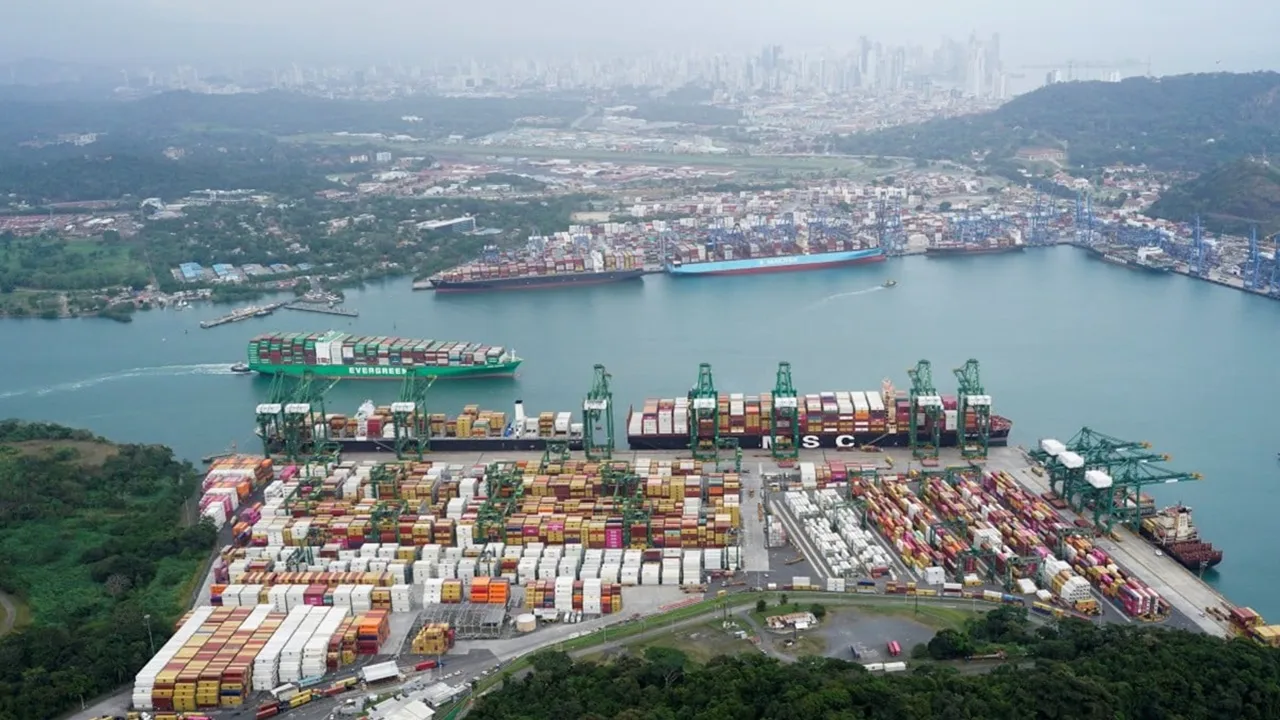
The Port of Balboa, operated by Hutchinson Port Holdings (HPH), is an important transshipment hub on the Pacific side of the Panama Canal. It handled 2.5 million TEUs in 2018, but the port is close to capacity and has limited expansion options. The ship in the middle (blue color) is operated by Maersk Line and is of post-Panamax design, implying that it cannot enter the old locks of the Panama Canal (which begins on the left side of the photo). The transshipped containers can either be placed on another ship or on the Panama Canal Railway, which has an intermodal terminal immediately adjacent to the port.
Through this rail connection,
Through this rail connection, a container can be brought to the port of Colon on the Atlantic side of the canal. In 2015, a new container port expansion project was approved at Corozal, just upstream of the port of Balboa, on 120 hectares of land that used to belong to the US Army, and which has been administered by the Panama Canal Authority since the hand over of the canal zone to the Panamanian government in 1999. The expansion is expected to add about 5 million TEUs of capacity in two phases but was delayed because of more limited growth prospects.
About : APM Terminals
APM Terminals is a leading global port and container terminal operator headquartered in The Hague, Netherlands. As an independent business unit of Danish shipping giant A.P. Moller-Maersk, it manages a network of over 60 port facilities and 100+ inland locations across 5 continents. They focus on efficient, safe, and sustainable cargo handling, aiming to be the world's best terminal company by 2026.
Related : CK Hutchison's move to MSC and Blackrock risks falling through
#APM Terminals #The Port of Balboa # Panama Port #CK Hutchison #Beijing’s Hong Kong #(HPH) #Maersk
You Might Also Like

Recommendation News

Marine Cultures
With Sakhraoui Tarek Caricaturiste 17 January 2026
Marine Tech
Fincantieri files €100 million lawsuit against Paroc in a US court 15 October 2025
Incidents
MSC Houston V Lost 15 Containers Off Portugal 16 October 2025
Seafarers
ITF files complaint against Slovenia over sham union scandal affecting seafarers’ rights 22 March 2026
Marine News Room
Baltic Sea and Space Cluster HUB meeting at the Maritime School in Gdynia 27 January 2026