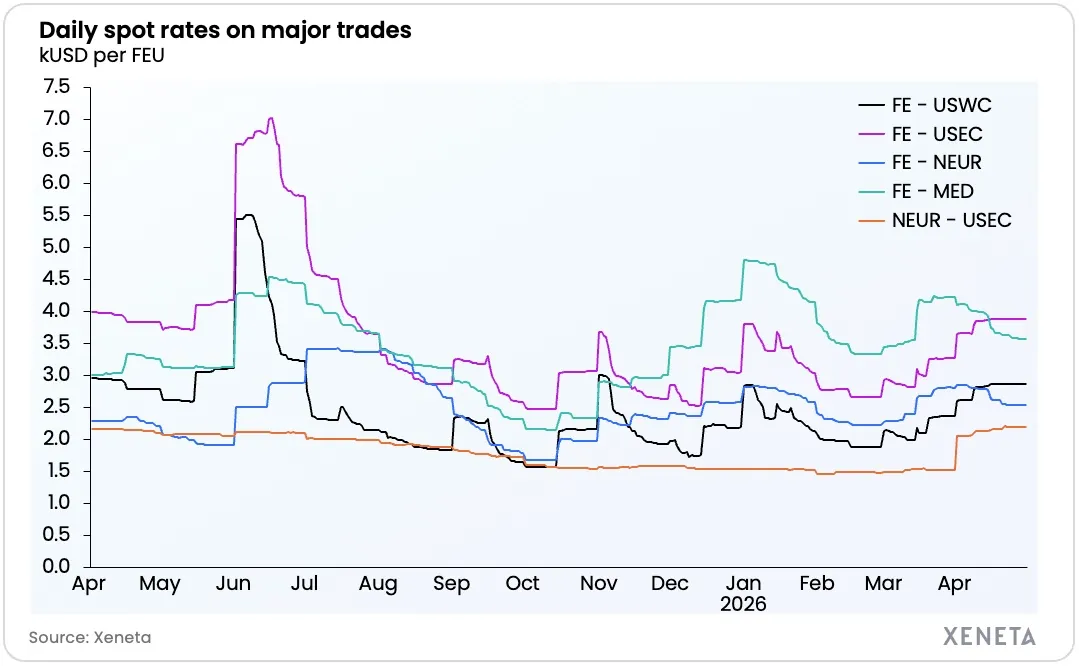
Currently, ocean freight rates average $3,567 per FEU from the Far East to the Mediterranean and have fallen 15% over the past month (from $4,221 per FEU).
According to new data on the Xeneta Shipping Index (XSI®), ocean freight container carriers are finding it hard to strike a balance between risk and reward during new contract negotiations as the market remains uncertain in the Red Sea. Data released today by Xeneta shows that the Global XSI® (the average rate of all valid long-term contracts in the market) remained fairly flat in April, rising by just 1.7% from March to reach 154.3 points.
The impact of the Middle East conflict
Meanwhile, the impact of the Middle East conflict is making life increasingly complicated for shippers, with shipping routes becoming more uncertain and shipping times longer. They must be smart when bidding for new long-term contracts to avoid losing potential revenue, as they try to cope with supply chain disruptions and rising spot rates for global ocean freight," wrote Peter Sand, Xeneta analyst, in his latest report on ocean freight rates.
Sand highlights that "the supply chains that ocean carriers have established to deal with issues in the Middle East, changing routes through inland corridors, alternative ports, and new service networks, are now functioning with enough regularity that spot rates are beginning to mirror a more stable, albeit still high, operating environment."
Related : Xeneta 's report this week updates shipping rates
A significant increase in the XSI® for European imports
On the other hand, Emily Stausbøll, Xeneta's senior shipping analyst, said: 'We saw a significant increase in the XSI® for European imports in April, primarily due to the ongoing impact of the conflict in the Red Sea.
However, given that the spot market for trades such as Far East to Mediterranean is still up by more than 60% compared to 12 months ago, you would expect carriers to push for higher long-term rates.” The reason they aren’t is that they are scared of overcapacity in an uncertain market.”
The freight rates from the Far East to the US West Coast
At $2,864 per FEU (40-foot container), the freight rates from the Far East to the US West Coast remained essentially unchanged since the end of February, although they are still 52% higher. On the US East Coast, spot rates have increased by 46% from pre-crisis levels to $3,873 per FEU. These rates have reached a high point due to continued congestion at transshipment hubs in Southeast Asia and the resulting longer transit times across the network.
Routes to Europe
'Routes to Europe are slowing down further. Xeneta explains that freight rates have fallen more significantly on routes to Northern Europe than on routes to the United States. This is because of a combination of shipping line adjustments on these corridors and the seasonal slowdown in demand in the second quarter. The capacity in Northern Europe has increased by 7.6% from a week ago. The analysis continues: 'Spot rates from the Far East to Northern Europe have fallen by 10% over the past month, reaching $2,528 per FEU. Over the same period, rates from the Far East to the Mediterranean fell by 15%, reaching $3,567 per FEU.'
Maritime transport tenders in 2026
In the long term, despite the challenges posed by the conflict in the Middle East, negotiations continue to be based on balancing supply and demand for capacity. Xeneta customers bidding for maritime transport tenders in 2026 have, in most cases, reported offers below the long-term market average in the first phase, despite high spot rates on key routes. In the third phase, these shippers secure even deeper discounts as carriers compete for volumes over the next 12 months.
'The long-term market is driven by supply and demand fundamentals,
Analysts have stated that the long-term market is driven by supply and demand fundamentals, as opposed to the crisis sentiment that underpins the spot market. Ocean carriers began negotiations with ambitious pricing, but freight forwarders responded effectively and played their cards right. With contracts being finalised for May and June, this signals that the market expects the current level of disruption to be temporary, even though the spot market has not yet priced in this expectation.'
Currently, ocean freight rates average $3,567 per FEU from the Far East to the Mediterranean and have fallen 15% over the past month (from $4,221 per FEU).
# Xeneta Shipping Index (XSI®) # Peter Sand #Emily Stausbøll #ocean freight rates #container freight # Middle East #Conflect
You Might Also Like

19 November 2025

Recommendation News
Incidents
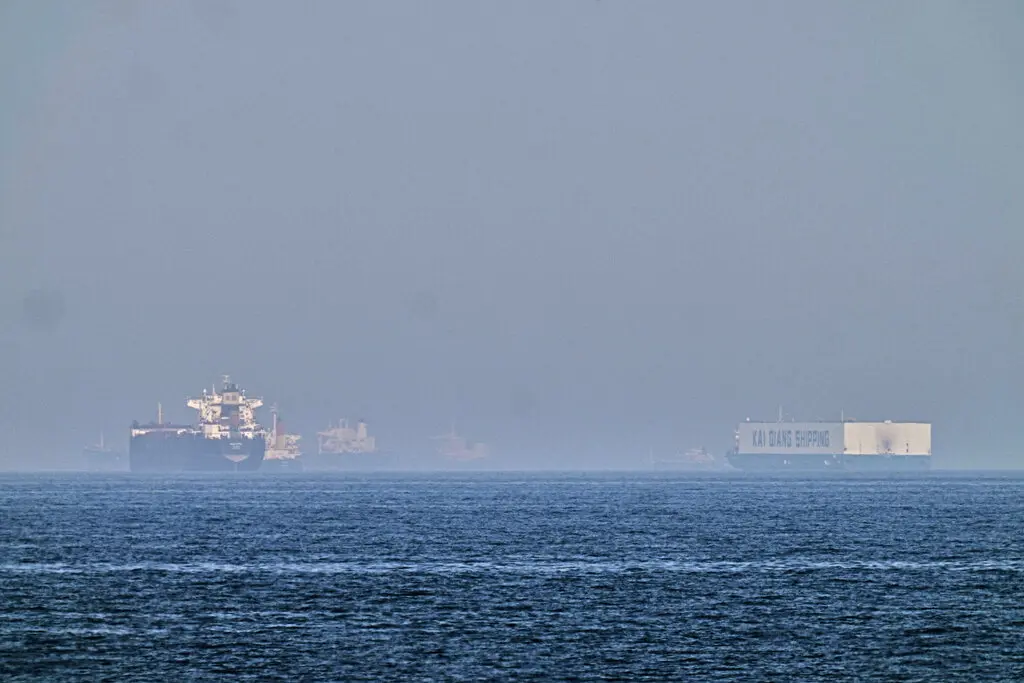
A Maersk 'military' ship passes by Hormuz, which is under crossfire. 06 May 2026
Ports
Port of Antwerp- :Total halt amid traffic control and pilot strikes 25 November 2025
Ports
Rabi: The "floating dock" GREEN DOCK 3, successfully crossed Suez Canal 07 December 2025
Ports
Circle Group wins €280,000 contract to digitize the port supply chain 26 December 2025
Incidents
At least eight die after migrant boat sinks off Greek island of Lesvos 16 October 2025