The objective of the project, which is part of the Life Mystic programme, is to deliver a solution to the marine generator segment that combines operational continuity, emissions reduction
In a rapidly evolving maritime sector characterised by growing demands for performance, sustainability, and innovation, strategic alliances play a key role. It is in this context that Nanni has commissioned ScandiNAOS AB to develop a methanol dual-fuel version of Nanni’s John Deere-based engines. This fruitful technological partnership, with successful testing of the engine, aims to support the sector’s transition to cleaner energy solutions while maintaining high performance and operational reliability
The objective of the Nanni project
The objective of the project, which is part of the Life Mystic programme, is to deliver a solution to the marine generator segment that combines operational continuity, emissions reduction, and compatibility with established engine platforms. In order to develop this system, Nanni collaborated with ScandiNAOS AB, a company that specialises in methanol dual-fuel conversion systems.
One of the main advantages of this system is its flexibility
One of the main advantages of this system is its flexibility: when the methanol tank is empty, the engine automatically switches back to diesel without interrupting navigation. Thanks to the dual-fuel configuration, approximately 60 to 70 per cent of conventional diesel fuel can be replaced with methanol while maintaining engine performance. Its use represents a major step toward cleaner and more sustainable boating.
The technical base is a 6-litre John Deere engine
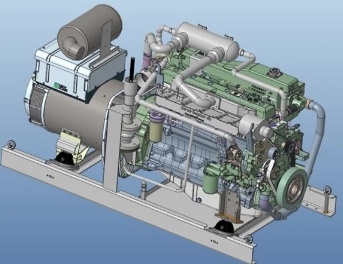
The chosen technical base is a 6-litre John Deere engine, marinized by Nanni and intended for genset applications. At the heart of the project is a conversion kit developed by ScandiNAOS, which introduces a dedicated methanol injection system and electronic management capable of controlling dual-fuel operation. Of particular interest, especially from an operational and commercial perspective, is the fact that the engine can seamlessly switch from dual-fuel mode to pure diesel operation if the methanol tank runs empty.
For professional vessels and large pleasure craft.
The system was designed to operate with a methanol energy share of between 50% and 75%, but Nanni's project aims to achieve a mix equivalent to around 70% methanol and 30% diesel. This solution significantly reduces diesel consumption without compromising performance or reliability — two factors that remain crucial, particularly for professional vessels and large pleasure craft.
IACS standards
IACS standards for progressive loading of engines and generator sets were adhered to during the testing process, with a RINA representative present. According to the company, the engine performed smoothly and stably during transitions between different operating modes, even under load.
The emissions data
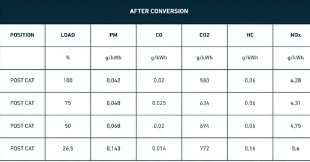
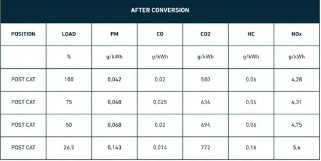
The emissions data are particularly noteworthy. Following the dual-fuel conversion, there was a significant reduction in carbon monoxide and hydrocarbon emissions, with levels dropping by between 95% and 99%. Additionally, nitrogen oxide emissions saw a substantial decrease, reaching a maximum reduction of 65% across all load points. Particulate matter was also significantly lower than with the conventional diesel configuration, confirming cleaner combustion.
Nanni is developing a platform that can integrate alternative fuels
Rather than seeking to replace existing architectures completely, Nanni is developing a platform that can integrate alternative fuels while remaining compatible with existing technologies and operating systems. This could be crucial in the coming years, as global methanol availability and bunkering infrastructure gradually increase, albeit unevenly.
For the yachting industry
For the yachting industry, this topic is especially interesting when we look to the future. While dual-fuel methanol is currently being used for the first time in generators, this technology could form the basis for future developments in high-speed main propulsion systems, particularly in areas where owners, shipyards, and operators are demanding solutions that reduce the environmental footprint without compromising the range, ease of management, and operational availability of vessels.
About: ScandiNAOS AB
ScandiNAOS AB is a Swedish ship design company working with energy-efficient and sustainable shipping. The goal is to contribute to the development of successful marine transport systems with minimum environmental and climate impact.
In recent years, the work to introduce methanol as an alternative marine fuel has been the focus area. Several projects have been done with smaller and larger ships of different types. Other fields where ScandiNAOS provides competence are, for example, energy efficiency, waste heat recovery, electric propulsion, and wind-assisted propulsion.
ScandiNAOS AB was founded in 2005 as a cooperation between NAOS Ship and Boat design SRL, Globtech AB, and Enmar Solutions AB (MarDeQ AB).
About; Nanni
Nanni designs and develops complete marine solutions, including engines from 10 to 2200 hp, marine generators from 5 to 800 kW, manoeuvring systems and interfaces. Nanni distributes its products through its sales and service network in 90 countries worldwide
#.Nanni #ScandiNAOS AB # emissions data #methanol energy #NAOS Ship #high-speed dual-fuel engine
You Might Also Like

29 November 2025
Recommendation News
Ports
Pilbara Ports cleared as potential cyclone threatens 06 February 2026
Incidents
Thailand : Pre-dawn fire at Phuket's Chalong Bay pier destroys 22 speedboats 08 January 2026

Ports
Singapore port traffic rises in October as vessel and container volumes increase 15 November 2025
Yachts&Cruises
Newly Upgrade MSC MAGNIFCA Leaves Shipyard in Malta for Mediteriance Sailing 22 December 2025