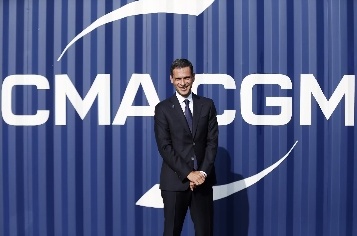
The Chairman of CMA CGM told Corriere della Sera that the company's goal is to set up a network of alternatives to reduce supply chain dependence on a single bottleneck
Saadé acknowledges that the company is still in a crisis situation, with nine vessels still stranded in the Persian Gulf.
The Strait of Hormuz remains a major risk factor for global trade, and the crisis could have far more profound consequences than the current disruption to shipping traffic. In an interview with Corriere della Sera, Rodolphe Saadé, Chairman and controlling shareholder of CMA CGM — the world’s third-largest container shipping group after MSC and Maersk — issued this warning, arguing that the issue concerns not only the Persian Gulf, but also the stability of the entire freedom of navigation system.
Saadé acknowledges that the company is still in a crisis situation, with nine vessels still stranded in the Persian Gulf. He anticipates that it will take several months to fully restore operations. Therefore, for the French shipowner, it is premature to speak of a return to normal, even though shipping lines and logistics operators continue to revise routes and operational plans.
The potential consequences of the crisis
Saadé expresses concern over the potential consequences of the crisis, stating that it could result in the introduction of long-term restrictions on the freedom of maritime freight transit. 'Global trade relies on freedom of navigation,' he observes in the interview. For this reason, he deems the notion of introducing a toll for passing through the Strait of Hormuz nonsensical: 'If we start imposing passage fees at Hormuz, why not extend the same logic to Gibraltar or other strategic straits tomorrow?'
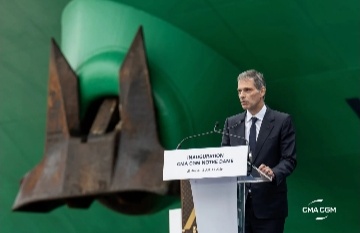
This precedent undermines one of the foundational principles of international trade
He explains that the risk is that this precedent could undermine one of the foundational principles of international trade. And the Strait of Hormuz is not an isolated case. "The problem, then, is not the channel itself, but the increasing vulnerability of major hubs in globalisation." From the difficulties at the Bab el-Mandeb strait, at the entrance to the Red Sea, to the tensions surrounding Taiwan and the effects of the war in Ukraine, the number of strategic passages exposed to geopolitical crises is increasing.
CMA CGM is adjusting its logistics strategy
In response to this scenario, CMA CGM is adjusting its logistics strategy. The aim is not to replace traditional routes, but rather to establish an alternative network that reduces supply chains' dependence on a single bottleneck. “We can no longer rely on a single transit point. We must create alternatives,” says Saadé. This includes investing in the Sohar terminal in Oman and developing intermodal connections that allow goods to be offloaded at Gulf ports or Jeddah for onward transport by land.
Related: CMA CGM to acquire FedEx Supply Chain for $1.4 billion.
Relying on the Cape of Good Hope route
Despite the longer transit times and higher costs involved, relying on the Cape of Good Hope route is also becoming a structural risk management tool. Currently, around 60% of the CMA CGM fleet continues to transit via the Suez Canal, while the remaining 40% sails around Africa when more direct routes are deemed unsafe.
The company's expansion in the United States
This context also the company's expansion in the United States through a partnership with FedEx is also part of this context. As part of the deal, CMA CGM will be managing 123 warehouses across North America, as well as acquiring the American group's third-party logistics operations. However, for Saadé, the critical challenge lies not merely in growing the logistics business, but in building a supply chain that can withstand a world in which major international trade hubs are increasingly exposed to geopolitical tensions.
Source: Italian Media
# CMA CGM #Suez Canal #Strait of Hormuz #Rodolphe Saadé #Corriere della Sera #United States #Bab el-Mandeb Strait #FedEx # Cape of Good Hope
You Might Also Like


19 December 2025
Recommendation News
Marine News Room
Mohamed Farouk writes: TIC 5.0- How is smart technology redefining trust in global trade? 18 June 2026
Marine Tech
NuProShip II – Pioneering the future of sustainable Marine Propulsion with Nuclear reactors 02 February 2026
Marine Tech
Bureau Veritas supports Australia’s Defence Seaworthiness Project 01 November 2025
Shipping Lines
MSC has acquired Spadoni, the historic Livorno-based shipping agency. 31 August 2026
Marine News Room
Capt. Morgan Dawicki to ALAM Al MWANI : A require transformation of maritime education. 25 December 2025