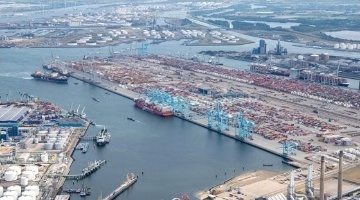
The largest container vessels travel through the Yangtze Canal to and from the APMT 2 and RWG terminals in the Prinses Amaliahaven. Both terminals are currently expanding their capacity.
The first stage of the Yangtzekanaal widening programme has been completed by the Port of Rotterdam Authority, with the next phase now underway. This will allow two-way traffic by containerships of up to 24,000 TEU, according to the Authority. A 500-metre tugboat quay was completed on the canal's southern side by contractors Hakkers, De Klerk and Van Oord. This quay provides 12 berths with shore power. The widening of the Yangtzekanaal along the same section enables two-way navigation by ships of up to 18,000 TEU.
A 500-metre tugboat quay on the canal’s southern side
Contractors Hakkers, De Klerk and Van Oord completed a 500-metre tugboat quay on the canal’s southern side, providing 12 berths with shore power. The work widened the Yangtzekanaal along the same section and enables two-way navigation by ships of up to 18,000 TEU.
20 inland shipping berths alongside 10 existing berths
A 1,450-metre quay wall is now being built by the consortium to the west of Antarcticakade. 20 inland shipping berths are to be added alongside 10 existing berths, all with shore power, and a heavy-load area is to be created for occasional cargo and specialised materials.
A maintained depth of NAP minus 6.8 metres is ensured in the berths
A maintained depth of NAP minus 6.8 metres will be ensured in the berths. Approximately 1.4 million cubic metres of sand will be dredged and used for land reclamation at Maasvlakte 2. Work on the second phase is scheduled to continue until 2028. The extra capacity is there to handle the extra traffic generated by the expansion of the APMT 2 and Rotterdam World Gateway terminals in Prinses Amaliahaven.
Reducing carbon emissions by approximately 50%
Around 10,000 cubic metres of cement-free geopolymer concrete will be used in the upper section of the new quay wall, reducing carbon emissions by approximately 50% compared to conventional concrete. The third phase, which is planned for after 2028, will include further dredging and deepening. The wider programme is intended to support two-way traffic by potential future containerships with a capacity of up to 30,000 TEU.
Related: Port of Rotterdam: Major progress on Air Products’ new liquid hydrogen facility
The largest container vessels
Conversely, the largest container vessels travel through the Yangtze Canal to and from the APMT 2 and RWG terminals in the Prinses Amaliahaven. Both terminals are currently expanding their capacity. This means that there will soon be more traffic on the canal and that space will need to be made for larger vessels to pass through. Over the coming years, the navigable channel of the Yangtze Canal will be widened along its entire length. Once the project is complete, the canal and therefore access to the Maasvlakte will be ready to safely and efficiently welcome the next generation of container vessels yet to be developed.
Second phase initiated
After the first phase was delivered, the second phase was immediately initiated. This phase involves the construction of a 1450 quay wall to the west of the existing Antarcticakade with 20 extra inland shipping berths, in addition to the 10 existing berths. A heavy load zone will also be constructed – for occasional transshipment of freight or specific materials. The inland shipping berths in front of the quay wall will have a maintained depth of NAP -6.80m. To widen the navigable channel and realise the inland shipping berths, 1.4 million cubic metres of sand will be dredged, which will be reused for land reclamation on Maasvlakte 2. These works will make two-way traffic possible for container vessels up to 24,000 TEU.
Sustainable quay wall
The top of the new quay wall will be constructed with around 10,000 m³ of geopolymer concrete. This material contains no cement and reduces carbon emissions by around 50% compared with traditional concrete. The project is therefore in line with the ambitions of Port of Rotterdam Authority to make the construction and maintenance of port infrastructure even more sustainable. Port Authority maintains around 80 kilometres of quay walls and 200 kilometres of slopes. In the coming years, further investments will be made in new and replacement quay walls. It is expected that geopolymer concrete will be used more and more often in these types of projects.
About: The Port of Rotterdam Authority
The Port of Rotterdam Authority is a Dutch public limited company that is responsible for managing and developing Rotterdam's port and industrial area, as well as supporting safe and efficient vessel traffic. The Municipality of Rotterdam owns 70.83% of the company, while the Dutch state holds the remaining 29.17%. In 2025, the authority recorded revenue of €940.4 million ($1.07 billion), a net profit of €266 million ($303 million), and investments totalling €291.4 million ($332 million). During the year, Rotterdam handled 428.4 million tonnes of cargo, including 14.2 million TEU.
#Port of Rotterdam Authority #Yangtzekanaal widening # Hakkers #De Klerk #Van Oord #RWG terminals #Yangtze Canal #largest container vessels # Prinses Amaliahaven
You Might Also Like


19 October 2025
Recommendation News
Marine Tech
B V and Seatrium signed an MOU for developing next-generation offshore power. 10 May 2026
Shipping Lines
Maersk Enhances Connectivity Across the Americas with New Manzanillo Depot 18 December 2025
Shipping Lines
Noble Corporation plc to announce fourth quarter and full year 2025 results 05 February 2026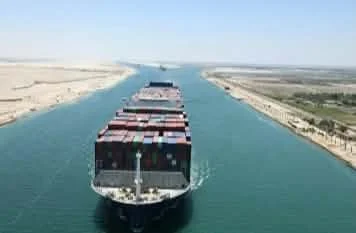
Shipping Lines
Premier Alliance also returns to the Suez Canal 06 October 2026
Shipping Lines
Italy : Reappointed Gloria Dari as president for the three-year of the Spedimar 12 December 2025