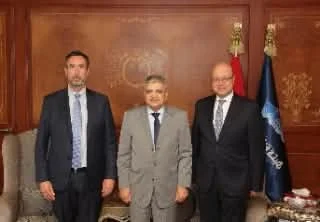
The JIFEX 2026 organiser outlines opportunities for regional logistics integration, Saudi-Jordanian cooperation, smart ports, and resilient trade corridors
Raed Abu Saada, Vice President of the Arab Federation for Exhibition and International Conference Organisation in the Levant, the organiser of JIFEX 2026, says the region is entering a new phase in which logistics competitiveness will depend not only on individual ports, but on the ability to build integrated networks connecting ports, industrial zones, border crossings, railways, roads, customs systems, and digital platforms.
In an interview with Alam Al-Mawani, the conference’s media sponsor, Abu Saada highlighted significant opportunities for Saudi, Jordanian, and other Arab companies in port management and operations, logistics zones, supply chain integration, maritime services, land transport, digital platforms, cybersecurity, training, and services supporting major industrial projects.
He also discussed Aqaba’s potential as a regional logistics hub, Saudi Arabia’s growing influence on the region’s transport map, the role of JIFEX 2026 in facilitating partnerships, and the importance of resilience amid geopolitical disruptions affecting the Red Sea and global supply chains.

The vision behind JIFEX 2026
What is the vision behind JIFEX 2026, and what are the main issues it will address?
Raed Abu Saada: We are working to develop a regional platform that brings together decision-makers, port authorities, transport and shipping companies, logistics service providers, investors, customs authorities, technology providers, and financial institutions in one place. The objective is to move discussions beyond diagnosing problems towards identifying actionable solutions, projects, and partnerships
The 2026 edition is particularly significant because the transport and logistics sector is undergoing an unprecedented transformation. Geopolitical developments in the Red Sea and maritime chokepoints, changing shipping routes, and the growing importance of supply chain security and continuity, alongside digital transformation, artificial intelligence, and smart ports, have all redefined the concepts of logistics security and competitiveness.
Accordingly, the conference agenda will focus on ports and critical infrastructure, alternative trade corridors, multimodal transport, railways and border crossings, trade facilitation and customs procedures, investment and public-private partnerships, digital transformation, artificial intelligence, cybersecurity, and supply chain sustainability and resilience.
At the Levant level, we start from a fundamental conviction: the future of logistics services in the region cannot depend on ports, border crossings, and transport networks operating as isolated islands. Instead, ports must be connected to industrial zones, borders, railways, roads, digital platforms, and customs within an integrated system.
One of the conference’s key strategic objectives is therefore to promote regional logistics integration — moving from competition between individual ports to competition between integrated logistics corridors, and from isolated national thinking towards building regional networks and corridors capable of reducing transit times and costs while improving the reliability of cargo flows between Arab countries and global markets.
The future of specialised exhibitions and conferences
Do you expect agreements or partnerships to be concluded on the sidelines of the conference? How do you see the future of specialised exhibitions and conferences?
Raed Abu Saada: One of the most important functions of modern economic exhibitions and conferences is to turn networking into business and investment opportunities. However, we must always be precise in this regard; we do not announce an agreement until the parties have completed their procedures and it is ready for signing.
What we can say is that JIFEX provides a suitable environment for exploring memoranda of understanding, partnerships, and cooperation opportunities in port operation and development, logistics zones and centres, multimodal transport, shipping and customs clearance, logistics technology, digital transformation, training and capacity building, as well as investment and public-private partnership opportunities.
Our role as organisers is to bring opportunity owners together with decision-makers, capital, and expertise, rather than simply providing a platform for exhibition.
As for the future of specialised exhibitions and conferences, I believe the industry will change significantly. Success will not be measured solely by attendance figures, but by what an event generates in terms of business matching, investment opportunities, knowledge-transfer partnerships, and outcomes that can be followed up after the event.
At IPCO, we are therefore working to gradually transform JIFEX from a multi-day event into a year-round platform connecting companies, institutions, and investors; following up on opportunities and projects; and providing specialised content, business meetings, and field visits. Each new edition should build on the results of the previous one rather than starting from scratch.
Aqaba is a regional logistics hub
To what extent can Aqaba become a regional logistics hub and a gateway to global markets?
Raed Abu Saada: Aqaba has several important strategic assets: a prime location on the Red Sea; a diversified port system; a special economic zone and investment-friendly legislation; road networks connecting it to Jordan’s hinterland and neighbouring markets; as well as plans to develop rail connectivity, digital infrastructure, and logistics services. However, we must be realistic: geographical location alone does not create a logistics hub.
A successful logistics centre depends on the speed and flexibility of cargo movement, transport costs, customs efficiency, the regularity of shipping services, the quality of road and rail connectivity, the level of digitalisation, the reliability of services, and the ability of different stakeholders to operate as part of a single integrated system.
This is where Aqaba’s real opportunity lies. Jordan has already included, within its 2024–2028 Transport Strategy, the objective of developing an integrated and flexible transport system and strengthening the Kingdom’s position as a transport hub. Its Economic Modernisation Vision also seeks to enhance regional connectivity, develop infrastructure, promote smart solutions, improve data systems, and facilitate trade.
I do not like to present Aqaba as an alternative to the region’s other ports. That is not a vision that serves us in the long term. Instead, we should view Aqaba as a node within a regional logistics network that can integrate with Saudi and Egyptian ports, East Mediterranean ports, and overland corridors extending towards Saudi Arabia, Iraq, Syria, and beyond.
Recent developments have shown that any alternative logistics corridor can serve as a strategic safety valve and an alternative supply artery for global supply chains, helping to mitigate transport disruptions while supporting multimodal transport across the region.
This is also consistent with the approach advocated by the United Nations Conference on Trade and Development (UNCTAD). Future global competition will not be between Aqaba Port and Jeddah Islamic Port, or between any two individual ports; it will be between complete logistics chains and corridors in terms of time, cost, reliability, and resilience.
Saudi Arabia’s logistics and investment boom
How do you view the impact of Saudi Arabia’s logistics and investment boom on the region’s maritime transport map?
Raed Abu Saada: What is happening in Saudi Arabia’s transport and logistics sector represents a significant transformation at the regional level. The National Transport and Logistics Strategy has clearly established the objective of positioning the Kingdom as a global logistics hub, alongside the development of ports and logistics zones, multimodal connectivity, digital transformation, and greater private-sector participation.
The regional significance of this experience extends beyond expanding the capacity of Saudi ports. It also involves reshaping trade networks across the Red Sea and strengthening connections between ports, industrial zones, railways, roads, logistics services, and technology.
Jeddah Islamic Port is an important example of the development of maritime connectivity and logistics services. Meanwhile, Port of NEOM — formerly Duba Port — and the OXAGON project represent another model focused clearly on automation, sustainability, and integration between industry, ports, and supply chains.
Port of NEOM is currently undergoing an advanced development phase that includes a new container terminal and automated and digital operating technologies.
At JIFEX, we do not look at the Saudi experience simply from the perspective of showcasing it, but from the perspective of what we can learn from it, and where we can build partnerships.
What opportunities for cooperation do you see between participating companies and their Saudi counterparts?
Raed Abu Saada: There are significant opportunities for Jordanian, Arab, and Saudi companies in port and logistics-zone management and operations, supply chain integration, maritime services, land transport, digital platforms, cybersecurity, training and skills development, and services supporting major industrial projects.
More importantly, the relationship should not be one-directional. Major projects in Saudi Arabia are generating demand for a broad network of suppliers, operators, and service providers across the region.
At the same time, Aqaba and Jordan can form part of a regional supply and connectivity network serving these projects and the surrounding markets.
Shipping routes and supply chains
Shipping routes and supply chains are facing rapid geopolitical and environmental changes. What solutions will JIFEX explore?
Raed Abu Saada: I believe the most important lesson of recent years is that efficiency alone is no longer enough; it must be accompanied by resilience.
A company that achieves the lowest transport costs but relies on a single route, port, or information system may be more exposed to risks than a company with alternatives, business continuity plans, and the ability to rapidly redirect its supply chain.
The current situation in the Red Sea confirms this. The International Maritime Organization (IMO) has been monitoring risks surrounding navigation in the region and, during July and August 2026, renewed calls for risk assessments, the protection of seafarers, and the safety of navigation and supply chains.
JIFEX will therefore address risk management, business continuity, alternative corridors, port security, marine insurance, operational resilience, crisis management, supply chain security, and the integration of maritime transport with road, rail, and air transport.
The role of digital transformation
What is the role of digital transformation and smart ports?
Raed Abu Saada: We do not want to approach digital transformation simply as a showcase for technology or as a collection of new devices and software.
A truly smart port is one in which ships, terminals, customs authorities, trucks, warehouses, and cargo owners can exchange information securely and at the right time.
The conference will therefore focus on Port Community Systems, Single Window platforms, artificial intelligence, the Internet of Things, automation, Digital Twins, data analytics, cargo tracking, cybersecurity, and the integration of port data with cities and transport networks.
Regional experiences in this field have also become increasingly advanced. Saudi Arabia, for example, is developing smart-port platforms that bring together data on ships, containers, and trucks while providing shipment-tracking services.
The issue, therefore, is not whether we use technology, but how we transform data and technology into shorter transit times, lower costs, greater transparency, faster decision-making, and more resilient supply chains.
The geopolitical momentum in the Red Sea region
In light of the geopolitical momentum in the Red Sea region, how can shared logistics infrastructure become an integrated platform serving regional trade?
Raed Abu Saada: In my view, this is one of the most important strategic questions facing the region in the coming years.
The Red Sea should not be viewed merely as a maritime corridor through which ships pass, but as an integrated economic and logistics system encompassing ports, industrial zones, special economic zones, land crossings, airports, railways, energy networks, and digital platforms.
The steady increase in vessel sizes, the growing reliance on economies of scale to reduce costs, and the role of hub ports and the benefits that follow all require genuine integration among ports to enable cargo to be distributed quickly across multiple destinations.
Jordan’s Economic Modernisation Vision
What are the key partnership opportunities linked to projects such as NEOM, OXAGON and Jordan’s Economic Modernisation Vision?
Raed Abu Saada: Integration between Aqaba and Saudi ports does not necessarily mean establishing a single operating entity. Rather, it means building an Integrated Regional Logistics Network through which ports and border corridors can exchange data, coordinate procedures, develop shared services, and provide cargo owners with multiple options.
Several practical areas can serve as a foundation for this, including electronic connectivity and the exchange of advance shipment data, facilitating customs transit procedures, developing regular land-transport services, future rail connectivity, cooperation between logistics zones, facilitating truck movements, developing Ro-Ro services where economically viable, and coordinating business continuity plans in the event of disruption to any route.
These are not ideas detached from reality. In 2026, Jordanian-Saudi technical committees discussed electronic connectivity between border crossings, the exchange of data and information, and the facilitation of cargo transport. The transport ministers of the two countries also discussed the development of the regional railway project as a tool for strengthening economic integration and supply chains.
As for NEOM and OXAGON, the opportunity should not be reduced to treating them as markets for a single project. They represent a new industrial and logistics ecosystem that requires suppliers, contractors, transport and storage services, ports, digital services, training, maintenance, and supply chain solutions.
At the same time, Jordan’s Economic Modernisation Vision seeks to improve infrastructure, regional transport, logistics, digitalisation, and trade facilitation. This creates genuine space for shared interests and cooperation.
I believe the region’s greater ambition should be to transform its geographical location from a mere advantage on the map into genuine economic value. This requires moving beyond infrastructure connectivity towards operational, digital, and commercial connectivity — ensuring that ports, roads, borders, railways, data, and procedures operate as an integrated system. I do not believe the strategic question for the future is which port will be the largest or which port will capture the biggest share.
An Arab and regional logistics network
The more important question is: How can we build an Arab and regional logistics network that makes trade flows through our region faster, more reliable, and more competitive, while creating shared economic value for all participating countries?
That is precisely the spirit we want JIFEX 2026 to embody: moving from individual competition to integration, from managing cargo flows to developing trade corridors, and from talking about opportunities to building partnerships that can be implemented.
Source: Alam Al-Mawani
#JIFEX 2026 #Alam Al-Mawani #OXAGON #NEOM #Raed Abu Saada #, Aqaba #IPCO #Jordan #Sudi Arabia #Egyptian ports #Red Sea #Jeddah Islamic Port # UNCTAD)
You Might Also Like

18 November 2025

09 October 2025
Recommendation News

Yachts&Cruises
Grimaldi increases capital by 50 million for its subsidiary Trasmed 08 October 2025
Incidents
Captain of the Russian tanker has been ordered to be detained by a Swedish court. 16 March 2026
Marine Tech
Bound4blue completes second suction sail installation for Maersk Tankers 03 May 2026
Yachts&Cruises
Stena Line Celebrates launch of hybrid ferry Stena Futura in Belfast 22 November 2025
Incidents
The UK has denied that its navy ship was hit in the Mediterranean. 06 April 2026