The three governments aim to respond more effectively to the geopolitical and economic challenges currently facing Europe, which are becoming increasingly complex and intertwined.
The ARRRA cluster is to be made fit for the future by a collaboration that has been agreed upon.
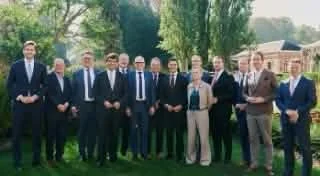
The prime ministers and ministers of Flanders, the Netherlands and North Rhine-Westphalia met in Meise, Belgium, on 5 October at the Port Summit. There, they spoke with the port CEOs within the ‘Antwerp-Rotterdam-Rhine-Ruhr Area’ (ARRRA), including the Port of Rotterdam, to discuss strengthening the region’s competitiveness. The agreements between the governments have been set out in a final declaration.
The ARRRA cluster plays a crucial role in Europe’s economy and energy supply, and in ensuring its strategic autonomy. Companies across this port-industrial cluster are highly interconnected and collaborate closely. Together, the ports in the region generate around €65 billion in added value and support nearly 600,000 jobs. However, high energy prices, international competition, lengthy permitting processes and regulatory fragmentation are undermining the competitiveness of the ARRRA cluster.
A future-proof ARRRA cluster
By better aligning infrastructure, knowledge and industrial capacity in the region, the three governments aim to respond more effectively to the geopolitical and economic challenges currently facing Europe. The parties have agreed to work together to ensure a future-proof ARRRA cluster. The ports involved are Duisport, North Sea Port, Port of Antwerp-Bruges, Port of Cologne/HGK, Port of Moerdijk, Port of Oostende and Port of Rotterdam.
Four priorities
During the summit, the parties set out four priorities:
Stronger circular value chains and a cross-border market for raw materials. The investment climate for the circular economy in Europe must be strengthened through the creation of an internal market for secondary raw materials and the upscaling of circular value chains, while ensuring regulatory harmonisation. Accelerated expansion of energy infrastructure for CO2 and hydrogen. The parties wish to cooperate more closely on CO₂ transport and storage, hydrogen, pipelines and investment certainty. By organising cooperation more efficiently, the parties aim to accelerate the development of cross-border energy infrastructure
Sustainable and resilient inland navigation.
Sustainable and resilient inland navigation. Climate change is increasing the vulnerability of inland navigation. The parties therefore seek to strengthen cooperation on strategic water management and the sustainability of inland navigation. Innovative logistics through automated freight transport and drones. The parties intend to use cross-border corridors, such as Antwerp–Rotterdam, to implement automated freight transport by road and water. The parties also see opportunities for greater cooperation in the field of drones, provided that rules and procedures are further harmonised.
Ports welcome the summit outcomes
The ports have welcomed the final declaration of the Port Summit. Earlier this summer, the ports sent a joint letter calling for a level playing field for businesses in the region, improved cross-border energy infrastructure and faster permitting processes through so-called ‘acceleration areas’. The ports are already working closely together on the issues discussed at the Port Summit.
Related: Rotterdam starts 1,450-metre quay build for two-way 24,000-TEU traffic

A joint call to the European Union
Flanders, the Netherlands and North Rhine-Westphalia are also bringing the outcomes of the Port Summit to the attention of the European Union. They are asking the European Commission to recognise the ARRRA as a strategic European port-industrial cluster. Specifically, Flanders, the Netherlands and North Rhine-Westphalia are calling on the EU to accelerate work on strategic cross-border energy infrastructure, provide greater regulatory clarity, and improve funding opportunities for major port transition projects.
Minister-President Rob Jetten: “The economic significance of our ports is self-evident. They show that the Antwerp-Rotterdam-Rhine-Ruhr Area is a shining example of what can be achieved with open trade, clean industry and circular innovation when we work together across borders.”
Minister-President Matthias Diependaele: “The Netherlands and North Rhine-Westphalia together form Europe’s largest economic and logistical hub. The port and industrial cluster centred around Antwerp, Rotterdam and the Rhine-Ruhr region generates jobs, prosperity, innovation and security of supply. It is precisely because of our interconnections that we are crucial to Europe’s industrial future. Through this Port Summit, we are further fine-tuning that cooperation: less fragmentation, less gold plating and more scope for investments that make our economy more resilient and strategically stronger.”
Minister Marcus Optendrenk: "Our ports, waterways and logistics routes do not stop at national borders. Automated transport on roads, waterways and in the air will only become a competitive advantage if we set the rules together. North Rhine-Westphalia, Flanders and the Netherlands are showing today how this can be done."
# Port of Rotterdam #ARRRA cluster#Rob Jetten# Matthias Diependaele #Minister Marcus Optendrenk
#Flanders#Netherlands #North Rhine-Westphalia#Port of Moerdijk# Port of Antwerp-Bruges
You Might Also Like

09 December 2025

11 December 2025
Recommendation News
Marine Tech
Rina signs a double Thai partnership with PTT Public Company 08 October 2026
Marine News Room
Mohamed Farouk writes: TIC 5.0- How is smart technology redefining trust in global trade? 18 June 2026
Marine Tech
ABS Chairman and CEO Named International Personality of the Year at the Greek Shipping Awards 10 December 2025
Incidents
Captain of cargo ship VSG GLORY to Red Sea assize court 16 October 2025
Marine Tech
Bper supports Grimaldi in the development of its car carrier fleet 23 May 2026