Currently, 1,035 bulk carriers, totaling 46.7 million deadweight tons, are over 25 years old, representing 7% of the fleet's vessels and 4% of its capacity.
BIMCO warns that even this recovery rate would remain below the high demolition levels seen in the 2010s, leaving a significant number of obsolete vessels in service
BIMCO's latest "Shipping Number of the Week" report shows that only 70 bulk carriers, totalling 3 million deadweight tons, were scrapped between January and October 2026. The majority of these were smaller vessels in the handysize and supramax segments. Since 2021, demolition activity has remained low, driven by high freight rates and disruptions that have increased shipping distances and tightened the supply-demand balance, Filipe Gouveia, head of maritime industry analysis at BIMCO, said.
A significant demolition backlog
A significant demolition backlog has been created by the prolonged slowdown. Based on historical ship decommissioning patterns observed between 2000 and 2019, BIMCO estimates that an additional 856 ships totalling 61 million deadweight tons would have been scrapped. This equates to around 6% of the current capacity of the bulk carrier fleet. Consequently, the fleet is ageing. The average age of a bulk carrier is now over 13 years, compared to around 10 years at the start of the decade.
The fleet currently
Currently, the fleet comprises 1,035 bulk carriers totalling 46.7 million deadweight tons, of which 7% are over 25 years old and represent 4% of the fleet's capacity. The older capacity is particularly concentrated in the handysize and panamax segments, and as ships remain in service longer, the bulk carrier fleet has gradually aged, with the average age of bulk carriers now exceeding 13 years, up from an average of 10 years at the start of the decade.
A gradual weakening of the supply-demand equilibrium in 2027
In the fullness of time, BIMCO anticipates a gradual weakening of the supply-demand equilibrium for dry bulk cargo in 2027 and 2028, owing to the accelerated delivery of new vessels. Deliveries are expected to rise by 19% in 2027 and a further 4% the following year, primarily driven by the Capesize segment.
Related: BIMCO documentary committee to adopt biofuel and SALEFORM updates on 25 February
BIMCO's most recent projections for the dry bulk market
The outlook is in accordance with BIMCO's most recent projections for the dry bulk market, which predict an augmentation in fleet capacity and a continuation of the pressure on the supply-demand balance. Lower freight rates could encourage shipowners to dispose of older vessels, which could increase demolition volumes to 5.5 million deadweight tonnes (dwt) in 2027 and 9.2 million dwt in 2028 — the highest annual levels since 2020. However, BIMCO warns that this recovery rate would still be lower than the high demolition levels seen in the 2010s, leaving a significant number of obsolete vessels in service.
Alphaliner's report confirmed the findings of the BIMCO report.
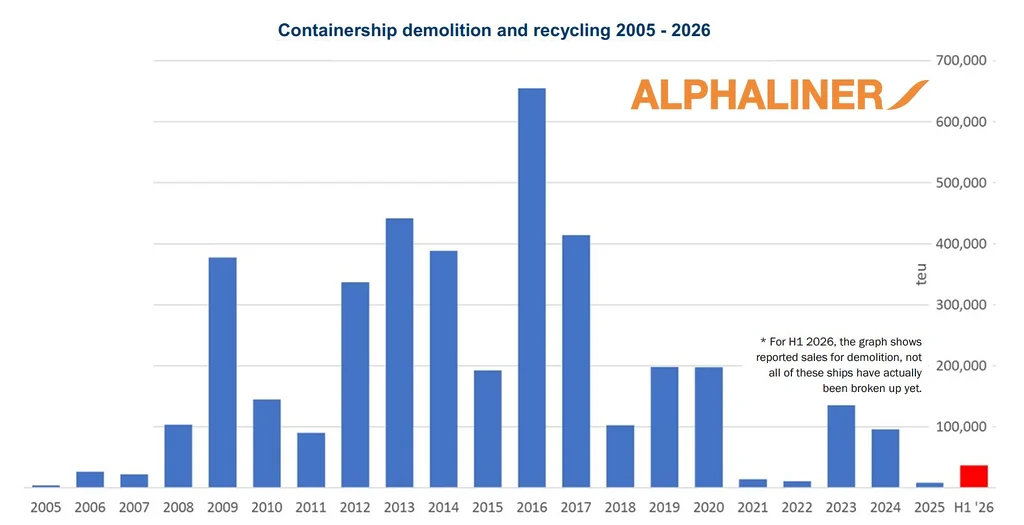
Meanwhile, Alphaliner's report confirmed the findings of the BIMCO report. According to Alphaliner, containership demolition sales remained exceptionally low during the first half of the year, despite figures being boosted by accidents and sanctions. The market for demolishing containerships continues to decline. Only eleven cellular vessels, with a total capacity of 36,700 TEU, were reported as having been sold for recycling in the first half of the year.
A Significant increase compared to 2025,
In terms of capacity, this is a significant increase compared to 2025, when only twelve vessels totalling 8,172 TEU were commercially disposed of for recycling over the course of the whole year. However, nearly 32,000 TEU of the capacity sold so far this year resulted from accidents or sanctions, rather than being commercially motivated. When considering only commercial sales, the first half of the year saw just five ships totalling around 4,800 TEU reported as sold for recycling.
The healthy container shipping market
An expert at Alphaliner confirmed that the healthy container shipping market, characterised by persistently high demand for tonnage and robust charter and freight rates in recent months, has been a primary factor in shipowners' and carriers' reluctance to sell their older tonnage. Instead, they have chosen to capitalise on the lucrative trading environment.
Different Sources
#Alphaliner #BIMICO #Filipe Gouveia #Shipping Number of the Week #Bulk carrier demolitions #container shipping market
You Might Also Like


Recommendation News

Marine Tech
Joshua Jordan was appointed CEO of Roboat 07 October 2026
Ports
Europe’s ports : Ready for the market uptake of new shipping fuels 06 October 2025
Ports
Port of Los Angeles Sets All-Time Monthly Cargo Record 10 October 2026
Marine News Room
Raul Villa Caro : Navy’s training ship-“Juan Sebastián de Elcano” 28 October 2025