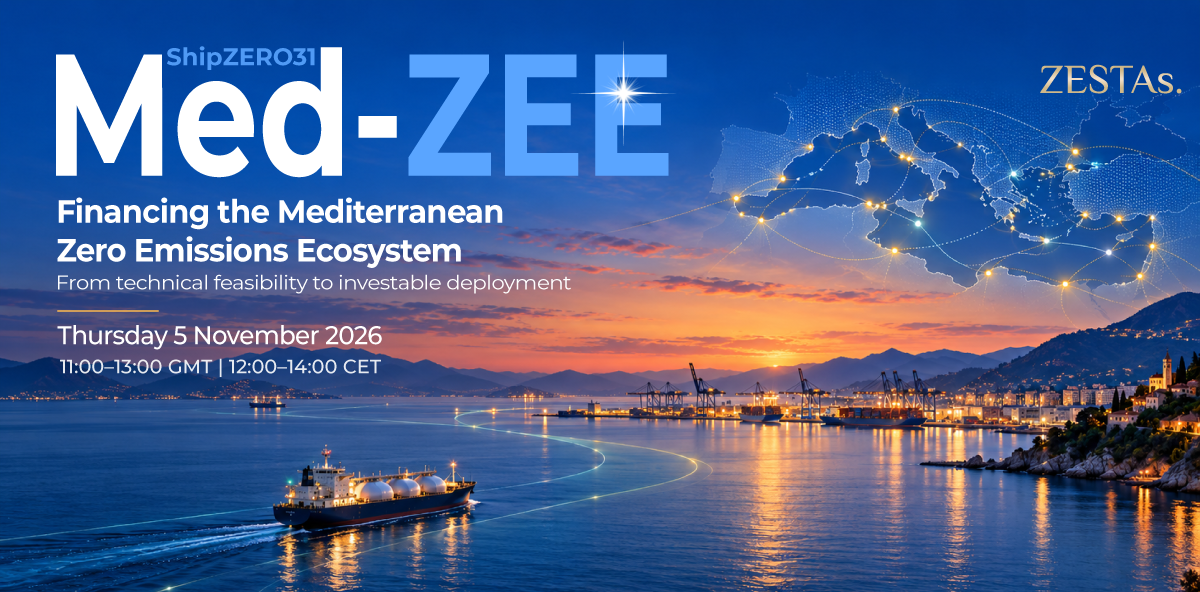
The Mediterranean covers less than 1% of the world’s oceans, yet it carries 21-22% of global shipping activity
The IEA rates North Africa’s renewable potential among the world’s highest. Egypt has signed 27 MoUs for hydrogen projects linked to 115 GW of renewables.
By Madadh MacLaine
Secretary-General, ZESTAs
The Mediterranean covers less than 1% of the world’s oceans, yet it carries 21-22% of global shipping activity by port calls, and the region has warmed around 20% faster than the global average. Wealthy European economies, rising ones such as Morocco, countries in conflict, and some of the poorest in the region share its coasts, shipping lanes, and air.
The Mediterranean’s diversity and contrasting realities are exactly why it shows how a global policy can work. Governments meeting at the IMO's Marine Environment Protection Committee (MEPC 85) from 30 November should adopt the Net Zero Framework (NZF), the first global fuel standard and the first global price on emissions for any industry.
The technology is on the water
Delegates often debate technology that might exist someday, but on the water, it already does. More than 2,000 battery-powered ships operate today on coastal, inland, offshore, and deep-sea routes, and 925 more are being built. Hydrogen fuel cells are installed or nearly complete on 25 commercial vessels. Viking Libra, due for delivery this month, will run on liquefied hydrogen and fuel cells on Mediterranean and Northern European itineraries.
The IEA rates North Africa’s renewable potential among the world’s highest. Egypt has signed 27 MoUs for hydrogen projects linked to 115 GW of renewables.
What lags is demand
In Egypt’s Suez Canal Economic Zone alone, an OECD assessment counts 18 green hydrogen and derivative projects still at concept or feasibility stage, and names uncertain offtake and hydrogen pricing as a direct constraint on bankability. Lenders hesitate to finance production without credible demand. Shipowners hesitate to commit to a fuel they cannot be sure will arrive at scale and at a viable price.
This is where the NZF comes in, because a fuel standard that tightens over time, a price on emissions, and rewards for zero- and near-zero fuels tell producers, banks, and shipowners that the customer will be there. For the Mediterranean, that means projects that have been waiting can move.
Greece has the most to gain
Greece, the world’s largest shipowning nation by carrying capacity, is already moving. Greek ports and companies are already moving. The TRIĒRĒS Hydrogen Valley includes planned hydrogen bunkering infrastructure at Piraeus, and the EU-funded SAFeCRAFT project, coordinated from Greece, is preparing to retrofit a hydrogen generator set on a 180,000 DWT Capesize bulk carrier. A global framework could turn projects like these into a market and make Greek ports supply hubs for the eastern Mediterranean.
How quickly it could change
Enclosed water, short routes, abundant renewable energy, and a regional body with decades of experience: no other sea has all four. With a clear demand signal, the Mediterranean could build connected zero-emission shipping networks that link vessels and routes with renewable electricity, hydrogen, charging, and bunkering. Part of this is already mandated: from 2030, passenger and container ships at berth in major EU ports must use shore power or another zero-emission technology. Extending that rule from the ports to the short routes between them would phase out fuel oil along the coast, clean up the air in port cities and set shipping on a path to zero emissions.
The Mediterranean runs from wealth to destitution, and a transition that leaves the southern shores behind will not last. The IMO Net-Zero Fund is meant to reward zero- and near-zero-emission fuels and to support infrastructure, training, and technology transfer in developing countries. How that revenue is distributed will matter. Used well, it could help emerging renewable and hydrogen producers around the Mediterranean take part as suppliers, not only importers of technology developed elsewhere.
The choice at MEPC 85
Governments need to adopt the NZF and then Mediterranean states can go further. REMPEC, the IMO’s regional centre, already leads regional work on emission controls and is well placed to study whether the Mediterranean could become the first region with a greenhouse gas control area, one that builds on the global framework and never replaces it.
Some will say the cost is too high or the legal path too complex. Those are fair concerns, and a global framework is the way to meet them: one rulebook, shared support, and a predictable market.
Related: ZESTA Launches Global Liquid Hydrogen Alliance to Accelerate Zero-Emission Shipping
If it works in the Mediterranean, it can work everywhere. Adopting the IMO’s NZF is where that starts.
Few places hold as much of the world's economic range in one body of water as the Mediterranean. Wealthy European economies, rising ones such as Morocco, countries in conflict, and some of the poorest in the region share its coasts, shipping lanes, and air. They also share an institution: REMPEC, the IMO's regional centre, which brings together 21 Mediterranean countries and the European Union to prevent and respond to marine pollution from ships.
If shipping's energy transition can work among countries this different, it can work anywhere. That is why governments meeting at the IMO's Marine Environment Protection Committee (MEPC) from 30 November to 5 December should adopt the Net Zero Framework (NZF), the first global fuel standard and the first global price on emissions for any industry. The Mediterranean shows what that unlocks.
The technology is here now
Debate in the room too often centres on where technology might be someday. On the water, the picture is different.
ZESTA’s October 2026 technical report, Uptake of Hydrogen and Battery Systems in Commercial Shipping, submitted to the IMO, records at least 2,124 battery-powered ships already in operation on coastal, inland, offshore and deep-sea routes and another 925 under construction. Hydrogen fuel-cell systems were installed or near completion on 25 commercial vessels in 2026, with a combined nominal output of 36 MW. In the Mediterranean, Viking Libra, due for delivery in November 2026, will use liquefied hydrogen and fuel cells to provide up to 6 MW of power and will sail Mediterranean and Northern European itineraries.
The energy is there too. The IEA describes North Africa’s renewable-energy potential as among the highest in the world and projects solar PV capacity across the wider MENA region to grow tenfold by 2035. Egypt has signed 27 MoUs for hydrogen projects linked to 115 GW of renewable generation, and Tunisia is targeting 320,000 tonnes of hydrogen a year by 2030.
The need is just as clear. The Mediterranean covers less than 1% of the world’s oceans yet carries 21-22% of global shipping activity by port calls, and the region has warmed around 20% faster than the global average.
What is missing is demand
Supply is not the obstacle. In Egypt’s Suez Canal Economic Zone alone, an OECD assessment identifies 18 green hydrogen and derivative projects still at the concept or feasibility stage. The same assessment names uncertainty over long-term offtake and hydrogen pricing as a direct constraint on bankability. Lenders hesitate to finance production without credible demand, and shipowners hesitate to commit to a fuel they are not sure will be available at scale and at a viable price.
The NZF breaks that stalemate. A fuel standard that tightens over time, a price on emissions, and rewards for zero- and near-zero fuels tell producers, banks, and shipowners that the customer will be there. For the Mediterranean, that means projects that have been waiting can move.
An opportunity for Greece
Nowhere is that opportunity clearer than in Greece, the world’s largest shipowning nation by carrying capacity, with Greek owners controlling around 397 million deadweight tonnes at the start of 2026. Greek ports and companies are already moving. The TRIĒRĒS Hydrogen Valley includes planned hydrogen bunkering infrastructure at Piraeus, and the EU-funded SAFeCRAFT project, coordinated from Greece, is preparing to retrofit a hydrogen generator set to a 180,000 DWT Capesize bulk carrier in a project running to November 2027. A global framework could turn projects like these into a market and position Greek producers and ports as supply hubs for the eastern Mediterranean.
How quickly the Mediterranean could change
Enclosed water, short routes, abundant renewable energy, and a regional body with decades of experience: no other sea combines all four. With a clear demand signal, the Mediterranean could build connected zero-emission shipping networks that match vessels and routes with renewable electricity, hydrogen production, and charging, and bunkering infrastructure. Part of this is already mandated: from 2030, passenger and container ships at berth in major EU ports must use shore power or another zero-emission technology. Extending that from ports to the short-sea routes between them would progressively displace fuel oil in ports and coastal waters, improve air quality in port cities, and put shipping on a pathway towards zero emissions.
Related: MBF and ZESTAS sign MoU to accelerate zero- emission
Fairness is what makes it hold
The Mediterranean runs from wealth to destitution, and a transition that leaves the southern shores behind will not last. The IMO Net-Zero Fund is intended not only to reward zero- and near-zero-emission fuels and technologies, but also to support infrastructure, training, technology transfer, and capacity building in developing countries and to mitigate impacts on vulnerable states. Independent analysis estimates that the Framework could generate around US$11-12 billion a year in its early years. How that revenue is distributed will matter. Used effectively, it could help ensure that emerging renewable-energy and hydrogen producers around the Mediterranean take part as suppliers, not only as importers of technology and fuels developed elsewhere.
The choice at MEPC 85
Governments need to adopt the NZF. Mediterranean states can then go further. REMPE, C already leads regional work on emission controls and is well placed to study whether the Mediterranean could become the first region with a greenhouse gas control area, one that builds on the global framework and never replaces it.
Some will say the cost is too high or the legal path too complex. Those are fair concerns, and a global framework is the way to meet them: one rulebook, shared support, and a predictable market.
If it works in the Mediterranean, it can work everywhere. Adopting the IMO’s NZF is where that starts.
#Madadh MacLaine # The Mediterranean # ZESTAs #global shipping activity #Egypt #The IEA #MEPC) #IMO
You Might Also Like

Recommendation News
Shipping Lines
Maritime war risk premium rise with Israel-Iran conflict escalates 19 October 2025
Incidents
Container Stack Collapse at Port of Rotterdam Involving LNG Bunker Vessel 10 February 2026
Yachts&Cruises
One ferry sold and one purchased by Corsica Ferries 18 November 2025
Ports
Customs Support Group acquires Turin-based TSD Cargo 25 November 2026
Marine Tech
ABB to build over 100 MVA shore power capacity for Rotterdam Shore Power terminals 06 January 2026