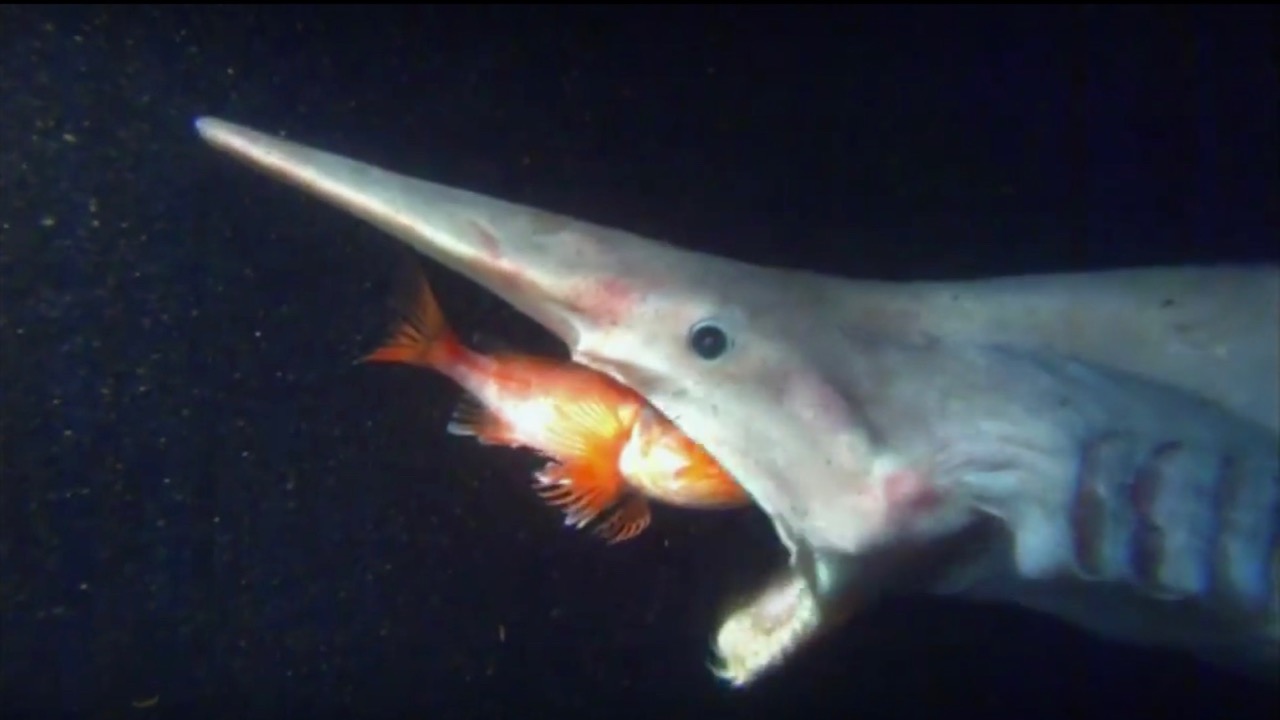
Unlike the fast and powerful great white shark, the goblin shark is more of a slow and steady predator.
Goblin shark is a rare, ancient deep-sea predator known for its bizarre appearance and a unique "slingshot" jaw mechanism that allows it to rapidly extend its mouth to capture prey. This elusive "living fossil" is the only surviving member of a lineage that dates back 125 million years to the age of the dinosaurs. Various anatomical features of the goblin shark, such as its flabby body and small fins, suggest that it is sluggish in nature.
This species hunts for teleost fishes, cephalopods, and crustaceans near the sea floor and in the middle of the water column. Its long snout is covered with ampullae of Lorenzini that sense minute electric fields produced by nearby prey, which it can snatch up by rapidly extending its jaws.
In honor of the Japanese scientist
The common name "goblin shark" is a calque of its traditional Japanese name 天狗鮫, their scientific name, Mitsukurina owstoni, tenguzame, a tengu being a Japanese mythical creature often depicted with a long nose and red face Another name for this species is elfin shark the name which honor's Japanese scientist Kakichi Misukuri and British naturalist Alan Owston, who first discovered the shark. 'goblin shark' is a much catchier (and creepier) name. This title pays tribute to its eerie,
ِِApearance is so horrifically mesmerising

The goblin shark's appearance is so horrifically mesmerizing it's hard to look away. With their long flat snouts, ghostly pinkish colour - due to their thin skin - and razor-sharp teeth, they look like a relic from another time (which, in a way, they are - but more on that later). Still, the most unsettling feature is their extendable jaws, which lengthen at a frightening ten feet per second .The rear teeth near the corners of the jaw are small and have a flattened shape for crushing. Much individual variation of tooth length and width occurs, as for whether the teeth have a smaller cusplet on each side of the main cusp, and regarding the presence of toothless gaps at the symphysis or between the main and rear teeth.
Highly sensitive snouts
Goblin sharks aren't too picky when it comes to food. The goblin shark diet consists mainly of deep-sea fish, squid and crustaceans - basically, whatever unlucky creature happens to swim too close. Thanks to their highly sensitive snouts - which can detect electrical signals from prey - they can hunt even in the pitch-black depths of the ocean. Good luck hiding.
Lank and sluggish appearance
Goblin sharks are no small fry. Most adults measure between ten and 13ft long, with some goblin sharks measuring over 18ft. That's roughly the size of a great white shark. However, they're far less muscular than their famous cousins, giving them a somewhat lank and sluggish appearance. The body is fairly slender and flabby. The two dorsal fins are similar in size and shape – both being small and rounded. The pectoral fins are also rather small and rounded. The pelvic and anal fins have long bases and are larger than the dorsal fins, while caudal peduncle is flattened from side-to-side and lacks keels or notches

Unlike great white shark
Unlike the fast and powerful great white shark, the goblin shark is more of a slow and steady predator. These creatures drift through the water like they're on a lazy river, using their flabby body and low-density liver to stay buoyant. This means they don't need to waste energy constantly swimming - instead, they lurk in the deep, waiting for an unsuspecting fish to drift in their direction.
https://www.googletagmanager.com/gtag/js?id=G-VQT6FQ9K2E">
#white shark ,#Goblin sharks , #Mitsukurina owstoni, #tenguzame, #Japanese scientist و #The mysterious predator , #deep ocean
You Might Also Like


Recommendation News

Shipping Lines
Hapag-Lloyd uses StormGeo systems for FuelEU Maritime 05 June 2026
Marine Tech
IMO : Global maritime community celebrates “Our Ocean, Our Obligation, Our Opportunity” 19 November 2025
Marine Tech
Saudi’s Front End and US-based Booster Fuel to Launch Revolutionary Mobile Fuel Delivery 25 November 2025
Ports
Spanish ports have introduced common LNG bunkering rules. 09 May 2026
Marine Tech
UK P&I Club and TT Club announce merger discussions 26 November 2025