
Poland : by Marek Grzybowski
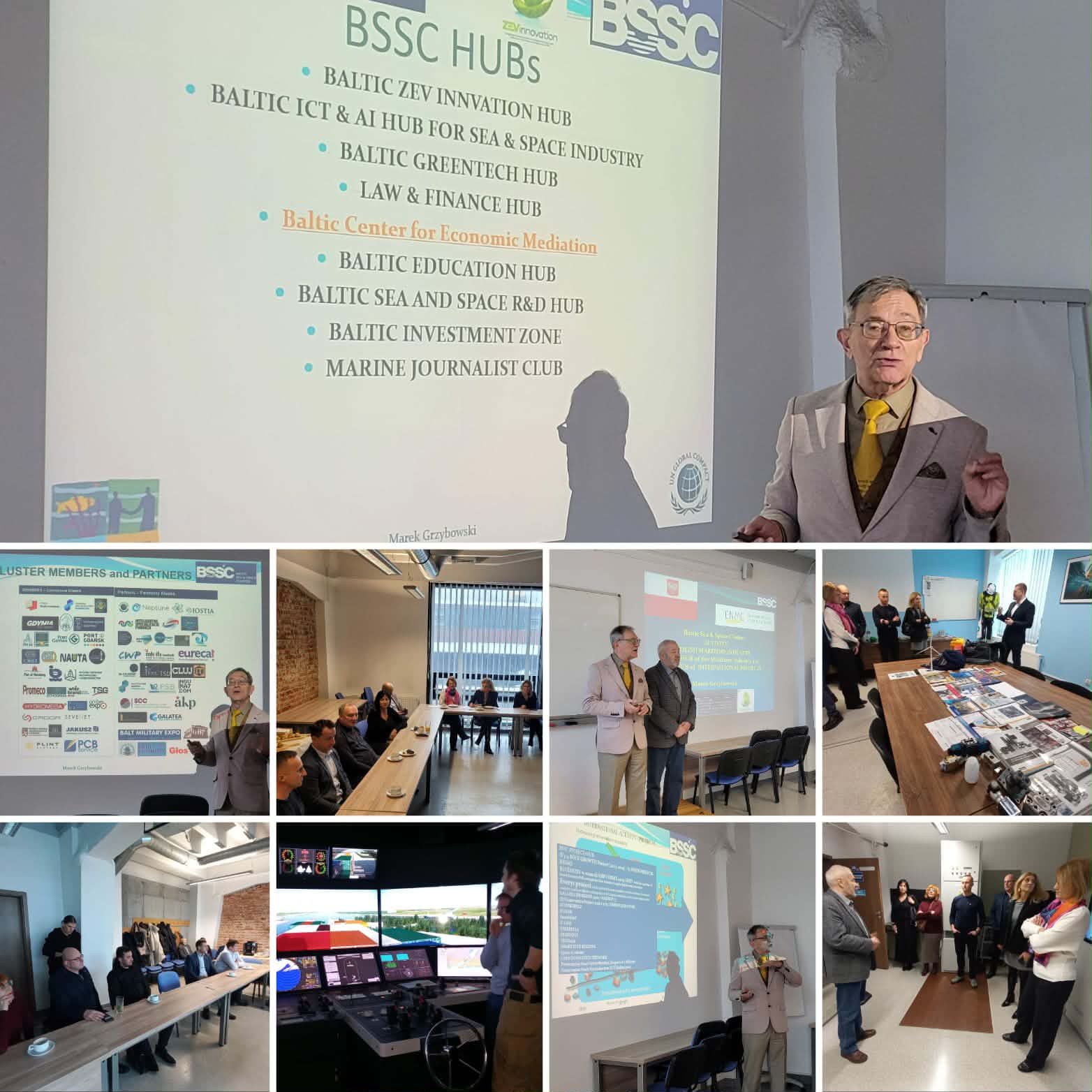
The New Year’s Meeting of the Baltic Sea and Space Cluster (BSSC) members took place at the Gdynia Maritime School. The annual activities of the Cluster, which collaborates with approximately 200 EU clusters, were summarized. The organization’s members are highly active in many areas. Business, scientific, and educational activities, as well as collaboration on international projects, are among the highlights.
The meeting was welcomed by Captain Krzysztof Michnal, President and Founder of the Maritime School and Chairman of the Pomeranian Regional Branch of the KIGM Council. “This is the oldest private maritime school with a history. It educates seafarers and officers for commercial vessels, passenger ships, large sailing vessels, and offshore vessels,” said Captain Krzysztof Michnal, welcoming the attendees.

A three-bridge, full-mission ship simulator from Kongsberg.
Regarding the students, there are a huge number of them because we enjoy a good reputation in terms of staff, lecturers, and facilities. We have top-class simulators here. “We have a three-bridge, full-mission ship simulator from Kongsberg. One of them is the bridge, on which we can conduct dynamic positioning courses. We have a Unitest engine room simulator – a Polish company.
Polish manufacturer in the production of ship engine room simulators
This is the number one Polish manufacturer in the production of ship engine room simulators,” said Captain Michnal. “We have a simulator for radio communications, electronic charting, tankers, and gas and chemical tankers – we offer basic courses and advanced, specialized courses, including a course in ship gas refueling. We also offer courses in the operation of drilling platforms and floating cranes, three-legged and four-legged jackups. There is also a port equipment simulator, and here we have cranes, overhead cranes, and mobile equipment. Gospodarka Morawska wrote about this here.

South and North America also benefit from our training –
To compete in the market, we must outperform universities in terms of equipment and personnel.” In terms of quality and innovation, to my delight, we remain consistently at the cutting edge, always a meter ahead of the pack. Otherwise, we wouldn’t have such a strong reputation. We operate without any subsidies or subventions. At the school, we teach officer and sailor candidates from various countries. We have Ukrainians, Slovaks, and Czechs – due to the similarity of language, it’s easy to educate them. When it comes to courses, practically all of Europe uses our services. Because we have such unique courses, South and North America also benefit from our training – that’s how far we reach
A Key Cluster in the Baltic Sea Region
The Baltic Sea and Space Cluster (BSSC) is a well-recognized brand on the international market as the Baltic Sea and Space Cluster. The BSSC cluster is considered a key cluster in the Baltic Sea region. The BSSC is the only cluster in the European Maritime Cluster Association (ENMC) from the Baltic Sea and North Sea regions

PSEZ’s plans to establish a branch of ESA (European Space Agency) in Gdańsk.
Agnieszka Pawlikowska, Director of the Pomeranian Special Economic Zone (PSEZ) Management Office in Gdańsk, spoke about the PSEZ’s plans to establish a branch of ESA (European Space Agency) in Gdańsk. The PSEZ is also planning to sign an agreement with POLSA (Polish Space Agency), the Polish Space Agency headquartered in Gdańsk. BSSC cluster members have more plans to strengthen space science in Gdańsk, including for Baltic Sea research.
SATBAŁTYK system is used to observe the Baltic Sea
Satellite information from the SATBAŁTYK system is used to observe the Baltic Sea by, among others, the Institute of Oceanology of the Polish Academy of Sciences in Sopot (IO PAN). The system is open, and information on the situation in the Baltic Sea is available to anyone interested in dozens of pieces of information about the state of Baltic waters, said Professor Mirosława Ostrowska of IO PAN, Vice-President of the Polish Academy of Sciences. She emphasized that Polish scientists conduct a great deal of top-quality research with little funding allocated to science. A new research vessel is needed, as the S/Y Oceania is already aging. The Oceania is a sailing ship built in 1985 at the Gdańsk Shipyard and belongs to the Institute of Oceanology of the Polish Academy of Sciences. IO PAN is currently the largest Polish institute researching problems in physics, chemistry, biology, and marine ecology. The vessel’s range is unlimited, and its autonomy is 30 days

The latest R&D projects being undertaken
Jan Dobiński, Director of the Ship Technology Center (CTO), announced the latest R&D projects being undertaken by the CTO. The center boasts certified model tanks, technical facilities, and a highly qualified staff with extensive expertise enabling it to design innovative shipbuilding solutions and conduct model testing and measurements for the shipbuilding industry. The CTO conducts research on hydrodynamics, materials science, and corrosion. Specialized laboratories analyze phenomena and conduct research on vibroacoustics, fire resistance, and the certification of marine products, equipment, and structures.Wind tunnels are used to test the air resistance of ships and land-based structures. The offshore laboratory tests models of offshore installations. The CTO also designs and manufactures specialized research and teaching equipment.

Apator Powogaz recently joined the BSSC Cluster
Apator Powogaz, a company with over 100 years of experience in both domestic and international markets, recently joined the BSSC Cluster. The company’s activities include the design, production, and sale of measurement devices (water meters, heat meters, and heat cost allocators), which are also used in seaports, shipyards, and their collaborating companies. Currently, Apator Powogaz offers innovative solutions such as ultrasonic water meters and AMR systems. The latter enable readings from heat meters, water meters, and heat cost allocators installed in residential, public, and industrial buildings.
SUBSEE
The meeting was also attended by the youngest members of the BSSC Cluster, Artur Słoboda and Paweł Kwiatkowski, founders and managers of SUBSEE. SUBSEE provides advanced underwater services using modern technologies such as remotely operated underwater vehicles (ROVs) and surface drones (USVs). These unmanned units are used for inspections, bathymetric measurements, environmental monitoring, sampling, and maintenance work. SUBSEE also utilizes magnetic robots and UHP (Ultra High Pressure) cleaning.
ESL POLSKA,
Natalia Bednarska, Vice President of ESL POLSKA, represented the new BSSC member. ESL POLSKA precisely aligns with these areas of activity, with its product offered in all major markets. The company collaborates with numerous international partners, with offices in Plymouth, Gdańsk, Singapore, and Long Beach, CA. Three space domain activities are offered in the EMdrone project. Thanks to promotion using modern marketing tools, the events and achievements of Polish companies, scientists, lawyers, insurance companies, and maritime schools are widely publicized internationally. Most activities are implemented thanks to long-established contacts and the high-quality offerings of carefully selected cluster members. Cluster members include companies, institutes, universities, and schools with high innovation potential.
Related : Grzybowski : President of the Baltic Maritime and Space Cluster
#Natalia Bednarska #SUBSEE #Apator Powogaz #Jan Dobiński # Gdańsk #SATBAŁTYK system # New Year’s Meeting #BSSC #Maritime School #Agnieszka Pawlikowska
You Might Also Like
Recommendation News

Shipping Lines
Suspension of LNG supplies from Qatar extended until November. 29 August 2026
Ports
APM Terminals started building a $550 million terminal in Bangladesh for ships 31 August 2026
Incidents
Eni contributed to the rescue of a drifting LNG tanker in the Mediterranean. 23 March 2026
Ports
LA Port sees 10 million-container year in sight with a steady October 19 November 2025
Shipping Lines
CMA CGM announces a 43% ETS surcharge 02 December 2025