Venezuela Expects Oil Investments of $1.4 Bn Under Production-Sharing Contracts in 2026
Prominent U.S. maritime unions, including the SIU, recently called on the Trump administration and Congress to require that any crude oil imported from Venezuela must be transported exclusively on U.S.-flag vessels crewed by American mariners, asserting such policy is essential to U.S. economic and national security interests.
Counter the growth of opaque “shadow fleet” tanker operations
“A cornerstone of an effective national maritime policy is gaining access to private, commercial cargoes that create steady demand for U.S.-flag vessels, American mariners, and the shipbuilding industrial base,” the unions wrote in a letter to senior administration officials. The SIU, Marine Engineers’ Beneficial Association (MEBA), American Maritime Officers (AMO), and the International Organization of Masters, Mates and Pilots (MM&P), which represent the majority of U.S. Merchant Mariners sailing in the U.S.-flag fleet, said that aligning American foreign policy and energy needs with “Ship American” principles would strengthen the U.S. maritime workforce, reduce reliance on foreign-controlled shipping, and counter the growth of opaque “shadow fleet” tanker operations used to move sanctioned oil outside U.S. oversight.
The letter is available on the SIU website.
The unions warned that current restrictions on Venezuelan oil have shifted global trade toward foreign-controlled shipping networks, including tankers operating outside U.S. labor and safety standards. As a result, U.S. maritime workers and carriers are excluded from energy cargoes that could otherwise support American shipping capacity and enforcement objectives.
Enhance sanctions compliance
Requiring U.S.-flag transportation for Venezuelan crude entering the United States, the unions said, would provide reliable commercial cargo for U.S. carriers, enhance sanctions compliance, and reduce reliance on foreign vessels tied to adversarial interests. The policy could also benefit U.S. refiners designed to process heavy crude by increasing supply options and helping stabilize domestic energy markets.
Maritime labor leaders emphasized that American mariners are prepared to support lawful, transparent energy trade that advances U.S. strategic interests.
Venezuela's energy sector
After Recent developments in Venezuela's energy sector signal a fundamental shift in global oil dynamics. Following political upheaval in early 2026, the United States has established direct oversight of Venezuelan crude exports, creating unprecedented market conditions that could reshape pricing mechanisms across international energy markets. This US-Venezuela oil deal represents a significant milestone in hemispheric energy relationships.
The world’s largest oil reserves
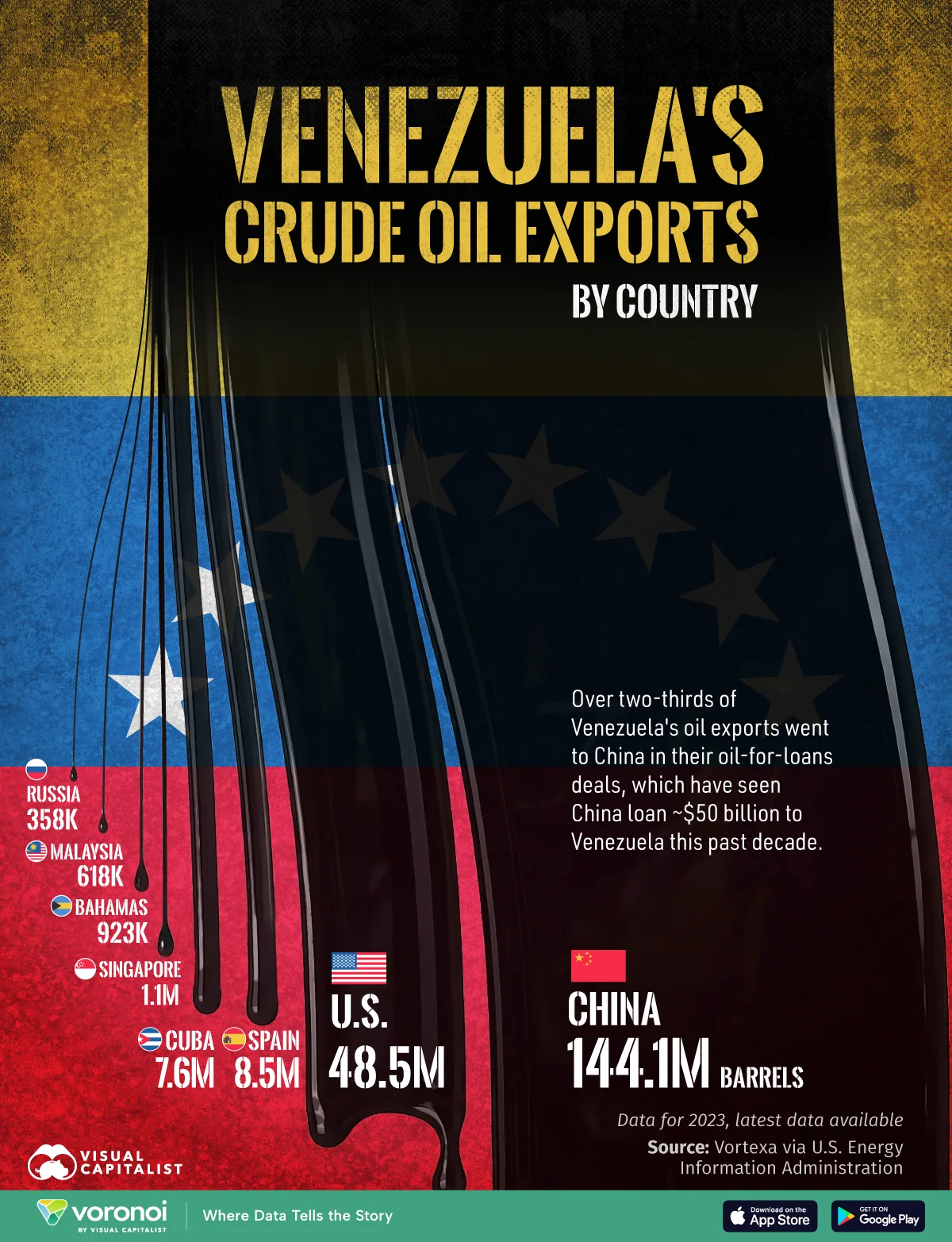
It is noteworthy that Venezuela holds some of the world’s largest oil reserves, but turning that potential into export revenue depends heavily on where its barrels can actually go. After Nicolás Maduro’s capture by U.S. forces, Venezuela’s oil industry is set to change significantly. But where were Venezuela’s oil exports going previously?
Massive foreign investment
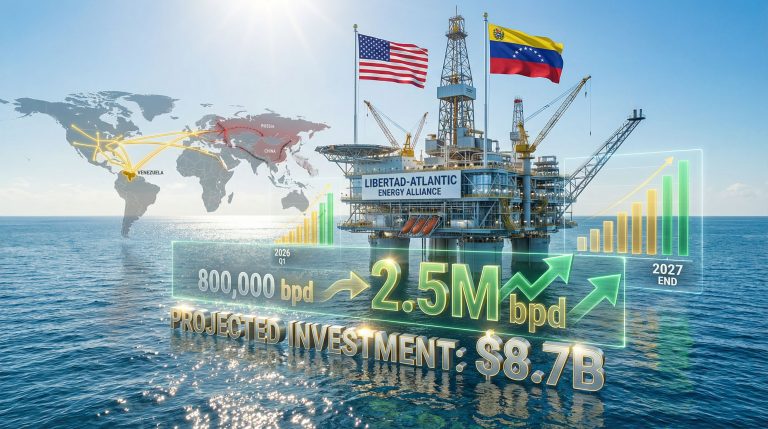
Venezuelan oil production in 2025 averaged approximately 1.1 million barrels per day (bpd), with OPEC data showing a year-end dip to around 896,000–956,000 bpd. While output saw some gains in early 2025, it faced constraints from aging infrastructure, limited investment, and ongoing sanctions. Meanwhile Venezuela will need massive foreign investment and years of infrastructure rebuilding to lift daily crude oil output from about 800,000 barrels per day to its former peak of roughly 3 million. while Venezuela Expects Oil Investments of $1.4 Bn Under Production-Sharing Contracts in 2026

Sharing contracts (PSCs) promoted
Venezuela expects to attract around $1.4 billion in investment this year in projects operating under oil production-sharing contracts (PSCs) promoted by the government, up from about $900 million last year, Interim President Delcy Rodríguez said.
PSC is a type of agreement between a government and a private oil and gas company
It is noteworthy that PSC is a type of agreement between a government (or state-owned oil company) and a private oil and gas company in which the government provides the resource, the company provides the investment and expertise, and they split the profits from production. Venezuela has long been a major oil producer with some of the world’s largest proven crude oil reserves, particularly in the extra-heavy crude of the Orinoco Belt. However, its output has declined sharply from peak levels of over 3 million barrels per day (b/d) in the late 1990s and early 2000s to around 0.9–1.1 million b/d in recent years due to chronic underinvestment, mismanagement, corruption, and infrastructure deterioration.
India will start buying oil from Venezuela
On the other hand US President Donald Trump claimed that India will start buying oil from Venezuela "as opposed to Iran," adding that "China is welcome to come in and will make a great deal on oil," according to a Bloomberg report. "India's coming in and they're going to be buying Venezuelan oil, as opposed to buying it from Iran," Trump claimed to reporters during a flight to Mar-a-Lago on Air Force One. "We've already made the deal, the concept of that deal," Bloomberg reported on Sunday.
Related : US : Captured of Second Oil Tanker Amid Tightened Blockade on Venezuela
Source : Differnt Agencies + Press - release Image : Discovery Alert
#U.S. maritime unions #U.S.-flag vessels #SIU#Donald Trump #(MEBA) #PSC #Oil of Venezuela #(MM&P) # President Delcy Rodríguez#Nicolás Maduro # Venezuela's energy sector
You Might Also Like


Recommendation News
Shipping Lines
Yang Ming and Hanwha Ocean Ink Deal for Six 13,000 TEU LNG Dual-Fuel Vessels 03 September 2026
Marine Tech
EU : A new project to cybersecurity in the maritime and port sectors has been launched. 26 January 2026
Ports
AD Ports and Kuwait Ports Sign MoU to Development and Operation of Shuaiba Port 16 December 2025
Marine News Room
Iyead khalil writes : What Are Smart Containers? 26 October 2025
Ports
Port of Long Beach reported a 31.7% increase in volume to 842,030 TEU 13 June 2026