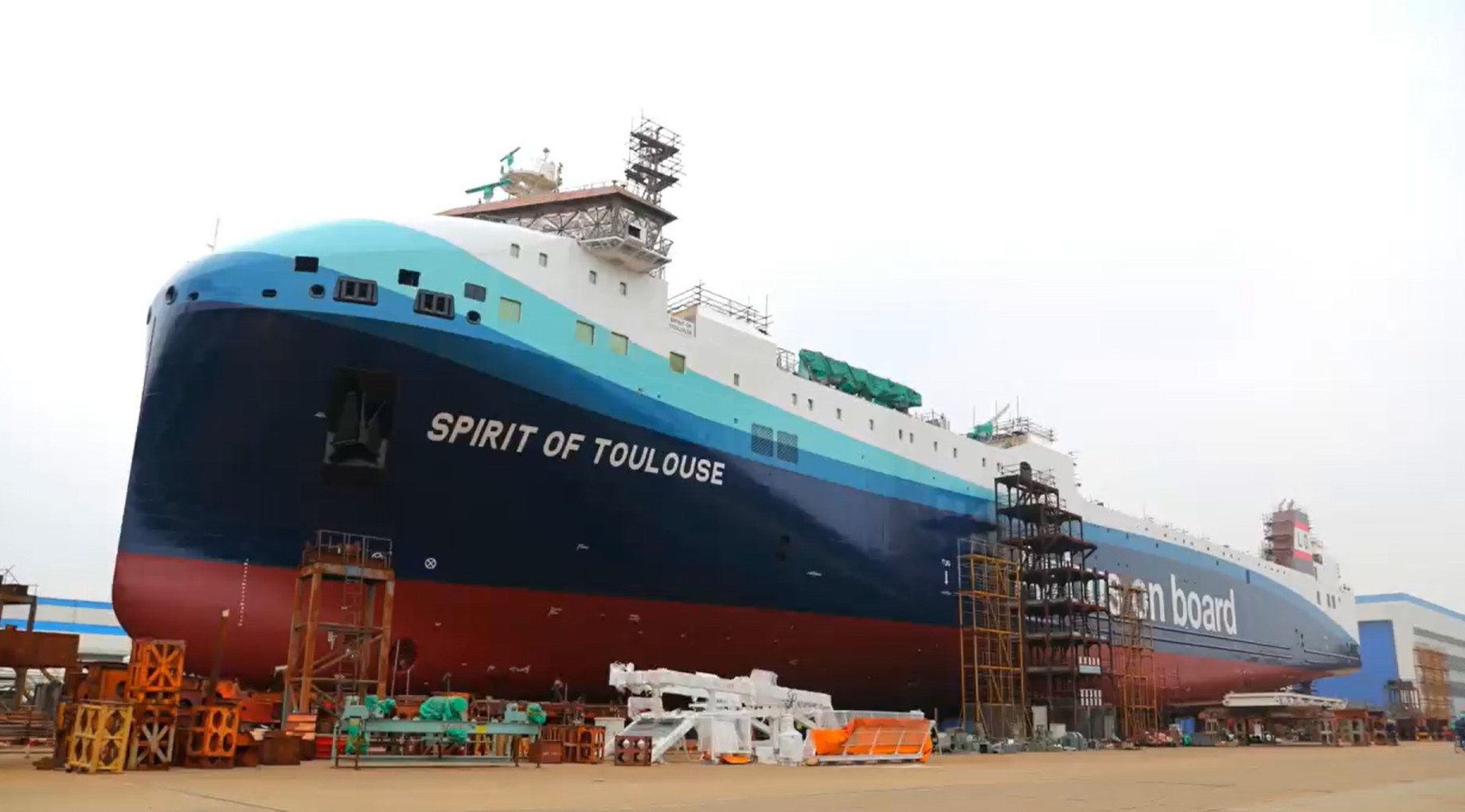
The vessel features an innovative green power system: methanol dual‑fuel + wind assistance. It delivers a practical, scalable “Chinese solution
LD Armateurs is set to welcome the first ship of its next generation RoRo vessels chartered to Airbus. The Spirit of Toulouse was launched last week at Wuchang Shipyard (CSSC Group). Two other vessels – Spirit of Mobile and Spirit of Mirabel – are under construction.
The new low-emission vessels, which will be used to ship aircraft components for Airbus, will each be powered by a combination of six 35-meter tall Norsepower Rotor Sails and two dual- fuel engines capable of running on e-/bio-methanol or marine diesel oil
Designed to minimize CO2 emissions
From the outset, these vessels have been designed to minimize CO2 emissions, employing a holistic approach. They include efficient propellers and shafts produced from recycled steel, very low-friction anti-fouling coatings, a smart power management system, and a heat conversion system. Equipped with routing software to optimize their routes, they will be able to maximize wind propulsion and minimize drag from adverse ocean conditions.
AI-powered control solution
This is further improved using an advanced AI-powered control solution which enables the vessels to adapt to changing external weather and sea conditions and achieve vessel-specific aerodynamic optimization. Together, these innovations will result in state-of-the-art vessels that combine cutting-edge technology to achieve ambitious environmental goals.

Each vessel in the new fleet to deliver a 70% decrease in CO₂ emissions, on a yearly
Each vessel in the new fleet is expected to deliver a 70% decrease in CO₂ emissions, on a yearly basis, compared with the previous generation of ships. LDA currently operates two vessels on the transatlantic route for Airbus, including the Ville de Bordeaux, the largest of the fleet, with a cargo capacity equivalent to six aircraft. The new vessels — Spirit of Toulouse, Spirit of Mobile, and Spirit of Mirabel — will match this cargo capacity. Further emission reductions could be achieved using low-carbon alternative fuels, such as hydrotreated vegetable oil (HVO) or e-methanol.
At fleet level, considering an increase in overall capacity, the introduction of the new vessels is expected to reduce average annual transatlantic CO₂ emissions by approximately 50% compared with 2023, while supporting higher transport volumes.

Chinese solution
The vessel features an innovative green power system: methanol dual‑fuel + wind assistance. It delivers a practical, scalable “Chinese solution” for the global shipping industry’s low‑carbon transition, highlighting China’s leadership in high‑end, green shipbuilding.
About :LD Armateurs (formerly Louis Dreyfus Armateurs)
LD Armateurs (formerly Louis Dreyfus Armateurs) is a French maritime company with over 170 years of experience, specializing in tailor-made industrial maritime solutions, including logistics, transport, subsea cable laying, and offshore renewable energy services. Headquartered in Suresnes, France, the group operates a fleet of around 30 vessels, serving sectors like dry bulk and offshore wind.
About : Norsepower Rotor Sails
Norsepower Rotor Sails are a modern, automated, and type-approved auxiliary wind propulsion system designed for ships, using the Magnus effect to reduce fuel consumption and CO2 emissions by up to 30%. These electric-driven, cylindrical sails improve efficiency, with costs for multiple units ranging from $1 million to $3 million.
#LD Armateurs # Norsepower Rotor Sails #Chinese solution #Spirit of Toulouse #Spirit of Mobile #Spirit of Mirabel #CO2 emissions # Wuchang Shipyard # RoRo Vessels Chartered # Airbus
You Might Also Like


Recommendation News

Marine Tech
Fincantieri Delivers New Naval Vessel to Indonesian Navy 15 October 2025
Shipping Lines
CMA CGM has completed the first bioethanol bunkering in Brazil. 14 July 2026
Marine Tech
Environmental groups condemn the decision as Mokihana sails out of the U.S. to India 03 March 2026
Marine Tech
Osama Rabie : Efforts to localize the Shipbuilding maritime industry 11 December 2025
Shipping Lines
Reasons for Asia's reliance on Middle Eastern oil - A report 04 March 2026