The frequent and rapid change of flag by ships, made it difficult to combat this phenomenon.
Ahead of the 113th session of the Legal Committee (Leg 113) of the IMO scheduled to take place in London from 13 to 17 April, The International Maritime Organization (IMO) secretariat has counted 529 vessels sailing under false flags, a sprawling fraud problem that will headline the agenda at next month’s legal sub-committee meeting and exposes systemic weaknesses in global ship registration.
In a note circulated
In a note circulated said the tally of falsely flagged ships has risen since LEG 112 and that 356 of those vessels are not classed by any classification society. The list, compiled with verification from S&P Global and published through the IMO’s GISIS platform, breaks the phenomenon down by purported flag state and vessel type, and highlights how the deception spans tankers, bulkers, containerships and smaller craft. Meanwhile the issue had already emerged during the previous session, in March 2025,
Several cases and government-issued alerts,
The list also includes several cases and government-issued alerts, which help understand how this phenomenon is developing and how efforts are being made to combat it. The Netherlands, for example, reported two fraudulent websites from Sint Maarten and 17 vessels illegally flying that flag. France reported a page related to Matthew Island (part of New Caledonia) but no vessels were involved. Fake registers, such as that of Malawi, have also been reported (resulting in a decline in the number of fictitiously registered vessels, from 27 in September 2025 to the 8 currently on the list), while both Timor-Leste and Lesotho have stated that they do not operate international registers.
Related :EU : A new strict measures against the so-called “shadow fleet"
Cases related to the misuse of MMSI numbers
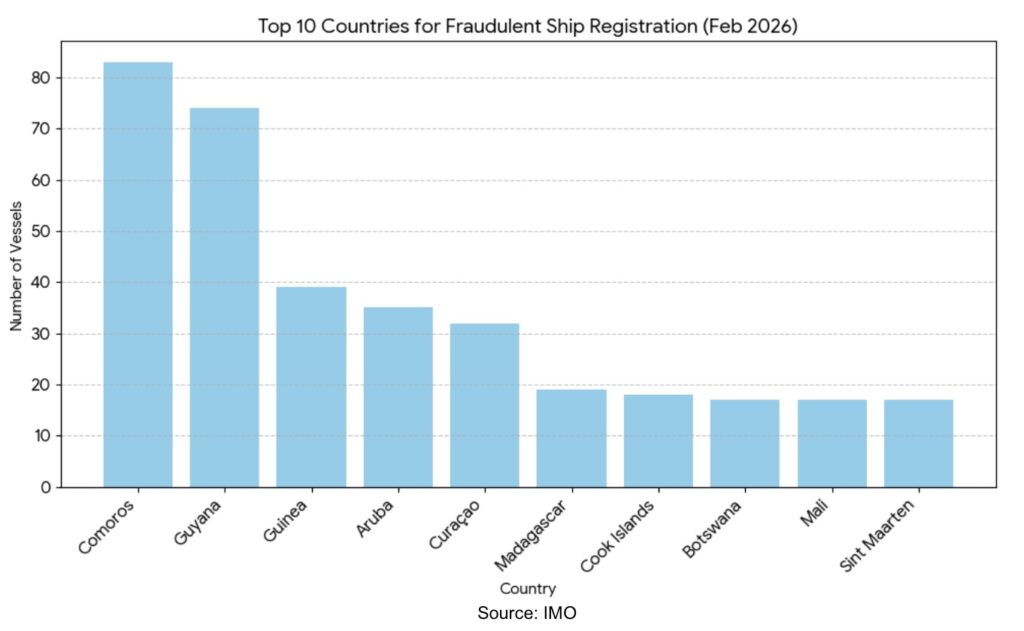
The United Kingdom has reported cases related to the misuse of Bermuda MMSI numbers by vessels claiming to be commercial fishing vessels, in violation of that country's regulations. Benin identified a false maritime administration site and reported 33 false flagged vessels (later reduced to 13 after further checks), Other cases involved , Mali and Guinea, as well as Tonga (whose register was closed in 2002) and the Comoros. The table also highlights numerous cases of false flags attributed to Guyana (74), Aruba (35), and Curaçao (32).
The top of shadow fleet sanctuaries
On the other hand Cameroon, which has ascended to the top of shadow fleet sanctuaries by dwt in recent months, has pledged a purge amid rising diplomatic pressure from the European Union. Landlocked Botswana, one of the recently erected fake flags, confirmed to the IMO last month that that it does not operate a register of ships, essentially confirming widespread suspicion that an operation purporting to register ships on its behalf was doing so fraudulently.
Communication from the Kingdom of Tonga
The IMO’s circular also relayed communication from the Kingdom of Tonga, which clarified that it had not operated an international registry for over 20 years. However, at least 12 shadow fleet vessels have broadcast AIS data they were flagged by the Pacific island kingdom since January.
Gambia, which in November purged 71 tankers from its registry and informed the IMO that fraudulent certification purporting to be issued by its registry were being circulated, still had 19 vessels using its MMSI prefix in January and February, according to Lloyd’s List Intelligence data.
Related :GNSS Interference in the Baltic Sea: A Collaborative Study
Difficult to combat this phenomenon
According to Lloyd's List, flag hopping, the frequent and rapid change of flag by ships, has also made it difficult to combat this phenomenon. This has increased in recent years, partly as a result of increased sanctioning pressure from the United States, the United Kingdom, and the European Union.
The jurisdictional ambiguity that allows ships to shift identities,
Writing for Splash earlier this month, David Heindel from the International Transport Workers’ Federation argued: “The jurisdictional ambiguity that allows ships to shift identities, manipulate registries, or operate without effective oversight is not accidental. It is built into the business model. This is why false flags and shadow fleets have continued to proliferate despite increased sanctions, surveillance, and massively increased media and political attention. Industry profits from opacity. Flag states – in the case of the worst offenders, with flags often outsourced to unscrupulous overseas business interests – profit from regulatory leniency. Together, they create exactly the conditions in which fraudulent registries, identity switching, and impunity thrive.”
Related : Mapping GNSS Interference On Shipping: From The Black Sea To The Gulf
Source :Multiple sources
#David Heindel #IMO #false flag #GISIS platform #manipulate registries#global ship registration#Lloyd's List
You Might Also Like


29 October 2025
Recommendation News
Marine Tech
bound4blue hits bullseye daily fuel savings on LDA Ro-Ro 14 October 2025
Marine News Room
Francis Zachariae ..Secretary-General of (IALA): Our dream ! 06 October 2025
Ports
Italian ports handling leaps during the second half of 2025 15 December 2025
Marine News Room
Exclusive - Dr. Khaled Almaaith : The Trajectory of Global Maritime transport and National Aspiration with 2026 07 December 2025
Shipping Lines
Asyaad Shipping Orders Two More MR Tankers in $1.036m Deal 11 September 2026