ِ Philippines driving forward with Blue Economy legislation and the UK Government channelling significant support funds into sustainable ocean activities

By : Andy Hamflett,
Co-Founder and Director, NLA International
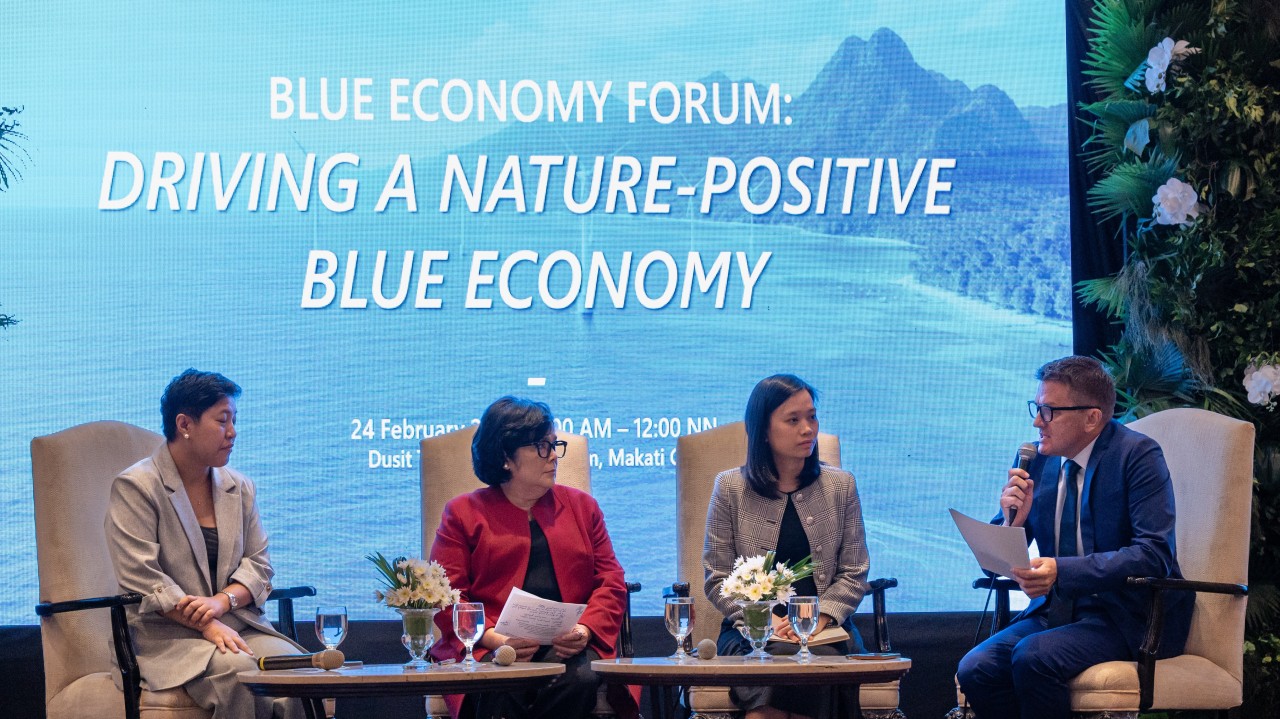
A diverse collection of marine and maritime stakeholders gathered in the Philippines to explore the emerging potential of the Blue Economy in the Philippines. The Blue Economy Nature Forum – convened by the British Embassy in Manila – was opened by Seema Malhotra MP, the UK Minister for the Indo-Pacific. She highlighted ongoing UK-Philippine engagement opportunities related to the agenda, as part a continued celebrations of 80 years of formal engagement between these two island nations.
Ministers from relevant Philippine Departments (Energy, Environment and Interior and Local Government gave their own reflections, before I was invited to deliver a keynote address on the principles, challenges and pathways of a Blue Economy approach to tee up further panels on more detailed issues. With the Philippines driving forward with Blue Economy legislation and the UK Government channeling significant support funds into sustainable ocean activities, it was a timely event.
The vibrant Manila event
This vibrant Manila event follows many similar strategic developments. Seychelles has had a Blue Economy Strategic Policy Framework and Roadmap since 2018. The European Union produces a detailed Blue Economy report every year. Launched in 2019, Africa’s Blue Economy Strategy sets projections for related economic and job growth to the year 2063. The Association of Southeast Asian Nations (ASEAN) formally launched its Blue Economy framework in 2023. We have even seen several land-locked countries (such as Laos and Ethiopia) developing their own Blue Economy strategies and frameworks, an approach further endorsed by ASEAN, whose own framework document insists that freshwater resources should very much be part of the blue conversation.
In recent years
In recent years, the global conversation surrounding the Blue Economy has in some part been dominated by such ambitious strategy and policy declarations, ocean summits and the launch of regional frameworks. For some, it has to be said, this has led to certain levels of cynicism that the Blue Economy is just the latest ‘buzz’ phrase – easy to talk up, more difficult to actually structure and deliver. Leaders in the Philippines may face such perception challenges as they move forward into their next phases of delivery (though I most definitely saw no evidence of this today!).
Underpin sustainable Blue Economy success.
Thankfully, though, in choosing to focus my presentation in Makati on emerging practice in relevant governance structures, I was able to highlight how several governments worldwide have indeed been progressing the domestic machinery required to underpin sustainable Blue Economy success. So what might the Philippines, and any other nation, take from these approaches as they look to bring structure to aspiration?
What is Blue Economy Governance?
Blue Economy governance is the institutional mechanism a country uses to consolidate all relevant marine and maritime responsibilities into a unified, cohesive and manageable portfolio. It is about creating an "architecture of authority" capable of coaxing or compelling powerful, potentially siloed ministries and agencies – such as fisheries, energy, tourism and transport – to align their mandates and operations toward a shared sustainable Blue Economy approach. No small feat, especially in larger and more complex/industrialised nations. Detailed analysis of recent developments – drawn from NLA International’s in-field activities and our Blue Economy Knowledge System – reveals that a few models of governance can be seen to be emerging. Three are explored below.

The ‘Cell’ Model
For countries in the early stages of their Blue Economy transition, establishing a small ‘cell’ or focal unit within an existing agency can be considered a low-cost and achievable entry point. However, while such an approach can enable momentum without lengthy and difficult multi-ministry restructuring, the model carries the risk of marginalisation if the cell lacks the hierarchical authority to compel legacy ministries to act, or the budget to do things itself. The development of Bangladesh’s Blue Economy Cell over the past several years exemplifies this structural vulnerability, despite good intentions.

Establishment of the Cell
Established in 2017, the cell was originally overseen by the Ministry of Power, Energy and Mineral Resources and was intended to act as an ‘advisor and coordinator’ for 26 identified marine and maritime sectors. However, over time critics argued that it effectively seemed to disappear from view, with no tangible progress in its first four years of operation. This was attributed to a lack of allocated staff and budget, meaning it could only really ‘just hold meetings’. Focus shifted to the cell’s institutional placement, with stakeholders arguing for its relocation to a central planning or fiscally related position to grant it the power it lacked.
The cell’s operations have indeed now been shifted to the Blue Economy “Wing” in the General Economics Division of the Bangladesh Planning Commission. This coincided with greater support from the Asian Development Bank, with revised proclamations that that the nation’s Blue Economy “could double in size in the next 10-15 years” with the right management. UNDP are also active on the Blue Economy in Bangladesh, focusing on coastal communities and innovative financing models.
While these new plans are still nascent, credit must be given to the Bangladesh government for responding positively to criticism of the cell approach and changing its alignment. In doing so, it has also provided an invaluable lesson to other nations looking to invest in Blue Economy governance structures.
The Dedicated Ministry Model
At the other end of the scale, Blue Economy matters can be elevated to a top-tier political portfolio by creating a standalone ministry. While this offers high visibility and clear accountability, its success depends in large part on defined leadership, proper budget allocation and coherent implementation levers. Zanzibar’s Ministry of Blue Economy and Fisheries (MoBEF) represents a highly mature iteration of this model.
The ministry has formalized an Implementation Strategy (anchored from the outset in its original Blue Economy Policy) that explicitly grants it responsibility for monitoring and reporting. Zanzibar has also utilised a highly effective "mini delivery lab" approach, actively translating high-level priorities into concrete implementation roadmaps focused on delivery.
Progressing a Blue Economy Bill to further formalise
Just creating a ministry does not, of course, guarantee action any more than establishing a ‘cell’ does. Symbolic ‘nameplate’ ministries that lack the technical capacity to drive real progress are also possible. Belize – another Blue Economy trailblazer – countered this risk by establishing a rapid ‘First 100 Days’ build-out model to signal from the start that this was about action.
The new ministry prioritised building a technical ‘engine’ by establishing a dedicated Policy and Planning Unit. As detailed in their 100-Day Plan Progress Report, this body was explicitly tasked with driving a five-year strategic plan. By prioritising early administrative structuring over mere political signalling, Belize successfully converted high-level ambition into a credible, delivery-focused approach equipped to unlock international financing. Amid much else, the Caribbean nation is now progressing a Blue Economy Bill to further formalise its approach.
The Interministerial Commission Model
Where creating a dedicated, standalone ministry is not considered feasible, some nations are exploring high-level commissions to move towards whole-of-government coordination. Morocco’s Interministerial Commission for the Development of the Blue Economy (CIDEB) is one such example.
CIDEB’s operations are also linked to a World Bank "Program-for-Results" (PforR) instrument. The core intention of this linkage is that line departments are mobilised and financially incentivised to deliver against shared, measurable results, to tie coordination directly to financing. To maintain this operational momentum, Morocco has also designated a named coordinator (from the Budget Department of the Ministry of Economy and Finance) to manage this multi-department mobilization, ensuring the commission acts as an executive delivery mechanism rather than a periodic consultative "talk shop"
Governance, schmovernance!
To turn back to address any potentially cynical friends lurking in the room – so what? Anyone long enough in the tooth could suggest that such developments just lead back to the old adage – “If in doubt, restructure!”. However, the good news is that the hard work invested into the development of such models around the world is beginning to bear fruit. By enthusiastically adopting an entirely cross-cutting Blue Economy approach over the past half decade, for example, research shows that Zanzibar’s fisheries value increased by over 40% from 2020 to 2023. A targeted focus on seaweed cultivation led to production roughly doubling between 2019 and 2024 (c18k tonnes v c9k tonnes).
Over 80% of the country’s seaweed farmers are women
The fact that over 80% of the country’s seaweed farmers are women also brings the social inclusion pillar intro central view. Changing sectors, $1.9 billion in tourism-related investments was secured in Zanzibar between 2021 and 2024, creating 9,535 jobs. The ROI there is especially rewarding – January this year saw a 19% year-on-year monthly increase in tourist visitors. This was not an aberration, either, but the latest in several months of successive double digit growth in the sector, brought about by infrastructure investments, targeted marketing aligned to niche offers such as eco- cultural and heritage tourism – all grounded in a strong and high-level commitment to environmentally sustainable practices.
Overarching governance structures in place to drive progress.
Such success in such a relatively short timescale would not have been possible without sound overarching governance structures in place to drive progress. This is not just about ensuring sound planning, management and monitoring systems are in place for their own sake, but also to be able to point directly to such developments in order to foster investor confidence. Seeking inward investment for high-potential Blue Economy sectors was the President Mwinyi’s clear aim from the start, as evidenced in speech after targeted speech. Investors are as alive to ‘buzz’ phrases as any other stakeholder, so are reassured when they can see grand aspirations grounded in well-honed structural changes that provide strong lines from policy to implementation.
Writing the next chapter

It was no surprise at all to learn that the many delegates in Manila are already living and breathing the Blue Economy. Finance is flowing; fantastic NGOs such as Rare, Blue Alliance and WWF Philippines offer direct routes to meaningful stakeholder engagement and impactful project delivery; the approach to ecosystem and natural capital accounting is advancing rapidly; and bilateral engagement – such as that with the UK – is focused on critical strategic matters and targeted investment of resources.
Chapter of the Philippine Blue Economy story
The assets are undoubtedly there, so it will be fascinating to track what new governance arrangements emerge in the Philippines to make the most of them – to enable focused delivery; to offer assurance to open up investment pipelines; and to allow all stakeholders to see where they ‘fit’ in the development model, and thus how they can contribute to shaping the nation’s new Blue Economy future. In an increasingly competitive regional landscape for ocean and climate finance, governance coherence itself becomes a distinct strategic advantage. The next glistening chapter of the Philippine Blue Economy story cannot come soon enough.
The second and final part of this Pulse mini-series
The second and final part of this Pulse mini-series on Blue Economy governance will highlight – using real case studies – the key success factors that underpin such structures and suggest what additional elements might ensure that success is lasting and sustainable. To discuss how we might be able to help you, please contact us at: hello@nlai.blue.
NLA International sits
NLA International sits at the intersection of policy, practice, finance and diplomacy. We actively partner with governments, development banks and investors to bridge the gap between ambition and execution, offering specialised expertise in areas such as establishing a Blue Economy Vision, Governance Design and Investor-Readiness Diagnostics to ensure sustainable ocean economies are built on credible, delivery-focused foundations.
Related : Adam Laabs writes Again, a Disaster
https://www.linkedin.com/pulse/blue-economy-governance-building-blocks-sustainable-jtarc/
#Andy Hamflett #Blue Economy Governance #British Embassy #Manala #WWF Philippines # ASEAN #World Bank #Bangladesh #Morocco #Belize
You Might Also Like

19 November 2025
14 October 2025
Recommendation News
Marine Tech
MACN and STIP Jakarta Sign New MoU to Equip Next Generation of Seafarers with Integrity Skills 12 February 2026
Shipping Lines
Negotiations for the sale of the Israeli company Zim 28 November 2025
Shipping Lines
Mottola's Crossbow (D'Amico): The shipping market is upside down because of the war with Iran. 14 March 2026
Yachts&Cruises
SA Yachts Delivers its new flagship, the Gran Turismo 67m M/Y Sea Raider X 21 July 2026
Yachts&Cruises
MSC Grandiosa Sails to the U.S. Ahead of Maiden Season in Port Canaveral 27 November 2025