Wider adoption of methanol as a ship fuel is being paved the way for by SRC's Methanol Superstorage, which enhances safety and efficiency.
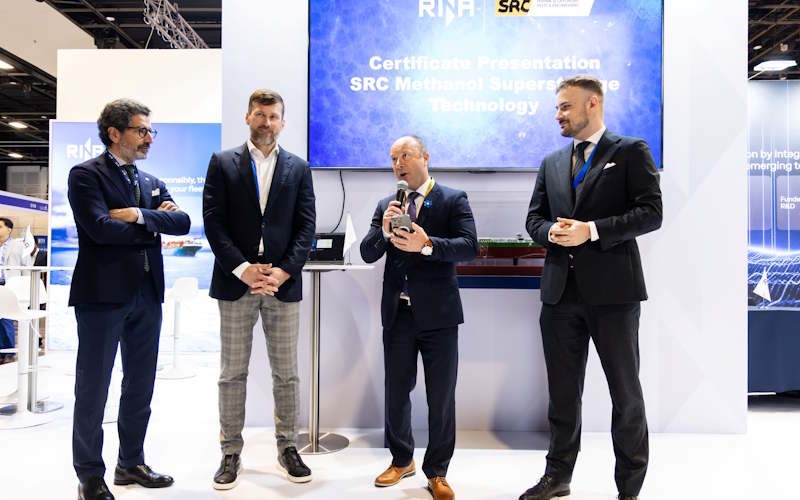
SRC Group has secured Type Approval from RINA for its Methanol Superstorage system, enabling shipowners to deploy methanol and ethanol as marine fuels without sacrificing tank capacity, according to RINA.
The approval confirms compliance with class requirements on safety, performance, and reliability, advancing the system beyond its Approval in Principle granted in March 2025 and providing a class-backed pathway for owners assessing alternative fuel installations.
Methanol is rapidly gaining traction as a next-generation marine fuel
Methanol is rapidly gaining traction as a next-generation marine fuel, particularly in light of the International Maritime Organization’s (IMO) Net Zero ambition for 2050. Although methanol is relatively simple to handle and store, its lower energy density compared to traditional heavy fuel oil (HFO) presents challenges for ship design and operational range. Existing regulations require a cofferdam structure between tank walls, which significantly reduces usable storage volume onboard. SRC’s Methanol Superstorage overcomes this challenge with an innovative design.
Sandwich Plate System (SPS),
By replacing the conventional cofferdam with a 25mm thick Sandwich Plate System (SPS), an elastomer core sealed between two steel plates, the technology delivers a triple-barrier containment solution that offers up to 85% more fuel volume within the same footprint.
They announce that SRC Group’s innovative Methanol Superstorage Technology has received our Approval in Principle (AiP)."Our AiP reflects the latest rules for ship classification and incorporates IMO’s interim guidelines (MSC.1/Circ.1621) as well as updates to the International Code of Safety for Ships Using Gases or Other Low-Flashpoint Fuels (IGF Code). The approval confirms that SRC’s system ensures an equivalent level of safety to existing requirements, while significantly improving storage efficiency across multiple ship types. "
The design's compatibility with methanol and ethanol fuels
The AiP also affirms the design's compatibility with methanol and ethanol fuels, including the technical acceptance of key structural features such as perimeter bar connections. This development provides stakeholders with a high degree of confidence that the solution can be implemented without regulatory barriers during the detailed design phase.
With over 240 methanol-capable ships
With over 240 methanol-capable ships already in service or on order, the demand for safe, efficient, and retrofittable fuel storage systems is greater than ever. SRC’s Methanol Superstorage Technology, now validated by RINA, will play a crucial role in accelerating the decarbonisation of the global shipping fleet.
Reductions in greenhouse gas emissions
Methanol and ethanol offer substantial reductions in greenhouse gas emissions versus heavy fuel oil, but require roughly double the storage volume, a constraint that SRC’s design targets directly. The system replaces conventional cofferdams with a sandwich-structured tank built on SPS Technology’s Sandwich Plate System, combining a 25 mm elastomer core between two steel plates. The bonded structure transfers loads, absorbs impact energy, and creates a sealed, oxygen-free layer that prevents hidden corrosion while eliminating the need for internal inspections.
Related : RINA and Hanwha partner for battery-hybrid propulsion in the ferry sector

.A third containment barrier
A third containment barrier is formed within the structure to limit leakage and emissions, while maintaining safety equivalence with conventional cofferdam arrangements under IMO MSC.1/Circ. 1621 and removing inspection-related risks, including toxic exposure, vapour accumulation, and confined-space hazards.
Case studies indicate vessels fitted with the system can store close to twice the volume of methanol or ethanol compared with conventional tanks. Fewer components and the removal of gas-freeing procedures reduce maintenance exposure and extend service life.
The system is designed for application across vessel segments from workboats and offshore support vessels to ferries, cruise ships, tankers, and cargo vessels. Type Approval is expected to support flag state certification as demand for methanol-fuelled tonnage builds, with projections pointing to nearly 20% of the global orderbook by 2030.
The Maritime Innovation Award
Alex Vainokivi, Innovation Manager at SRC Group, said the approval provides validation for owners evaluating methanol as a long-term fuel option across multiple vessel types. The system has also secured approvals in principle from Lloyd’s Register, ClassNK, and the Panama Maritime Authority, and received the Maritime Innovation Award from the Royal Institution of Naval Architects in 2025.
RINA is an Italy-based classification society and certification body providing technical assurance, rule development, and verification services across maritime and industrial sectors.
#RINA #SRC Group #Alex Vainokivi #Maritime Innovation Award # third containment barrier #Methanol # Net Zero ambition for 2050 # (SPS),
You Might Also Like

Recommendation News

More
Marshall Islands Creates First Marine Sanctuary 28 October 2025
Ports
Port of Oakland Moves 174,239 TEUs in November as Exports Increase 27 December 2025
Shipping Lines
Maersk, Hapag and Gemini launch a new Asia-Med service passing through the Suez Canal 20 October 2026
Incidents
The Santa Cruz ferry in the port of Genoa has been released 15 October 2025
Marine Tech
The Holland Shipyards Group has delivered third offshore support vessel, the Men Skey, to Dixstone. 25 March 2026