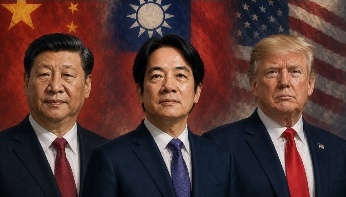
I cannot conceive of the risk of a war between China and the US over Taiwan, given that the island's geopolitical relevance cannot be compared to that of Ukraine and Europe, or the Middle East
I believe that, during his next visit, Xi will propose a solution similar to the one that saw Hong Kong returned to China in 1997 to Trump
Why must the US and China go to war over an island whose possession won’t affect world affairs much?

Former Chief Economist and Op-Ed writer. Maritime and LinkedIn expert.
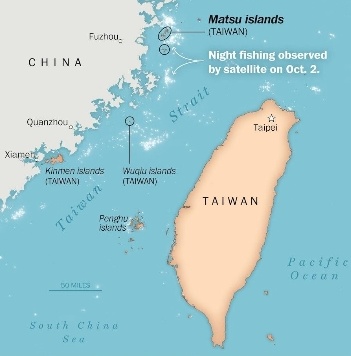
Mainland China was not far from the Taiwanese military island. I looked through fixed binoculars, like those found in many cities in elevated places, to appreciate the city below. We had arrived by plane from Taipei, and there wasn't much to see on the island until you entered a tunnel, where a whole subterranean military world opened up to visitors. I don’t remember the name of the island, as many years have passed since then – it was 1986, forty years ago. It could have been one of the Kinmen, Wuqiu or Matsu islands – look at how close they are to the mainland on the map.
In 1991, I began my third phase in London
Since the age of 12, I have lived my life very intensely, committing myself to one passion at a time. In 1986, I was in the second phase of my life, which lasted from 1984 to 1990, in national politics. At the time, I was the Private Secretary to the President of the Guatemalan Congress, and I had been invited by the Taiwanese government to visit the country for almost three weeks. The following year, in 1987, I became General Secretary of the youth wing of the Christian Democratic Party. It was the largest political party and the party in government at the time. (In 1990, I left politics due to a schism within the party. In 1991, I began my third phase in London thanks to a British Council scholarship, which led to an MSc and a PhD in Economics.)
The first wave of East Asian economic miracles.
The Taiwanese government has always invited influential people from other countries to showcase Taiwan's economic success, which, alongside Japan and South Korea, formed the first wave of East Asian economic miracles. As part of this international campaign, I was invited, along with around 25 other young political leaders from Latin America, most of whom were from countries that had already severed diplomatic ties with Taiwan.
Taiwan was at the height of its international standing in 1969.
In 1986, Taiwan had diplomatic relations with 23 countries. The seven Central American countries were among the largest of these, alongside Paraguay and the Dominican Republic; the others were much smaller. Today, Guatemala and Belize are the only Central American countries that maintain diplomatic relations with Taiwan, while all the others have switched to China. This was already a very low number compared to the 70 countries that recognised Taiwan at the height of its international standing in 1969. Currently, barely 13 countries have diplomatic relations with Taiwan.
Three weeks of full immersion in Taiwanese affairs
The almost three weeks of full immersion in Taiwanese affairs included many sessions about the different facets of Taiwan's success, as well as plenty of visits to factories and other places around the island to gain a first-hand impression of its achievements. The trip to the military island near mainland China was the icing on the cake of that grand tour
The Taiwan Gordian knot
It was an amazing trip, but I realised just how determined Taiwan was to reclaim the mainland — an utterly absurd goal. This brings me to the most important topic of discussion at today's and tomorrow's meeting between Trump and Xi: the Taiwan Gordian knot.
I will be blunt: I cannot conceive of the risk of a war between China and the US over Taiwan, given that the island's geopolitical relevance, with 23 million inhabitants, cannot be compared to that of Ukraine and Europe, or the Middle East, both of which have hundreds of millions of inhabitants. With all due respect, Taiwan belongs to China, and the sooner we accept that, the better it will be for that part of the world.
The ideal solution
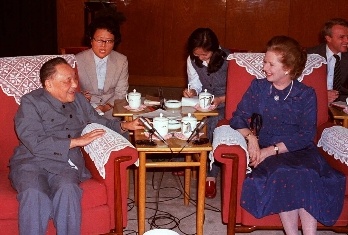
The ideal solution for me would be a deal similar to the one reached between the UK (under Margaret Thatcher's leadership) and China (under Deng Xiaoping's leadership). Under that agreement, the two countries agreed in 1984 that Hong Kong would be returned to China in 1997, and China also committed to a policy known as 'one country, two systems' for the following 50 years, up to 2047. Somehow, I believe that Xi will propose a similar solution to Trump during this visit.
Related: Pablo Rodas-Martini writes: 'A busy RoRo terminal where every car has a GPS/RTLS tag.'
Essentially, this approach solves a pressing problem by spreading its impact over time until it is fully absorbed by future generations. For example, if an agreement were reached by 2030 for Taiwan to be incorporated into China by around 2050, with an additional forty or fifty years of 'one country, two systems', Taiwanese people would have ample opportunity to decide whether to remain in a unified China or to migrate to countries such as the US, Australia, or other Asian nations, as many Hong Kongers have done (between 1.3 and 1.6 million).
Let's take a look at Taiwan's history.
Before you criticise me for not respecting the right of the Taiwanese people to self-determination, let's take a look at Taiwan's history. Taiwan could have become independent in the 1950s, 1960s or 1970s, when the US was extremely powerful, and China was poor and isolated. However, the Taiwanese made a huge mistake, a sin of origin: for decades, they insisted that there was only one China. They believed that reunification would eventually happen, and that Chiang Kai-shek (or a successor) and the Kuomintang — who were defeated militarily by the communists after WWII — would somehow regain control of mainland China. The Taiwanese government repeated this fantasy to its people for decades, and it is the same fantasy that we were told when I visited Taiwan in 1986.
Some things were almost surreal.
Some things were almost surreal. When I was there, they were still claiming that Taiwan had the national support of all of China, since the living members of the National Assembly of the Republic of China elected almost forty years before were in Taiwan and not on the mainland. As proof of this, a small group of septuagenarians and octogenarians would be presented regularly as the true representatives of China's distant provinces. It was a ludicrous thesis, but they kept repeating it. The mainland, home to hundreds of millions of Chinese, had to accept the decisions of an assembly that had been elected in 1947, whose surviving representatives lived in Taiwan. This charade finally ended in 1990.
The Taiwanese obsession
The Taiwanese obsession with reclaiming the entire country was their original sin. As part of this blindness, on 25 October 1971, they chose to leave the UN when China was admitted as the legitimate representative of the Chinese people, rather than becoming independent and joining the UN as a new country. At that time, China had 841 million inhabitants, while Taiwan had just 15 million. The UN merely ended a farce by awarding the seat to the real China.
Autopian vision of a world in which Taiwanese people would control China,
Why must the US and China go to war over an island whose possession won’t affect world affairs much? Taiwan's most sensitive exports, chips, could easily be relocated to the US, Japan, South Korea, or other Western countries. Why would the US and China risk nuclear war over an island whose inhabitants were blind enough not to declare independence in the 1950s, 1960s or 1970s? They were chasing a utopian vision of a world in which Taiwanese people would control all of China, as was the case before WWII. The Kuomintang remained in power until 2000, a time during which the independence movement in Taiwan did not exist yet.
The Sino-British Joint Declaration,
I truly hope that something like that —passing the initial ball to the 2040s and the second one to the 2060s or 2070s— by reaching an agreement similar to the one between the UK and China would reduce the tension in that part of the world and would begin a peaceful transition, not now or in ten years but in some decades in the future. As I have said, the Sino-British Joint Declaration, signed in 1984, was a masterful solution to a highly contentious issue. The handover date was agreed as 1 July 1997, but it had at its core the 'one country, two systems' principle, establishing that Hong Kong's capitalist system would be preserved and its way of life would remain unchanged for 50 years after the handover, until 2047. However, this promise has not been fully kept, as democracy in Hong Kong has been eroded. Nevertheless, it has given people time to adapt, either by accepting the new reality or by migrating to other countries.
In my opinion
In my opinion, this would be the best solution for that region and the world, as a war between the US and China could potentially lead to WW III. While approximately 50% of Taiwanese people who support independence would be highly disappointed, such a solution would be good for the entire world.
Chiang Kai-shek and the Kuomintang party
In short, if you repeat a lie for decades, don't be surprised when it comes back to haunt you. Chiang Kai-shek and the Kuomintang party, which ruled the country from 1949 until 2000, transformed a poor, sparsely populated and forgotten island into a miracle. However, by ruminating obsessively about the past, they kept so many ghosts alive. They never considered independence, and by the time the Democratic Progressive Party (the current party in power) campaigned for self-determination and later independence, it was too late. Taiwan has been both: a tremendous economic miracle and a horrific historical mistake.
Source : LinkedIn
#Kuomintang party # Chiang Kai-shek #Sino-British Joint Declaration #Hon Kong #Pablo Rodas-Martini #Tiwan #China #Trump #US–China geopolitical relations
You Might Also Like

19 October 2025

Recommendation News
Shipping Lines
GEODIS in Switzerland strengthens its healthcare capabilities and expands its national footprint 08 April 2026
Ports
Port of Los Angeles hits second-busiest July with 960,464 TEU 19 August 2026
Incidents
Trump threatens to blow up Iran’s Kharg Island oil hub 31 August 2026
Shipping Lines
Trieste, La Spezia and Genoa have been included in the new Ocean Alliance program. 22 January 2026