MOL has established the 'MOL Group Environmental Vision 2.2' and set a target to achieve net zero GHG emissions by 2050.
MOL has established the 'MOL Group Environmental Vision 2.2' and set a target to achieve net zero GHG emissions by 2050. Achieving this target will be achieved through the incorporation of further adoption of energy-saving technologies into the key strategies. The group has plans to launch 25 vessels equipped with the Wind Challenger by 2030 and 80 vessels by 2035.
The decision was made to install two Wind Challenger sails
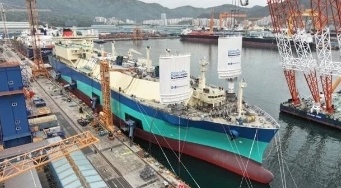
The decision was taken in September 2024 to install two Wind Challenger sails, a hard sail wind-assisted ship propulsion system, on a newly built membrane-type LNG carrier. This will be the world's first LNG carrier equipped with wind-assisted propulsion systems. This vessel's design is the most common in the current LNG carrier market, with a cargo tank capacity of 174,000 cubic metres. Sister vessels without the Wind Challenger sail have already visited LNG terminals around the world. The vessel is under construction at Hanwha Ocean Co., Ltd.'s Geoje Shipyard and is scheduled for delivery in 2026
The green light for an LNG carrier with a Wind- Ship
Back in August 2024, MOL got the green light from Nippon Kaiji Kyokai (Class NK) for an LNG carrier with Wind-Assisted Ship Propulsion Systems, which was a first for them. This vessel will be the first to be built based on the AiP-certified design.
The assessment looked at various factors
To get an AiP, MOL, Hanwha Ocean, and ClassNK carried out a risk assessment during the evaluation process. This assessment looked at various factors, including where the sails were placed, how they might affect visibility, emergency operation procedures, and other safety measures. The evaluation of the impact of sail installation on the cargo tank, conducted by Gaztransport et Technigaz SA (GTT), the designer of the vessel's cargo tank, also contributed to the award of this AiP. GTT has confirmed that the tank's structural safety is adequately ensured, even when considering the stresses imposed by the sails.
Related : MOL secures $1.6bn loan for LBC Tank Terminals acquisition and Names New Board of Directors
The Wind Challenger's robust
The Wind Challenger's robust design is complemented by several safety measures, including a fully enclosed navigation bridge and a lookout station on the vessel's fore deck, which further enhances visibility. The installation of Wind Challenger sails on an LNG carrier is a straightforward process. This vessel is scheduled for delivery in 2026 and will mark the world’s first LNG carrier equipped with Wind-Assisted Ship Propulsion Systems.
The installation position of the Wind Challenger
In terms of tradability, the installation position of the Wind Challenger is designed to minimise its impact on the existing design of membrane-type LNG carriers. This will allow the existing mooring arrangement to be retained unchanged, thereby minimising the impact on ship-shore compatibility and limiting the impact on the vessel's windage area
#MOL #(GTT) #Hanwha Ocean #Wind Challenger sails #ClassNK #Wind Challenger's robust #'MOL Group Environmental Vision #LNG carrier #The installation
You Might Also Like
Recommendation News

Ports
New Zealand’s biggest port to trial first all-electric straddle carrier 15 October 2025
Marine News Room
Adam Laabs writes : What’s Poisoning the Oceans Isn’t Oil It’s Indifference 13 November 2025
Ports
Port of Brisbane driving higher productivity and freight vehicle innovation 26 March 2026
Marine Tech
IMO : First maritime technical workshop for Latin America and the Caribbean 30 October 2025