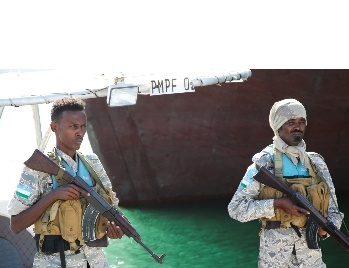
A tanker carrying 17 crew members has reportedly been held since 24 April 2026. Another two vessels were hijacked on 26 April and 2 May 2026, respectively.
Somali piracy is showing new signs of resurgence. are being shown in the western Indian Ocean and Gulf of Aden region after a series of vessel hijackings that have left dozens of seafarers being held hostage. The International Maritime Organization IMO and the chair of the Djibouti Code of Conduct/Jeddah Amendment have condemned the resurgence of Somali piracy on behalf of the signatory states. Three vessels and 44 crew members are currently being held captive in the western Indian Ocean and the Gulf of Aden.
A tanker was seized with 17 seafarers on board.
A tanker carrying 17 crew members has reportedly been held since 24 April 2026. According to the chair of the Djibouti Code of Conduct/Jeddah Amendment (DCoC/JA), the crew is in desperate need of assistance and is being held under extremely difficult and dangerous conditions. Onboard provisions are now critically low.
The fate and well-being of the crew members on board
Deep concern regarding the fate and well-being of the crew members onboard the other two vessels was further expressed by the signatory states. The other two vessels are reported to have been hijacked on April 26, 2026, and May 2, 2026, respectively. Fifteen and twelve crew members were reportedly on board the general cargo vessel and the oil tanker, respectively, at the time
The Djibouti Code of Conduct/Jeddah Amendment
The chair of the Djibouti Code of Conduct/Jeddah Amendment was stated in the wake of remarks made by the IMO secretary-general at the 111th session of the Maritime Safety Committee (MSC 111). These remarks highlighted the resurgence of piracy and armed robbery off the Somali coast.
Somali piracy is still present
"The ongoing incident highlights that Somali piracy is still present, not fully eliminated, and that ongoing international and regional collaboration is crucial for ensuring freedom of navigation, protecting seafarers, and maintaining maritime security and stability in the Western Indian Ocean and Gulf of Aden," the statement stated.
Related: The ReCAAP ISC did not receive any reports of piracy against ships in Asia over the past week.
The growing concern in the region regarding the resurgence of Somali piracy
The interventions delivered by several signatory states during MSC 111 were noted by the chair, including Kenya, the United Republic of Tanzania, South Africa, and others. The growing concern in the region regarding the resurgence of Somali piracy and the need for renewed international attention and operational responses were emphasised by these interventions.
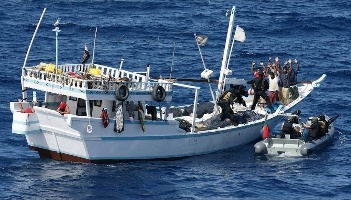
The concerns raised by other member states and the International Transport Workers' Federation (ITF) were also acknowledged by the signatory states, with calls being made for stronger, more urgent measures to protect seafarers operating in high-risk maritime environments.
Maritime security is still fragile
Even though there has been progress recently, maritime security is still fragile and needs continued attention, practical cooperation, and joint action by the international community. The signatory states urged the strengthening of regional and international cooperation, as well as the full implementation of SOLAS chapter XI-2 and the ISPS Code, and the enhancement of reporting and information sharing on piracy and armed robbery incidents.
Related: New piracy incident off the coast of Somalia: cargo ship seized.
Governments, naval forces operating in the region, international organisations, and maritime security partners were also called on to intensify efforts to secure the release of the crew members and prevent further acts of piracy and armed robbery at sea in the Western Indian Ocean and Gulf of Aden.
A pressing humanitarian concern.
"It must be ensured that seafarers never become collateral victims of geopolitical tensions, criminality, or delays in collective action," it was stated by the signatory states, with the chair adding, "As chair of the DCoC/JA, it is wished by South Africa that emphasis be placed on the fact that this situation is not solely a maritime security issue, but also a pressing humanitarian concern.""There are practical solutions," the chair said, but warned that "collective will" is needed to implement them "urgently, decisively, and without delay."
The Jeddah Amendment
The Jeddah Amendment to the Djibouti Code of Conduct (DCoC-JA) is a regional initiative aimed at combatting piracy, armed robbery against ships, and other illicit maritime activities in the Western Indian Ocean and the Gulf of Aden. The DCoC-JA is an expansion of the 2009 Djibouti Code of Conduct (DCoC), which was created to combat piracy and armed robbery against ships. Since 2017, its scope has expanded to address a wider range of illicit activities, including illegal, unreported, and unregulated (IUU) fishing, arms and drug trafficking, illegal trade in wildlife, crude oil theft, human trafficking and smuggling, and illegal dumping of toxic waste.
#The Jeddah Amendment #Somali piracy #IMO #SOLAS chapter XI-2 #ISPS Code #Gulf of Aden.# Indian Ocean #MSC 111 #Three Vessels #(DCoC/JA) #IUU
You Might Also Like

15 December 2025

15 October 2025
Recommendation News
Ports
Bangladesh drops plan to lease key Chattogram container terminal amid protests 10 February 2026
Shipping Lines
CMA CGM aims to have overtaken Maersk to claim second place by the end of 2027, 07 July 2026
Shipping Lines
Hapag-Lloyd seeks to acquire Israeli company ZIM 06 December 2025
Yachts&Cruises
Stena Line to discontinue the Halmstad–Grenaa ferry route 03 February 2026
Marine News Room
Exclusive : Suraya Yeasmin in interview to ALAM ALMAWNI 20 October 2025