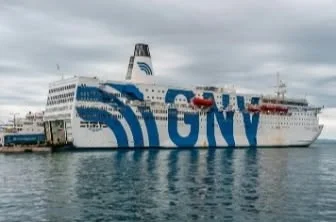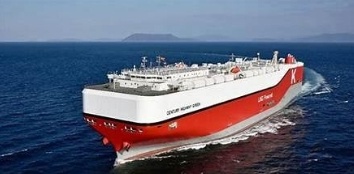
The vessels are designed for the frequent transport of small lots in European short sea shipping. They are also designed to comply with size restrictions that some European ports have for imported cars
“K” LINE Secures Time Charter Contract of Newly Built Liquefied CO2 Carrier for Northern Lights
Kawasaki Kisen Kaisha, Ltd. (“K” LINE) is pleased to announce that it has signed shipbuilding contracts with China Merchants Jinling Shipyard (Nanjing) Co., Ltd. for four 1,380-vehicle capacity LNG dual-fuel car carriers. The vessels were ordered for “K” Line European Sea Highway Services GmbH (KESS)*1, the “K” LINE’s European subsidiary.
Design of these ships
The vessels are designed for the frequent transport of small lots in European short sea shipping. They are also designed to comply with size restrictions, that some European ports for imported cars have. “K” LINE is confident that these vessel specifications will give KESS a competitive advantage in its European short sea shipping operations.
The vessels are equipped with straight stern ramps*2 with a load capacity of 60 tons. This enhances KESS’s capacity to handle heavy and oversized cargo and increases its flexibility to carry a wide variety of cargo types in addition to passenger cars.
The use of LNG fuel
The use of LNG fuel is expected to reduce emissions of carbon dioxide (CO2), a greenhouse gas (GHG), by 25% to 30% and emissions of sulfur oxides (SOx), which cause air pollution, by almost 100% compared to conventional vessels using heavy fuel oil. Additionally, to further reduce GHG emissions throughout the “K” LINE Group, we will consider using biodiesel, bio-LNG, or liquefied biomethane in addition to LNG.
Related: “K” LINE Acquires Full Ownership of “K” Line Wind Service
Configuration with lower methane slip emissions
The vessels each use a high-pressure ME-GI engine with a shaft generator, reducing methane slip (unburned gas) emissions, which is a greenhouse gas (GHG). While boil-off gas (BOG) generated from LNG tanks is generally used as fuel for generator engines on a vessel with a high-pressure main engine, these vessels are equipped with vacuum-insulated LNG tanks to reduce the generation of BOG. This enables a machinery configuration with lower methane slip emissions.
Under the Group’s long-term environmental policy
Under the Group’s long-term environmental policy, “K” LINE Environmental Vision 2050: Blue Seas for the Future,*3 the “K” LINE Group set the target of achieving net-zero GHG emissions in 2050. In line with this, “K” LINE has been working to introduce and operate LNG-fueled ships. The continuous use of bio-LNG is one of its key initiatives for achieving this target. “K” LINE will continue to work hard on the decarbonization of the marine transport industry, including through the use of carbon-neutral and zero-emissions fuels.
Outline of the Vessel
Overall length: approx. 129.95 meters
Width: approx. 20.5 meters
Maximum vehicle capacity: approx. 1,380
Ice Class: 1A
*1 KESS is a wholly owned subsidiary of “K” LINE that operates short sea and coastal transport services for completely built-up cars in Europe.
*2 A stowable, ramp-like passage installed at the stern of a vessel enabling vehicles to drive on and off the ship.
*3 “K” LINE Environmental Vision 2050: Blue Seas for the Future is a set of long-term guidelines regarding the environment that was established in 2015 and revised in 2020. As part of our action plan to reduce GHG emissions, we are engaged in several initiatives, such as the introduction of zero-emission fuels, such as ammonia and hydrogen, and carbon-neutral fuels such as bio-LNG and synthetic fuels.
ِِA time charter contract
On the other hand, K Line announced that it has secured a time charter contract for a newly built 12,000 m³ liquefied CO₂ carrier (the Contract) from Northern Lights JV DA (Northern Lights)*¹, jointly with Malaysia-based MISC Berhad (MISC). The vessel is to be constructed by Dalian Shipbuilding Offshore Co., Ltd. The contract is based on the time charter contract signed on 29 January 2026 for a 12,000 m³ liquefied CO₂ carrier.^(*2) The two new vessels will be used for cross-border CO₂ transportation within Europe.
# Dalian Shipbuilding Offshore # K Line #KESS #methane slip #European ports #Northern Lights#(MISC)
You Might Also Like

Recommendation News
Marine Tech
RINA successfully tests line pipe hydrogen suitability for Jindal 15 October 2025
Yachts&Cruises
The port of Civitavecchia has celebrated a new record for annual cruise traffic 17 January 2026
Ports
Spanish study: Port race in the Strait of Gibraltar leans toward Moroccan ports. 26 March 2026
Shipping Lines
Nor -Shipping: The search is on for our next Ocean Solutions Award winner 16 October 2026
Ports
First Official Visit: The Aida 4 ship docks at the Port of Algiers. 22 July 2026