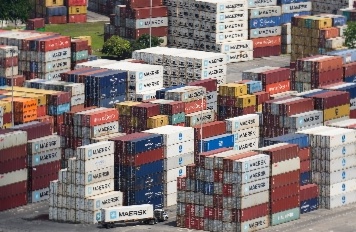
The Drewry Container Index averaged $3,969 over the past week, up 12% from the previous reading and 21% from a year ago
Iran announced today, Saturday, that it had once again closed the vital Strait of Hormuz
Rates for container shipping continue to rise, supported by growing demand on China's main export routes, while uncertainty is being caused by the implementation of the US-Iran agreement and its implications for global shipping. Drewry also noted that average spot freight rates for 40-foot containers between Shanghai and Genoa have increased by 12% over the past seven days, reaching $5,756 (41% higher than a year ago), while from the Chinese port to Rotterdam, the increase was 15% to $4,342 (37% higher than a year ago).
The current situation has been described as a "strong peak season" (an assessment that has been shared by many in Italy), driven by early shipments ahead of the Bunker Adjustment Factor (BAF) measures that have been announced by carriers for 1 July, along with additional Peak Season Surcharges. Additionally, only three ship departures will be cut on the Asia-Europe corridor next week. Overall, Drewry expects further increases in shipping costs in the coming weeks.
Freight rates for shipments on the transpacific route
Last week, similar increases were seen in spot freight rates for shipments on the transpacific route. Specifically, rates from Shanghai to New York rose by 15% to $6,769, and rates to Los Angeles increased by 10% to $5,142. However, these figures are closer to those recorded a year ago, with increases of 3% and 9%, respectively. Analysts have noted the introduction of six blank sailings for next week on this corridor, while carriers have announced surcharges to manage the strong influx of demand expected due to shippers' early shipments in anticipation of the upcoming July tariff increases. Drewry therefore expects further increases in freight rates for this route in the coming weeks.
Related:Drewry: The World Container Index Decreased 1% This Week 08-2026
Transatlantic freight rates have remained perfectly stable over the past seven days
However, transatlantic freight rates have remained perfectly stable over the past seven days. Rates for 40-foot containers are $2,507 on the Rotterdam–New York route and $957 in the opposite direction. The Drewry Container Index averaged $3,969 globally over the past week, which is an increase of 12% from the previous reading and 21% from a year ago.
Uncertainty remains regarding the US-Iran agreement
As mentioned, uncertainty remains regarding the US-Iran agreement and its implications, despite improved sentiment in the maritime transport markets. The easing of tensions should stabilise oil and bunker prices, ultimately putting less pressure on marine fuel prices. Nevertheless, freight rates will continue to come under pressure due to strong demand, as well as carriers implementing price increases and surcharges.

The Strait of Hormuz was closed again today.
On the other hand, Iran's central military command announced today, Saturday, that it had once again closed the vital Strait of Hormuz due to Israel's attacks on southern Lebanon, describing them as a breach of Tehran's agreement with the US. In a statement carried by state TV, the Khatam-al Anbiya Central Headquarters announced that the Strait of Hormuz would be closed to vessel traffic. The statement noted that this was in response to the enemy’s breach of promise and that further steps would be taken if the aggression continued to force compliance with obligations.
#Strait of Hormuz #Drewry Container Index #Italy #China # freight rates #Bunker Adjustment Factor (BAF) #Rotterdam–New York route #US-Iran agreement
You Might Also Like

Recommendation News

Seafarers
ITF files complaint against Slovenia over sham union scandal affecting seafarers’ rights 22 March 2026
Marine Tech
Santagata : A New CEO of Fincantieri’s Naval Vessels Division 15 October 2025
Incidents
Sweden releases seized oil tanker suspected of being source of oil spill 05 April 2026
Shipping Lines
MSC surpasses 7 Million TEU for the first time 03 November 2025
Marine Tech
Samskip moves forward with Norwegian Hydrogen as its preferred supplier of liquid green hydrogen 12 January 2026