The chief engineer was struck by debris and sustained severe injuries. The engine was stopped immediately after the accident was recognised. The Chief Engineer survived but could never work at sea again
Each month, The Swedish Club’s Loss Prevention team issues a new safety scenario to assist members in their efforts to comply with international safety regulations and follow best practices.
The medium-sized container vessel is engaged in short international trade. While on passage, smoke was detected from the shaft generator, activating a fire alarm in the engine room. Electrical power was transferred to an auxiliary generator, the shaft generator was electrically tripped, and the main engine was stopped. Inspection showed that the shaft generator had suffered internal damage and was mechanically immobilised.
The vessel
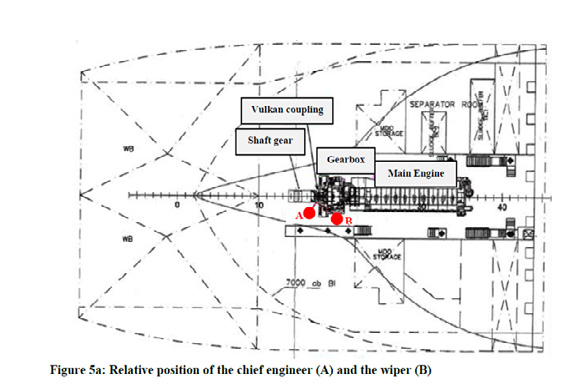
The vessel was powered by a medium-speed, four-stroke main diesel engine driving a controllable pitch propeller via a reduction gearbox. A shaft generator was driven from a gearbox power take-off (PTO) through a large flexible coupling. No clutch was fitted between the PTO and the shaft generator.
With the vessel without propulsion
With the vessel without propulsion, the engineering department decided to mechanically disconnect the shaft generator from the gearbox PTO in order to restart the main engine and continue the voyage. The chief engineer reviewed the coupling drawing and discussed the situation with the second engineer. He attempted to contact shore technical management for guidance but received no response. No formal risk assessment was carried out.
Related: TT Club highlights dangers of fire to mobile port equipment
Based on their interpretation of the drawing,
Based on their interpretation of the drawing, the engineers concluded that removing the bolts and spacer ring between the two halves of the flexible coupling would be sufficient to disconnect the shaft generator. The coupling guard was removed, and the bolts and spacer ring on the shaft generator side were taken out, effectively “splitting” the coupling.
Related: The Swedish Club : MSS Case March- Wrong charts lead to grounding
The main engine was turned on the turning gear
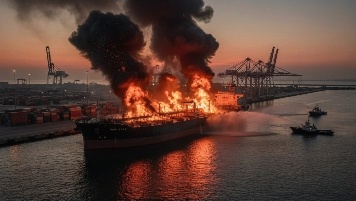
The main engine was then turned on the turning gear. The gearbox side of the coupling rotated, while the shaft generator side remained stationary. This was taken as confirmation that the shaft generator was disconnected. The coupling guard was refitted, and the main engine was restarted and brought up to approximately half operating speed. Shortly after the engine was restarted, sparks and abnormal vibration were observed in way of the coupling. This was reported to the chief engineer, who proceeded towards the rotating coupling to investigate. The main engine was not stopped before approaching the machinery. Within seconds, the flexible coupling catastrophically failed. The coupling, still mounted on the gearbox PTO but unsupported on the shaft generator side, disintegrated violently. Coupling components and the guard were ejected across the engine room platform.
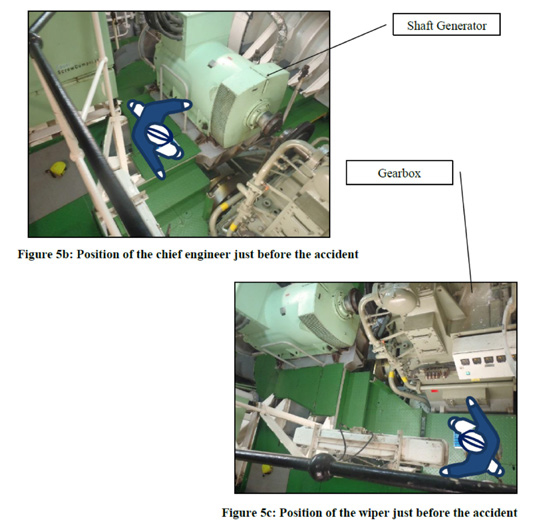
The chief engineer was struck by debris and sustained severe injuries. The engine was stopped immediately after the accident was recognised. The Chief Engineer survived but could never work at sea again because his right hand was amputated.
Questions
When discussing this case, please consider that the actions taken at the time made sense for all involved. Do not only judge but also ask why you think these actions were taken, and could this happen on your vessel?
- Does our SMS address these risks?
- What sections of our SMS would have been breached, if any?
- How do we ensure that we carry out jobs that we know how to do?
- What are our risk assessment procedures?
- At what point should the main engine have been stopped, and why?
- What risks were present but not recognised when the coupling was “split” and the engine restarted?
- What assumptions were made based on the turning gear test, and why were those assumptions unsafe?
- What lessons can be learned from this incident to reinforce safety culture onboard?
- What additional training or practical drills could help the crew be better prepared for a situation like this?
- What support do we need from management (additional training, updated procedures, more resources) to strengthen our procedures?
- What immediate, actionable steps can we take from today’s discussion?
#The Swedish Club #MSS Case June # Case Study # Catastrophic engine fire # serious injury# The Chief Engineer
You Might Also Like
Recommendation News

Shipping Lines
SAL Unites Its Ocean Services Under One Brand – 04 November 2025
Incidents
Captain of cargo ship VSG GLORY to Red Sea assize court 16 October 2025
Ports
Pilbara Ports updates on impact of ex-Tropical Cyclone Narelle 04 April 2026
Marine Tech
Danish Shipping welcomes EU proposal to include Indian ship recycling facilities on EU list 20 August 2026