The Royal Spanish Naval League is a centuries-old institution that unites the aspirations of the four maritime sectors: the Navy, the Merchant Marine, the fishing industry, and recreational boating
By: Raúl Villa Caro
Secretario de la Fundación “EXPONAV”
Greater La Coruña Area
The Royal Spanish Naval League is a centuries-old institution that unites the aspirations of the four maritime sectors: the Navy, the Merchant Marine, the fishing industry, and recreational boating. It is a private, independent, apolitical and non-profit association recognised by the state as an organisation of 'public utility'.Its primary objective is to defend Spain's maritime interests, and to fulfil this mission it has branches throughout Spain and as far afield as Italy and Florida.
Why is the Naval League necessary?
Its existence is founded on three primary justifications. Firstly, it is grounded in the need for an association that honours the historical figures who made us great by looking to the sea. Secondly, it provides a framework for defining medium- and long-term maritime policies. Finally, it champions values such as effort, perseverance, solidarity, freedom, commitment, integrity, tolerance and altruism that make us a more open society.
Divisional structure
The RLNE operates through several distinct areas. Activities related to the sea, such as lectures, events and publications, are organised by the Culture division. The Nautical Tourism division promotes recreational boating by actively participating in domestic and international functions, events, and trade fairs.
The Ship Modelling Division promotes the craft by organising exhibitions and model displays, as well as courses on workshop techniques, naval architecture and drafting for modellers. Guided tours of various naval museums are also conducted. The historical documentary records of the RLNE are preserved by the Archives and Library Division, as are its accumulated bibliographic and cartographic collections.
Related: Raúl Villa Caro writes: 'Classification Society (CSS) certifications on military vessels.'
The Fishing Division protects and defends the marine environment, promoting sustainable fishing practices in the interests of the Spanish fishing sector. Meanwhile, the Underwater Archaeology Division aims to raise public and Spanish governmental awareness of the importance of Spain’s underwater cultural heritage.
Finally, the Technical-Maritime Office serves as the RLNE’s advisory body specialising in maritime affairs and comprises two sections: the Technical Committee and the Maritime Auxiliary Patrol.
Institutional Relations of the League
The Navy is one of the institutions with which the League maintains strong ties. Another noteworthy organisation is 'Fidalmar', which brings together various international maritime and naval leagues and for which the RLNE serves as the General Secretariat. Its mission is to support the maritime interests championed by the various member countries' leagues.
Another body closely linked to the League is the International Institute for Transport Mediation and Arbitration (IIMAT). Its mission is to foster the development and competitiveness of Spanish maritime companies and industries. The President of the RLNE is the Third Vice President of the IIMAT, and the RLNE was one of the body's founding promoters.
The Real Academia de la Mar (RAM) is an organisation dedicated to highlighting the value of maritime culture and Spain's maritime traditions. The RLNE manages the RAM's administrative operations.
Proa a la Mar magazine
Proa a la Mar magazine was established in 1979 as the League’s official publication, succeeding the renowned Vida Marítima, which had existed since the LME’s inception. It is currently published at least twice a year (excluding special editions), with the ongoing aim of raising public awareness in Spain of the importance of the sea. The 190^(th) issue was released in June, and a special edition dedicated to Álvaro de
Bazán was published earlier this year.
Each issue features interviews with key figures in the sector, opinion pieces, technical articles, updates on maritime legislation and regulations, historical content and current industry news. Furthermore, the magazine provides a platform for the views and contributions of the League’s members, including myself.
RLNE Maritime Fellowship Annual Gala Dinner
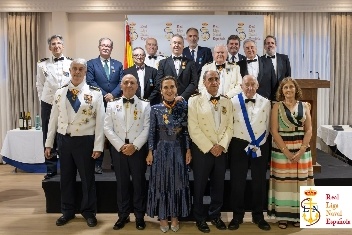
The traditional RLNE Maritime Fellowship Gala Dinner was held on 6 June 2026 at the social halls of the Navy Officers' Club in Madrid. The event began with the presentation of awards to the honorees. Notably, Vice President Marcelino González was awarded the Grand Cross. This was in recognition of his long-standing service to the institution. The Medal for Cultural Merit was also awarded to Francisco López Muñoz, Ramón López-Pintor and me. I was nominated by Juan Ignacio Pinedo, a Governing Board member and director of the Proa a la mar magazine, in recognition of my ongoing collaboration with the publication.
RLNE Structure in Galicia
As was stated earlier, the association is represented by delegations spread across the different autonomous communities, with each one being led by a regional delegate. Within each community, there are also provincial delegates.
The annual tribute to the victims of the Royal Navy torpedo cruiser HMS Serpent is one of the most notable regular activities in Galicia. Every year, the RLNE and the Camariñas City Council organise a commemorative ceremony for the victims of the HMS Serpent and all those lost at sea. This takes place at the 'English Cemetery' (Cementerio de los Ingleses) in Camariñas, where the HMS Serpent's crew, as well as those from two other sunken British merchant vessels, the Iris Hull (1883) and the Trinacria (1893), are buried. The ceremony includes a floral tribute to all victims of the sea. This burial ground is part of the European Route of Significant Cemeteries.
Details about shipbuilding
It was built in 1885 and launched in 1887. Displacing 1,770 tons, she was armed with six 6-inch guns and five 14-inch torpedo tubes. On 10 November 1890, she ran aground off Punta do Boi in Camariñas, resulting in the deaths of 172 crew members. The following day, the recovery of the Serpent's dead began; the sea continuously washed bodies onto the coast due to the wreck's proximity to the shore. The victims were buried on the beach in an improvised local cemetery (known as the *Cementerio de los Ingleses*, or "Englishmen's Cemetery"). Only three people survived — all of whom had been wearing life jackets. There were only 25 life jackets for the 175 crew members, which led to the mandatory use of life jackets for all Royal Navy crew members.
The bronze snakes
The bronze snakes that were part of the figurehead of the Serpent were located in Camariñas a few years ago. Originally part of the ship's bearded figurehead, the piece was kept by one of the Camelle divers who purchased the wreck and carried out salvage operations in the 1950s, as it was made of bronze. The snakes were found by a team from the provincial branch of the RLNE while they were inventorying potential shipwreck artefacts. These artefacts were stored in the attics of former divers and scrap dealers along the Costa da Morte. They also found consular documentation relating to the shipwreck.
In another solemn ceremony, the RLNE pays tribute to those who died at Covas (Viveiro) when the frigate Magdalena and the brig Palomo sank on the night of 2–3 November 1810. This event claimed the lives of 550 Spanish crew members.
Read the full article on
https://exponav.org/wp-content/uploads/Screenshot_20260622_075418_El-Ideal-Gallego.jpg
#The bronze snakes #Raúl Villa Caro #Royal Spanish Naval League #Nautical Tourism division #Maritime Auxiliary Patrol#HMS Serpent #Proa a la Mar magazine
You Might Also Like

Recommendation News

Ports
Costa Rica Accedes to the Revised Kyoto Convention as the 140th Contracting Party 02 November 2025
Shipping Lines
The Implications of a Global Increase in Oil Prices.-Report 20 March 2026
Shipping Lines
APM Terminals and Eurogate plan to turn NTB into one of the most modern and efficient terminals in Europe 15 February 2026

Marine Tech
ABS : Wireless Design Uses Ship’s Metal Structure for Transmission 29 October 2025