India accounted for 8% of the container traffic moving through Montreal in 2020. A decade earlier, the market was negligible, but it has since grown significantly, according to the port.
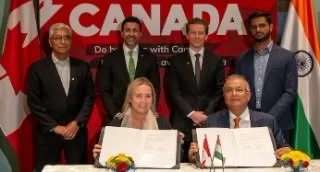
The Montreal Port Authority and Adani Group have renewed their collaboration agreement to develop India–Canada trade, particularly through the Mundra–Montreal corridor. Signed in Mumbai on October 15, the agreement accompanies Montreal’s appointment of an India representative and builds on a commercial relationship established in 2018.
Agreement strengthens commercial engagement
The Montreal–Adani partnership will support joint business promotion, information exchange and cooperation on port operations and road–rail logistics.
Captain Sandeep Mehta signed for Adani Group alongside Marie-Claude Galarneau, Montreal Port Authority’s Executive Vice-President and Chief Operating and Transformation Officer. Canadian International Trade Minister Maninder Sidhu attended. The partners will also explore vehicle transportation and exchanges between their teams.
Prakash Tulsiani has been appointed as Montreal's India agent with the aim of strengthening engagement with shipping lines, freight forwarders and cargo owners. India was the port’s second-largest market in 2025, accounting for one million tonnes of cargo, 60% of which was exported from Montreal and 40% of which was imported. It should be noted that this announcement concerns commercial cooperation and does not establish a new scheduled shipping service.
Cooperation builds on an established relationship
The latest agreement follows several years of engagement between the organisations. Their initial cooperation arrangement dates to 2018. An earlier renewal, signed on April 22, 2021, extended the relationship for five years and focused on business development, marketing, operational information and technology.
Related: Adani Ports to Sell India Port Stake to Swiss Shipping Group MSC for $1.40 Billion
India accounted for 8% of container volumes
At that stage, India accounted for 8% of container volumes moving through Montreal, measured against 2020 traffic. The port described the market as having grown from a negligible presence a decade earlier. The 2021 programme included container traceability, intermodal distribution, green energy and measures to ease truck movements around port facilities.
Connections between Mundra and Montreal were then described as operating through Mediterranean transshipment ports. That historical routing should be distinguished from any current carrier schedule, which shippers must assess separately when planning consignments.
Related: Adani Ports signs pact with Port Marseille Fos to boost IMEC trade corridor
Montreal’s cargo base provides a platform for growth
Montreal handled 34.3 million tonnes of cargo in 2025, with containers, liquid bulk and dry bulk contributing to its diversified business. Container throughput reached 1.52 million TEUs, increasing 3.6%, although containerised cargo weight declined 2.2% to 12.3 million tonnes. Liquid bulk totalled 13.45 million tonnes, while dry bulk reached 8.57 million tonnes, including 4.3 million tonnes of grain.
The varying movements of container units and cargo weight demonstrate that trade growth requires more than one measure. Changes in shipment composition can affect tonnage without resulting in an equivalent change in container activity. When Indian businesses are assessing the gateway, commercial suitability will depend on the commodity, destination, available carrier connections, and inland transport requirements.
Expansion accompanies market development
Montreal’s commercial outreach is taking place alongside investment in its infrastructure. During 2025, the Contrecœur expansion advanced through financing, environmental permissions and development arrangements. Preparatory work was awarded under a C$609-million contract for in-water construction. The port also completed projects including the Pie-IX rail bridge and quay rehabilitation works.
These investments provide context for its efforts to develop additional overseas business. Infrastructure and market development must progress together: handling capacity creates opportunities, while sustained utilisation depends on shipping services and customer demand. The practical significance for cargo owners lies in whether investment improves reliability across the complete port and inland journey.
Wider trade negotiations add policy momentum
The port agreement comes as Canada and India pursue a Comprehensive Economic Partnership Agreement. At a September meeting in Mumbai, Sidhu and Indian Commerce and Industry Minister Piyush Goyal reaffirmed their intention to conclude negotiations by the end of 2026. Canadian figures put bilateral merchandise trade at C$13.6 billion in 2025. Canadian goods exports to India totalled C$3.9 billion, while imports from India reached C$9.7 billion.
The leading Canadian exports were vegetables, mineral fuels, and wood pulp. Imports from India included precious stones, metals, machinery, and pharmaceuticals. It is important to distinguish these national figures, which cover trade through all gateways, from Montreal’s port-specific cargo statistics.
Commercial follow-through will determine results
For exporters and logistics providers, closer port cooperation can help identify customers, exchange operational knowledge and improve understanding of gateway options. Its measurable value will emerge through additional business relationships, dependable transport arrangements and cargo flows. The renewed partnership gives both organisations a framework for that work, while leaving shipping lines, forwarders and cargo owners to translate commercial opportunities into actual shipments.
Source: Predd - Release
#Prakash Tulsiani #Montreal Port Authority#Adani Group#Captain Sandeep Mehta #Marie-Claude Galarneau# India–Canada trade
You Might Also Like


Recommendation News

Incidents
An Augustea barge shipwrecked due to bad weather recovered 16 October 2025
Marine Tech
ClassNK has updated the OCCS guidelines to include notation for capture-ready vessel designs. 30 May 2026
Yachts&Cruises
New institutional leaders have been appointed to the Supervisory Board of Liberty Lines. 05 April 2026
Marine Tech
Trump pledges revitalize US shipbuilding 11 October 2025
Yachts&Cruises
Ragusa Xpress will sail between Malta and Sicily from mid-May 07 October 2025