The sailing vessel will combine wind and solar power with hydrogen fuel cells and engines designed to run on green methanol (MeOH), two technologies that will help reduce emissions and move towards more sustainable shipping
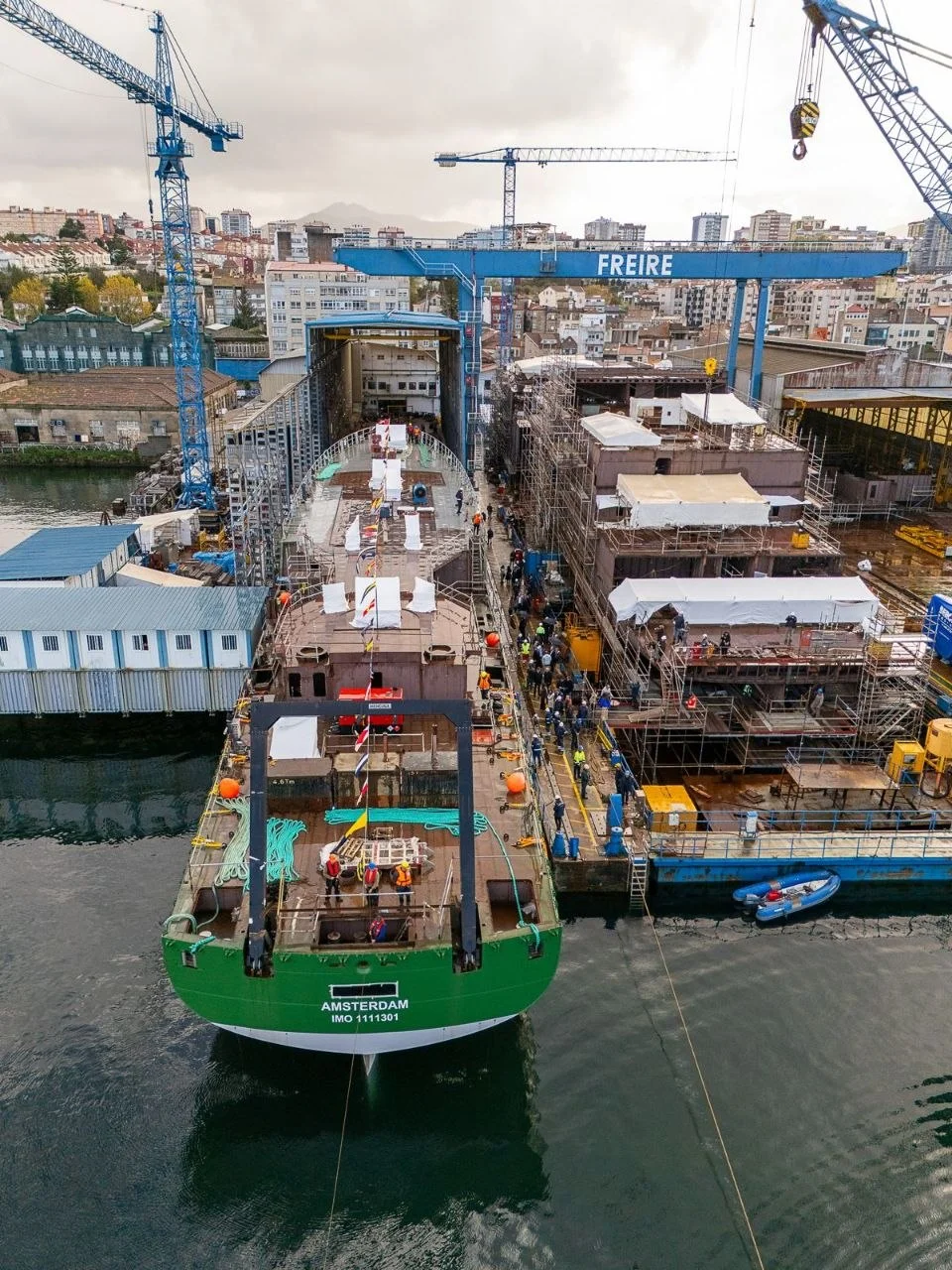
Freire Shipyard celebrated the launch ceremony of NB 737 on 25 November 2026 in Vigo, marking a major milestone in the construction of Greenpeace International’s new flagship vessel. Designed to support environmental campaigns and scientific research worldwide while minimising fossil fuel consumption, the vessel is scheduled for delivery by the end of 2027.
The vessel is designed with climate responsibility from the outset.
Greenpeace International Deputy Programme Director, Fabien Rondal, said: “Our new ship touching the water for the first time is a major milestone in an ambitious project, and a moment to recognise the work of everyone who has brought it this far. By combining different energy systems to minimise fossil fuel use, the ship will be capable of operating without fossil fuels as supply chains and logistics develop, without compromising on performance or the capabilities needed for Greenpeace’s global campaigns.
It shows what can be achieved when climate responsibility is built into a vessel from the outset, and sets an example for what the wider shipping industry can do to reduce its environmental impact”.
Southern Spars has engineered this generation of DynaRig
“Southern Spars has engineered this generation of DynaRig to deliver a combination of performance, reliability and cost-effective operation in a way that makes wind propulsion a realistic option for a much wider range of vessels. The Greenpeace project is a perfect opportunity to demonstrate that the tools needed to decarbonise shipping already exist and can be deployed commercially today.” James Austin, President, NTG Masts.
Wind propulsion is an integral part of the vessel’s performance
“From the outset, our ambition was to make wind propulsion an integral part of the vessel’s performance and overall efficiency, representing a fundamental shift away from reliance on fossil fuels towards harnessing wind as a primary source of propulsion. Building on our extensive experience in designing large sailing yachts and DynaRig systems, we developed the naval architecture around an efficient hull form, advanced sailing technology, and modern onboard energy systems.
Wind propulsion in the transition towards more sustainable shipping.
It has been a privilege to contribute to a project that combines proven sailing principles with innovative engineering, demonstrating how wind propulsion can play a leading role in the transition towards more sustainable shipping. The result is a vessel designed to support Greenpeace’s global environmental campaigns and scientific research while significantly reducing its reliance on fossil fuels and its overall environmental footprint.” Thys Nikkels, Dykstra Naval Architects.
Related: Freire Shipyard lays the keel of the Tauriko for Norwegian shipowner Napier
Accompany Greenpeace throughout every stage of such a significant project
“At Freire Shipyard, we are proud to accompany Greenpeace throughout every stage of such a significant project, both for the organisation and for the future of the maritime industry. NB 737 is a unique vessel, and its development is enabling us to take on new challenges in the field of shipbuilding. The technological solutions we are incorporating and the experience we are gaining throughout the project will allow us to continue contributing to the decarbonisation of the maritime sector and strengthen our position as a strategic partner in the design and construction of more sustainable vessels,” said Marcos and Guillermo Freire, Co-General Managers of Freire Shipyard.
Wind propulsion and energy management
With an overall length of 75 metres, the new sailing vessel has been designed to undertake demanding, long-range maritime operations, including campaigns in polar regions. Its design prioritises energy efficiency, combining wind propulsion with an intelligent energy generation, storage and management system to minimise fossil fuel consumption.
The vessel will feature a range of energy generation and storage technologies, including solar panels, battery storage systems, energy recovery systems and hydrogen fuel cells.
These will be complemented by four dual-fuel internal combustion engine generator sets for electricity generation. designed to use green methanol (MeOH) as their primary fuel, with small quantities of marine gas oil (MGO) used to initiate combustion.
Related: FREIRE SHIPYARD Signs a Contract with the Sweden to Build Four Naval Support Ships
One of the key features of the design is the automated DynaRig sailing propulsion system, comprising two rotating masts with a combined sail area of 1,746 square metres. Under favourable weather conditions, this configuration will enable the vessel to circumnavigate the globe using wind power alone. In addition, while sailing, the propellers will be able to operate as generators, harnessing the vessel's movement to produce electricity.
The aim is for the vessel to operate with minimal fossil fuel use from the outset, with a view to eliminating it entirely as the necessary supply chains and infrastructure become available.
In addition, the vessel will feature onboard laboratories, systems for deploying remotely operated vehicles (ROVs) and autonomous underwater vehicles (AUVs), a helideck equipped to support helicopter operations, and four auxiliary boats that can be deployed even in challenging sea conditions.
With the addition of NB 737, Greenpeace will expand its fleet, which currently comprises the Rainbow Warrior III, the Arctic Sunrise and the Witness, further strengthening its capacity to carry out environmental campaigns and scientific research in defence of the environment.
About Greenpeace International
Greenpeace is a global network of 25 independent national and regional organisations in more than 55 countries, with Greenpeace International functioning as a coordinating body for the network. Through peaceful, independent and evidence-based action, Greenpeace works to protect the environment and build a green and peaceful future. Its fleet of ships plays a vital role in this work, providing platforms for scientific research, documenting environmental damage, supporting frontline communities and bringing evidence from the world's oceans and remote regions to global attention.
About Freire Shipyard
FREIRE SHIPYARD is a family-owned shipyard located in the city of Vigo (Spain ), founded in 1895. Four generations later, the Freire family is still the sole shareholder of the company. The construction of steel-hulled vessels began in the early 1960s, and since then Freire has built more than 300 steel vessels for more than 25 countries.
Today, the shipyard is dedicated to the construction and repair of high-tech steel vessels up to 145 metres in length, including oceanographic and research vessels, fishing vessels, luxury mega explorer yachts, offshore support vessels, and military patrol vessels, and is considered a benchmark in the construction of state-of-the-art vessels.
Source: Press Release received by Maritime Tickers
#FREIRE SHIPYARD #Greenpeace # James Austin # Fabien Rondal #Guillermo Freire #wind propulsion #fossil fuel
You Might Also Like

08 October 2026

Recommendation News

More
Deep-sea intelligent aquaculture vessel launched in China 29 October 2025
Marine Tech
IRS has announced key leadership appointments effective 09 April 2026
Marine News Room
Prof.Dr. Moustafa M. El-Gammal: The Triangle of Death 06 October 2025
Incidents
A fire broke out following a drone attack on an oil port in southern Russia. 08 March 2026
Yachts&Cruises
ISA Viper 130 ft: power, design, and freedom. 10 October 2026