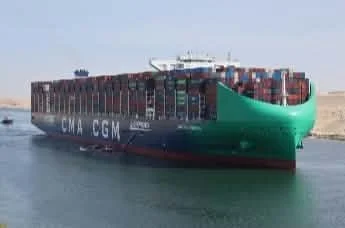
In April 2026, Maersk was the most reliable of the top 13 lines, with a schedule reliability of 76.1%. Hapag-Lloyd followed closely behind with 75.1%.
Q1 EBIT drops to USD 1.35bn in 2026 (so far)
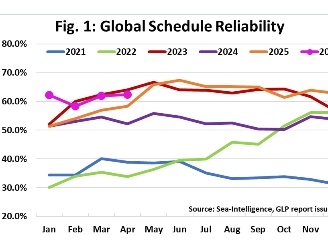
Sea-Intelligence has published issue 177 of the Global Liner Performance (GLP) report, which contains schedule reliability figures up to and including April 2026. As this 120-page report is very detailed, covering schedule reliability across 34 trade lanes and over 60 carriers, this press release will only highlight key points from the full report. In comparison with the preceding month, the worldwide container line reliability exhibited an augmentation of 0.4 percentage points in April 2026, attaining 62.4% — the zenith recorded that year thus far. This information was reported by Sea-Intelligence, an analyst.
Improved schedule reliability
Notably, in April 2026, global industry schedule reliability increased by 0.4 percentage points month-on-month (M/M) to reach 62.4%, marking the highest figure thus far in 2026. On a year-on-year basis, schedule reliability increased by 4.0 percentage points. Improved schedule reliability also led to a decrease in the average delay for late vessel arrivals, which fell by 0.27 days M/M to 5.34 days. However, on a year-on-year basis, the April 2026 figure was 0.31 days higher.
Maersk was the most reliable of the top 13 lines
Meanwhile, Maersk was the most reliable of the top 13 lines, achieving a schedule reliability score of 76.1% in April 2026. Hapag-Lloyd followed closely behind with 75.1%. Five lines were ranked in the 60–70% and 50–60% ranges, respectively. Wan Hai was the least reliable line with a schedule reliability score of just 39.6%. Five lines recorded a month-on-month improvement in schedule reliability in April 2026, while 11 of the 13 lines recorded a year-on-year improvement.
In March/April 2026,
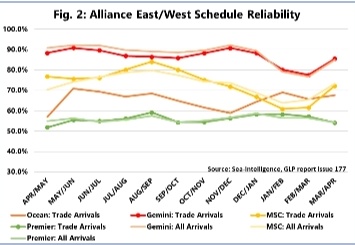
In March/April 2026, Gemini Cooperation recorded 85.0% schedule reliability across ALL arrivals and 85.6% across TRADE arrivals, followed by MSC at 73.4% for ALL arrivals and 72.3% for TRADE arrivals. Premier Alliance recorded 54.2% for ALL arrivals and 54.2% across TRADE arrivals as well. For the "old" alliances, "ALL arrivals" remain equal to "TRADE arrivals," and Ocean Alliance scored 67.6%.
Related: Sea-Intelligence : Global schedule reliability-March
Sea Intelligence explained that this distinction was necessary because "traditionally, alliance scores are based only on arrivals in destination regions. However, since this metric was not available for new alliances in February 2025, we introduced a new measure based on all arrivals, including stopovers in origin regions on East/West routes".
The financial and volume performance of the shipping lines
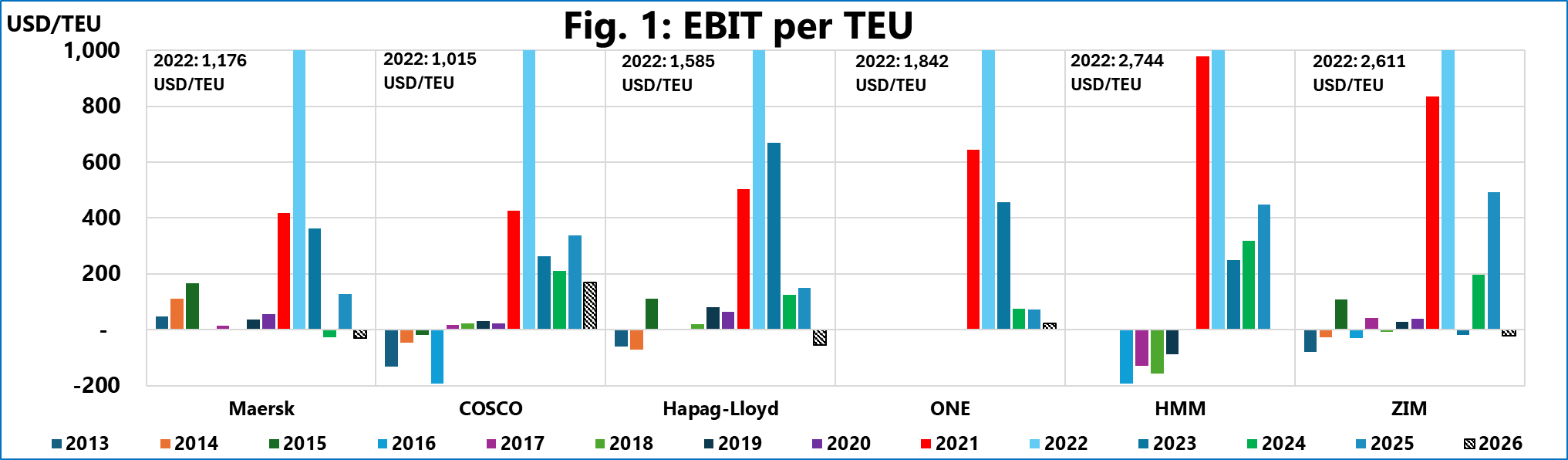
On the other hand, the analysis of the financial and volume performance of the shipping lines in Issue 766 of the Sea‑Intelligence Sunday Spotlight shows that 2026‑Q1 presents a challenging financial landscape. Across the shipping lines that have so far reported on their financial figures (minus HMM, who have not yet published its 2026‑Q1 EBIT, OOCL, who do not publish quarterly EBIT, and CMA CGM, who have stopped publicly publishing EBIT), a combined EBIT of USD 1.35bn was recorded, substantially lower than the USD 5.47bn EBIT of 2025‑Q1
#Sea Intelligence #Gemini Cooperation #March/April 2026 #Ocean Alliance # MSC# Premier Alliance# Maersk #Hapag-Lloyd#Wan Hai #Container liner punctuality # CMA CGM
You Might Also Like


Recommendation News

Marine Tech
ABS :Condition-Based Maintenance System from Samsung Heavy Industries Gets MART (MHM) Tier2 PDA 14 November 2025
Ports
SGP Breaks Ground on Dammam Integrated Logistics Zone and Unveils Terminal 2 Expansion 26 November 2025
Seafarers
ITF : Seafarers must be at the heart of shipping’s climate transition 29 October 2025
Incidents
Lifeboat Snaps Off Cruise Ship During Safety Drill 24 November 2025
Incidents
Tragic collision between a pilot boat and Calypso Yacht off the port of Livorno 25 February 2026