Saronic has been selected by the US Navy to advance to at-sea demonstrations under its MUSV Marketplace programme, and the companies that complete the at-sea testing phase will receive $15 million and become eligible for follow-on production.
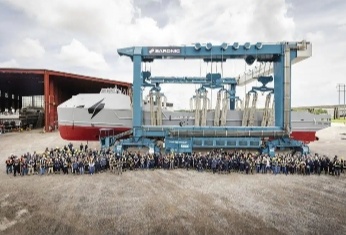
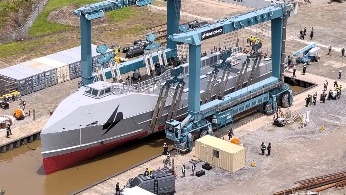
Saronic Technologies has announced the launch of its inaugural 180-foot Marauder medium unmanned surface vessel from its Franklin, Louisiana, shipyard. This significant achievement represents the successful transition of the autonomous vessel from initial design to on-water trials in a span of less than a year. The company, based in Austin, Texas, said that the Marauder is designed for long-range naval and commercial missions, and can operate either fully autonomously or under remote human supervision.
The first Marauder hull progressed from initial design to on-water trials in under a year — a feat unseen in American shipbuilding since World War II — thereby validating Saronic’s development approach and the integrated production model employed for its construction.
The vessel has a top speed of more than 25 knots and a range of up to 5,400 nautical miles. It can carry up to 150 metric tonnes of payload, including four 40-foot ISO containers, eight 20-foot ISO containers or other modular payload arrangements. The second hull is already being worked on, following its flip in March 2026. Construction of the third and fourth hulls is also underway.
Under its MUSV Marketplace programme,
Saronic has been selected by the US Navy to advance to at-sea demonstrations under its MUSV Marketplace programme, with the launch coming hot on the heels of this announcement. Companies that successfully complete the at-sea testing phase will receive $15 million and become eligible for follow-on production. The at-sea tests are scheduled to begin next month and be completed by October 2026.
The platform's potential applications, according to Saronic, include logistics, research, maritime domain awareness and persistent intelligence, surveillance and reconnaissance missions. Once the expansion of its Franklin shipyard is completed by the end of 2026, the company expects to be able to produce up to 20 Marauders per year
Revitalising American shipbuilding
“I’m incredibly proud of our team for achieving this milestone. The American shipbuilding industry hasn't seen anything like it in generations: designing, building, and launching an entire new class of ships in under a year," said Dino Mavrookas, Co-Founder and CEO of Saronic. 'It's what happens when design, production and manufacturing are fully integrated under one roof. With multiple hulls already underway and our shipyard continuing to grow, this is what revitalising American shipbuilding actually looks like: autonomous ships delivered at speed and scale, with the production capacity to back it up.”
Marauder: The future of naval and commercial operations
Marauder is designed for the kind of long-range missions that are the most demanding on any maritime vessel and the most dangerous for any crew. Designed to operate far from shore for extended periods without the additional stresses and complexities of supporting a full crew or putting them in harm’s way, Marauder can operate fully autonomously or under remote human supervision.
Marauder can sustain operations across vast ocean distances
Marauder can sustain operations across vast ocean distances thanks to its ability to reposition rapidly. It has a top speed of 25+ knots and a range of up to 5,400 nautical miles. Its 150-metric-tonne payload capacity can be configured to accommodate up to four 40-foot or eight 20-foot ISO containers, giving operators the flexibility to tailor the vessel’s mission load to meet their varied needs. These include logistics, research, maritime domain awareness, and persistent intelligence, surveillance and reconnaissance (ISR) operations, as well as other payloads, all without the need to modify the platform itself. It is vital that the vessel can adapt as mission requirements evolve, which is why modularity across applications is critical if we are to serve a broad base of customers.
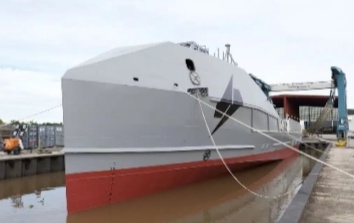
The core challenge of delivering persistent, autonomous capability at scale and on a timeline that allows for real fleet integration is addressed by Marauder. With its expanded capacity set to be completed by the end of 2026, Saronic’s Franklin shipyard will be able to produce up to 20 Marauders per year. This production rate will turn autonomous ships from a prototype into a programme
Saronic's Franklin, Louisiana, shipyard has been trialling a disciplined production approach, the result of which is the speed of Marauder's build. Rather than having separate design, manufacturing and autonomy development processes across different organisations and timelines, Saronic operates all three in-house. This enables tighter iteration, faster decision-making and improvements that build on each other for each hull. This is supported by a resilient supply chain and the strategic use of commercial components that enable rapid production.
Modern aluminium shipbuilding techniques form the basis of that approach. These include subassemblies designed for manufacturing speed, optimised production sequencing and modular construction methods. These allow the team to move quickly without sacrificing quality or repeatability.
Saronic completed its first Marauder hull in less than a year
The repercussions are already quantifiable. In a significant achievement, Saronic successfully completed the design and launch of its first Marauder hull in less than a year, significantly reducing the usual shipbuilding timelines. The development of the second hull is already 25 per cent ahead of schedule. The company expects to gain additional efficiencies as production increases.
This strategy is enabling Saronic to deliver expeditiously and on a substantial scale. The second Marauder hull was flipped over at the Franklin shipyard in March 2026. It is now being fitted out with mechanical, electrical and autonomy systems. Work on the third and fourth hulls is already underway. Each one demonstrates that Saronic’s production model is a repeatable system designed for building fleets rather than one-off prototypes.
Building new levels of intelligence, visibility and awareness into each Marauder
Saronic has developed a software-based fleet intelligence platform that gives operators human-in-the-loop visibility into the ship's internal autonomous operations in real time. This development has been undertaken alongside the development of Marauder's hardware. Marauder is a ship designed and built end-to-end for autonomy, making it the first of its kind. This means that every hardware component has a software interface for monitoring, observability and actuation.
Remote intervention
Telemetry, vessel state, and subsystem status are surfaced continuously by the platform, with alerting, logging, and historical data replay for diagnostics and forensics, and remote intervention in onboard autonomous processes is allowed by operators from anywhere. As the autonomy systems of the Marauder mature and the fleet grows, this intelligence platform will maintain transparency and auditability of that complexity, keeping it under operator control. It will also continue to evolve as mission demands dictate.
About: Saronic Technologies
Saronic Technologies is a defence technology company based in Texas that develops autonomous surface vessels for the US Navy and its allies. It designs and manufactures autonomous surface vessels (ASVs) and uncrewed boats for the US Navy and allied forces.
Source: Navy News
#Saronic Technologies #Marauder #American shipbuilding industry# Dino Mavrookas # Texas #Saronic's Franklin #US Navy#World War II #The first Marauder hull#Franklin shipyard
You Might Also Like

28 June 2026
Recommendation News

Marine Tech
Decisive Leadership Key to Success in a Maritime 5.0 World Says ABS Chairman and CEO 02 November 2025
Ports
CK Hutchison's move to MSC and Blackrock risks falling through 13 January 2026
Incidents
Oil tanker hit off Oman coast after drones strike Duqm port 01 March 2026
Marine News Room
Raul Villa Caro writes : longest-serving naval vessels 15 November 2025
Marine Tech
UK P&I Club and TT Club announce merger discussions 26 November 2025