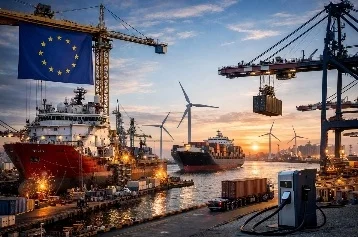
It will strengthen Europe’s industrial and technological sovereignty in the maritime sector, developing business cases to boost production at the EU’s manufacturing base and expand its presence in key markets.
The European Commission has called upon shipyards to join the new EU Industrial Maritime Value Chains Alliance. It has also called upon shipowners and institutions. It has called upon other public and private maritime sector stakeholders. Launched two days ago as part of the new EU maritime industrial strategy presented in March, the alliance aims to bring together participants in EU industrial and maritime value chains.
Europe’s industrial and technological sovereignty in the maritime sector
Ultimately, it will strengthen Europe’s industrial and technological sovereignty in the maritime sector across key markets. Specifically, the alliance will develop business cases to increase the production and market uptake of products and technologies that are relevant to the EU’s manufacturing base, and which meet the needs of the maritime transport, ports, and other industry sectors. The alliance will also promote targeted investments, public–private synergies, and industrial collaboration to encourage joint initiatives. Applications will be accepted on an ongoing basis, though an initial deadline has been set for 16 October 2026.
The new EU maritime industrial strategy
As previously mentioned, the initiative falls within the framework of the new EU maritime industrial strategy, launched by Brussels in March, which aims to preserve the sector's competitiveness as a 'fundamental element of Europe's security and strategic autonomy'.
The document acknowledges Europe's leading position.
The document acknowledges Europe's leading position in the production of highly sophisticated vessels, including naval ships, cruise ships and vessels for cable-laying and research. However, it also notes that in certain areas, such as ferries and support vessels for offshore wind farms, EU manufacturers are losing ground to their Asian counterparts.
Related: European Commission: Upgrade of the EU's energy infrastructure
Six priority areas
The initial phase will focus on six priority areas are: short-sea shipping, coastal and inland vessels, including dual-use vessels; special high-tech ships (icebreakers, tugboats, dredgers, research vessels, cable-layers, fisheries); ocean observation technologies, including drones and underwater robotics, to conquer 35% of the global market by 2035; net-zero emission technologies relevant to the maritime sector; manufacturing processes smart, circular and modular; maritime circularity, from ship recycling to the secondary metals supply chain.
The EMA alliance is divided into three bodie.s
The EMA alliance is divided into three bodies: a general assembly, convened at least once a year and composed of a representative of for each member organisation, which adopts opinions and recommendations; a Steering Board of up to 20 Representatives, chaired by the European Commission, which coordinates work and prepares assemblies; various thematic working groups, (market monitoring, financing, circularity) or dedicated to specific segments (ferries, inland navigation, ocean observation, wind propulsion). They can join as Member States, all public bodies of EU Member States and countries EEA-EFTA (Norway, Iceland, Liechtenstein), as well as active in the EU - companies, associations, NGOs, investors, research centres - that share the strategic objectives of the initiative. The Commission will evaluate the applications on a case-by-case basis by chance and may, for discussions on issues strategically more sensitive, reserve the participation of only for organisations not controlled by third-country entities.
The initiative provides for a first deadline set for 16 October
The call for expressions of interest in joining the initiative provides for a first deadline. This is set for the next 16 October. The alliance is set to last for the first three years, with the option to extend it by mutual consent. It will also contribute to the work of the High-Level Council on maritime industries and ports. This council was established by the European Commission as part of the Industrial Strategy, and will be chaired by the EU Commissioner for Maritime Affairs and the Executive Vice-Presidents. Its role will be to ensure a continuous exchange on the implementation of the actions outlined in the maritime industrial strategy and the EU port strategy, as well as to collect feedback on market development.
#European Commission #The EMA alliance #EU maritime industrial strategy #Brussels
You Might Also Like

Recommendation News
Marine News Room
Lloyd's seeks solution in Persian Gulf: "A thousand ships are at a standstill." 06 March 2026
Ports
Panama Canal Congestion Forces Gas Tankers Into Unusual Routes 30 August 2026
Shipping Lines
APM Terminals in Egypt celebrates 2.2 million TEU-expansion 19 November 2025
Marine Tech
EU : A new project to cybersecurity in the maritime and port sectors has been launched. 26 January 2026
Incidents
Estonian navy detains Russia-bound oil tanker in Baltic Sea 16 October 2025