
Raúl Villa Caro writes: Weddings at sea: myth or reality?
Article 51 of the current Civil Code, which governs this matter, does not allow a ship's captain to act as a competent authority for the solemnisation of civil marriages. However, a "small loophole" remains.
By: Raúl Villa Caro
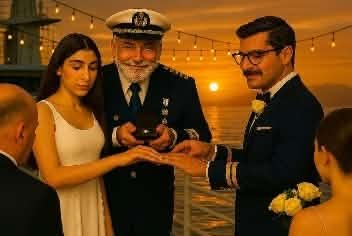
You have likely heard the legend that ship captains can perform weddings on the high seas, but is this a myth or reality? Let me state right away that—at least in Spain—it is a myth. This is especially true if we picture them as romantic ceremonies at sea, much like the ones we see in movies.
In our country, civil weddings may only be officiated by authorities such as mayors (or designated councilors), notaries, judicial officers, or diplomatic officials. However, Article 51 of the current Civil Code, which governs this matter, does not provide for a ship's captain to act as a competent authority for solemnizing civil marriages. Nevertheless, as we shall see later, a "small loophole" remains.
Article 52 of the Civil Code
Having noted the point made at the end of the previous paragraph, an exception must be added. Under Law 30/1981, which regulates marriage, Article 52 of the Civil Code provides for the possibility of a ship’s captain or commander solemnizing a marriage on board a vessel (or aircraft). However, this provision applies exclusively to cases where one of the parties to the marriage is in danger of death. It is, therefore, an exceptional scenario in which a prior marriage record is not required due to the urgency of the situation. Even if the danger of death arises from illness or physical condition, a medical opinion regarding the parties' capacity to give consent is still required.
A recognized legal reality,
Subsequently, the record must be forwarded to the Civil Registry to verify legal requirements and, where appropriate, register the marriage. Thus, while this is a recognized legal reality, its scope of application is very limited, as previously indicated. A separate category consists of "tourist weddings" performed on Spanish passenger cruise ships, where the captain officiates the union but it carries no legal effect. Marriages performed under foreign flags—where the applicable legislation does permit standard civil weddings on board—are a different matter entirely, as we shall see later.
Returning to the reference to the Civil Code, it should be noted that the possibility of a captain officiating a marriage did not arise “out of thin air” with the 1981 law; rules regarding civil registration and marriage under exceptional circumstances already existed prior to that.

Law 15/2015 on Voluntary Jurisdiction
This law significantly amended the provisions of our Civil Code. Many articles of the Civil Code were affected by this new reform. Among them is the current Article 51, which specifies the authorities empowered to solemnize marriages (those mentioned at the beginning of this article); notably, the captain of a ship is not included in this list. However, Article 52 of the Civil Code has not, in essence, been modified by Law 15/2015.
This article does permit marriages to be solemnized in cases of imminent danger of death, thereby preserving this extraordinary and urgent scenario. It continues to designate the captain or commander as the competent authority for marriages solemnized aboard ships or aircraft. This possibility is also provided for in Law 14/2014 on Maritime Navigation. Organic Law 1/2025 adjusts the civil authorities in light of judicial reform but does not alter the substance of the matter.

A unique case: marriage in combat
On 9 June 1982, Silvina Elisa Martínez entered into a marriage by proxy with René Marcelino Aguilar, a non-commissioned officer in the Marine Corps who was fighting in Puerto Argentino during the Falklands (Malvinas) conflict — right in the midst of the war with Great Britain. Conducted via legal representatives, the ceremony stands as the only marriage of this kind between Argentine citizens to take place during the war.
The story goes as follows
On 1 June, while handling twelve 30 mm artillery pieces and three surface-to-air missile launchers under constant naval artillery fire, Aguilar feared for his life. He spoke to his second-in-command, explaining that his girlfriend was pregnant and that he wanted to marry her so that their child would bear his surname at birth in case he did not return. Although holding the wedding seemed nearly impossible, on 9 June he was ordered to leave his position and travel to a nearby town. There, the governor himself — General Menéndez — was waiting to officiate the proxy marriage. Aguilar received a carton of cigarettes as a wedding gift.
Aguilar did not lose his life in the war.
As it turned out, Aguilar did not lose his life in the war. When the conflict ended and he returned to his hometown, however, the marriage certificate from Puerto Argentino had gone missing, and the authorities refused to recognise the union. He wanted to remarry, but this was not permitted as it was an unprecedented case. Ultimately, it took eight years to obtain the definitive certificate proving the marriage.
Related: Raúl Villa Caro writes: 'Classification Society (CSS) certifications on military vessels.'
What became of them?
They lived happily together until Silvina contracted the virus and passed away during the pandemic. For his part, Aguilar cherished every last memory of what it meant to get married amidst the horrors of war. He also passed away in February of this year, at the age of 67.
RESUMEN (Artículos en prensa)
Para leer artículo resumen publicado en el Diario de Ferrol el 07/07/26:
# Spanish passenger cruise #Aguilar #RAÚL VILLA CARO #Civil Code # Silvina Elisa # Law 15/2015 # Weddings at sea #myth #Reality #Article 51 #Malvinas
You Might Also Like


Recommendation News

Shipping Lines
COSCO SHIPPING Petroleum’s Investment in the New Construction of Two MR Tankers was approved 29 January 2026

Shipping Lines
Columbia Group appoints Ulla Eithz Nielsen to newly created Deputy COO role 12 February 2026

Incidents
Cargo Ship collides oil tanker off UK coast, causing fire disaster ( Photos + Video ) 16 October 2025