250-metre transport across a sea dike concludes 10 months of engineering; pontoon transport, SPMT operation, and jacking onto the final foundation all successfully concluded
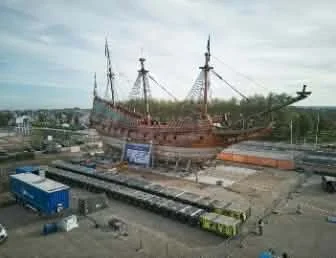
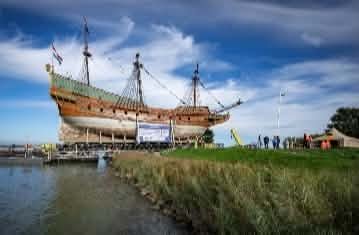
Wooden sailing vessel Batavia was successfully transported to and installed at its final resting place in Lelystad on Oct 2nd. The 1995-delivered, full-scale reconstruction of the 1628 Dutch East India Company ship had been prepared for its final voyage at Damen Shiprepair Amsterdam. It was transported on a specially built cradle, placed on a pontoon, and driven ashore at Museum Batavialand, Lelystad. Two SPMT trains of 28 axle lines each took the 646-tonne wooden ship and her 101.2-tonne cradle off a pontoon, up a purpose-built ramp, across the Markermeer dike and 250 metres onto the grounds of Museum Batavialand. The next day, the jacking system lowered her onto her permanent concrete foundation.
Q3 Heavy Lift assembled the two SPMT trains in Dordrecht and shipped them on a small pontoon to Amsterdam, where they drove onto the main pontoon and positioned themselves beneath the cradle. The axle count is driven not by weight but by stiffness requirements: 56 axle lines spread the load far enough along the cradle to keep it from deflecting under a vulnerable, 30+ years-old wooden hull that cannot tolerate being worked. The load paths were modelled in detail during ten months of engineering, which established where the Batavia is strong enough to carry support and how high each support point had to sit.
A 250-metre route surveyed metre by metre
The pontoon was trimmed to meet a prepared ramp, with load-spreading and crane mats laid to carry the trains across the dike footpath. The dike itself was the governing constraint, as the land behind it lies well below sea level. The technical partners closely collaborated with the Directorate-General for Public Works, the Water Authority Zuiderzeeland, the Province of Flevoland and the Municipality of Lelystad. The ramp was built deliberately long to keep the approach angle shallow and the ground pressure as even as possible. Q3 Heavy Lift set out the driving path in advance, including ground pressures, subsoil conditions and buried services. Lamp posts and street furniture along the route were removed and will be reinstated.
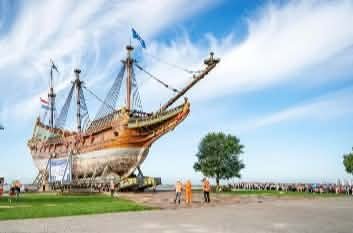
Coming off the pontoon, the trains made a turn and reversed the ship into position, again a maneuver preceded by soil investigation along the full route. "It is only 250 metres, but if you drive over a pipeline you didn't know was there, you have a problem," says Ard Suvaal, Project Manager at Trans Global Projects, which held project management, risk analysis, permitting and public safety for the operation. "That groundwork is what makes the difference on a job like this."
"We move large steel structures for a living - transformers, oil and gas, offshore. Usually, almost nobody sees those projects and it usually just inconveniences local people along the route. This time we have a reconstruction of a 17th-century VOC ship standing on the trailers, in full public view and with a lot of guests and media watching the operation. I am proud of that, and even more of how this team worked: all the partners put their calculations, ideas, second thoughts and solutions on the table and solved things together rather than waiting on each other."
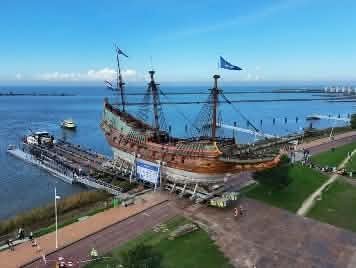
Eight metres higher than before
On her new position the Batavia stands more than 8 metres higher than at her old berth at the museum’s quayside, making her visible across the surrounding area. The move is intended to preserve the ship for the long term: ashore, the timber can dry, the hull is better protected from the weather and maintenance can be carried out properly. The Batavia will form the centrepiece of the redeveloped Museum Batavialand, due to open at the end of 2028.
Note for the editor:
· Additional financing needed: The museum plans to build a roof over the Batavia, so that the wooden ship is better protected against rainwater and the effects of the weather. The museum is sufficiently financed for the ship’s maintenance. However, for the vessel’s weatherproof shelter, the museum continues to search for sponsors and partners.
· Batavia dimensions: LOA 56.6 m, LBP 45.3 m, beam 10.5 m, air draught 30.5 m, draught 3.8 m,
· Built at Lelystad 1985–1995 under shipwright Willem Vos with more than 600 vocational trainees
· Cradle: 39.7 × 15.5 m, 87.2 t + 14t of wood
· SPMT: 2 trains × 28 axle lines = 56 axle lines (Q3 Heavy Lift), built up in Dordrecht
· Transport weight: approx. 646 t (hull, lead and remaining ballast removed) plus 101.2 t cradle
· Project partners: Museum Batavialand (owner); Trans Global Projects (project management, risk analysis); Damen Shiprepair Amsterdam (dry dock operations, setting the ship in the cradle); Koninklijke Van der Wees (towage, pontoon); FaraFlash (weighing, dimensional survey, conceptual cradle design); Kuperus & Gardenier (verification, advice on design and vulnerable areas); Q3 Heavy Lift (detailed cradle engineering, SPMT transport, roll-off, jacking, final placement); Anton Bouw- en Betontechniek (concrete foundation); Niron Staal (cradle fabrication); Halyard Risk (risk assessment o.b.o. the insurer)
· Commissioned by: Museum Batavialand, the Municipality of Lelystad, the Province of Flevoland and the Cultural Heritage Agency of the Netherlands
· All dates and times subject to weather and operational conditions
For more information:
Robert Waagmeester, Spokesperson, Museum Batavialand
T +31 6 83 49 08 23
E robert.waagmeester@batavialand.nl
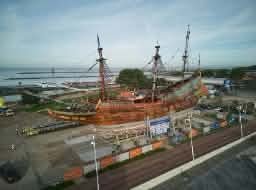
About Museum Batavialand
Museum Batavialand in Lelystad, the Netherlands, presents the history of Dutch land reclamation, water management and maritime heritage. Its collection includes the Batavia, built between 1985 and 1995 as a full-scale reconstruction of the 1628 VOC ship and visited by some five million people since construction began. The museum is being redeveloped to bring its shipyard, the Batavia, and its exhibitions onto a single site, and is scheduled to r
You Might Also Like

Recommendation News
Marine Tech
Global Bank Lending to Shipping Climbed Above $300bn 13 July 2026
Shipping Lines
Maersk and Hapag-Lloyd report an Asia-Mediterranean service via the Suez Canal 07 July 2026
Shipping Lines
Geodis unifies its brands: SEALOGIS and XP LOG become GEODIS 02 April 2026
Shipping Lines
RMB16.8bn :COSCO ordered capable new castlemax newbuilds emerge 15 January 2026
More
Courses : Notheast Maritime Institute /College of Maritime Science 13 February 2026