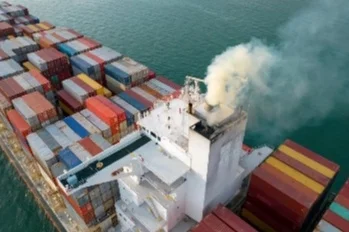
To achieve an agreement at the IMO, all Member States must engage constructively with each other and consider the full range of alternative proposals
WASHINGTON—This statement is made jointly by BIMCO, CLIA, IBIA, ICS, INTERCARGO, INTERFERRY, INTERTANKO, IPTA and WSC, representing the global commercial shipping fleet, in advance of the UN International Maritime Organization (IMO) Marine Environment Protection Committee (MEPC 85), which meets in London from 30 November to 4 December 2026.
The global shipping industry
The global shipping industry welcomes the ongoing efforts of all IMO Member States to agree on a global framework of practical, effective and purpose-fit regulations to help decarbonise international shipping. These efforts will further improve energy efficiency and help to achieve the goal of net-zero greenhouse gas (GHG) emissions by or close to 2050, as set out in the 2023 IMO GHG Strategy.
Related: IMO carbon plan could lift Panamax bill to €136,000 by 2030
Importance of an achievable, enforceable
While recognising that all government proposals and their constituent elements remain under consideration, the industry emphasises the importance of an achievable, enforceable and stable regulatory framework that reflects costs and availability, and provides clear incentives for the development and deployment of commercially viable alternative fuels. This framework must also meaningfully support a safe energy transition by providing data-driven, fuel- and technology-neutral solutions.
Shipping requires global rules that are applied equally to all ships
As a global industry, shipping requires global rules that are applied equally to all ships, regardless of their flag, ownership, trade, or business model. A coordinated global approach at the International Maritime Organization (IMO) is essential to avoid regulatory fragmentation, or regional or national measures resulting in duplicate compliance requirements for ships, or multiple charges for the same greenhouse gas (GHG) emissions. During the transition to lower-GHG fuels, only global regulation can ensure a level playing field.
The GHG reduction regulations
The GHG reduction regulations to be adopted by IMO Member States should reward verifiable emission reductions and incentivise further investments that advance maritime decarbonisation, whether through financial or technical means. Additionally, the regulations should provide optional/flexible compliance mechanisms to enable shipping companies of all sizes to manage the transition, recognising the current unavailability of commercially viable zero/near-zero GHG fuels and technologies (ZNZs) for the majority of the existing fleet.
Investment in the shipping industry
The shipping industry has invested billions of dollars in new ships that can use alternative, low-GHG fuels and innovative technologies. The regulatory framework must support credible transition pathways for existing ships and technologies. Continued industry investment and the effective implementation of these measures depend on global regulatory certainty, as well as the reliable, large-scale production of cost-effective alternative fuels.
Support the maritime energy transition
To support the maritime energy transition, shipowners and other maritime stakeholders — including marine fuel producers, charterers, ports and financiers — need investment certainty. An effective, globally agreed regulatory framework at the IMO is essential to provide clear, predictable production pathways for further emissions reductions. In order to drive decarbonisation across the shipping industry, support fleet renewal and financing decisions, and maintain a level playing field globally, this framework must be pragmatic and fit for purpose, and must be underpinned by clear, enforceable obligations. The industry’s global regulator, the IMO, needs to agree this framework as soon as practicable.
To achieve an agreement at the IMO
To achieve an agreement at the IMO, all Member States must engage constructively with each other and consider the full range of alternative proposals. This will help to identify areas of convergence and develop a global solution that considers strategic ambition, market readiness and technological readiness.
The shipping industry is committed to working constructively with all IMO Member States to finalise a meaningful and effective global regulatory framework, supported by the development of foundational technical guidance on issues such as fuel certification and greenhouse gas (GHG) lifecycle assessment. To ensure that this hard-to-abate sector is able to decarbonise as soon as possible through a safe and sustainable transition, it is essential that practical, enforceable and globally consistent solutions are advanced.
About CLIA
Cruise Lines International Association (CLIA) is the leading authority of the global cruise community. CLIA members and partners include the world’s most prestigious ocean, river, and specialty cruise lines; a business community of leading ports, destinations, shipyards and maritime product and service providers; and the largest network of travel professionals who specialise in cruise travel
Related: BIMCO adopts biofuel clause to support transition to low-carbon fuels
About BIMCO
BIMCO is the world's largest international shipping association, with 2,100 members in 120 countries, representing two-thirds of the world fleet by DWT. Its global membership includes shipowners, operators, managers, brokers, and agents. BIMCO is a non-profit organisation.
About IBIA
The International Bunker Industry Association (IBIA) is the voice of the global bunker industry and represents all stakeholders across the industry value chain. Its membership includes ship owners/operators, bunker suppliers, traders, brokers, barging companies, storage companies, surveyors, port authorities, credit reporting companies, lawyers, P&I clubs, equipment manufacturers, and marine consultants. Formed in 1993, IBIA has members in 70 countries.
About INTERCARGO
The International Association of Dry Cargo Shipowners (INTERCARGO) unites and promotes quality dry bulk shipping, bringing together more than 460 forward-thinking companies operating over 4,600 bulk carriers, from more than 35 countries. The Association provides the forum where dry bulk shipowners, managers and operators are informed about, discuss and share concerns and experience on key topics and challenges. The Association promotes its members’ positions at the IMO, the EU, as well as other shipping and international industry fora.
About INTERFERRY
INTERFERRY is the global ferry trade association with consultative status at the International Maritime Organization and similar influence at the European Union as well as many other maritime governance authorities. With membership exceeding 280 companies and representing more than 2,200 individuals in more than 40 countries, its primary purposes are to represent the ferry industry on regulatory and policy matters including safety and sustainability; to speak on behalf of the worldwide ferry sector which provides transport for over four billion passengers and 370 million vehicles annually; and to facilitate networking and communications among its members.
About ICS
The International Chamber of Shipping (ICS) is the principal global trade association for merchant shipowners and operators, representing all sectors and trades and over 80% of the world’s merchant fleet.
About INTERTANKO
INTERTANKO, the International Association of Independent Tanker Owners, has been the voice of independent tanker owners since 1970, ensuring that the liquid energy that keeps the world turning is shipped safely, responsibly and competitively. As of January 2026, the organisation has 191 Members, whose combined fleet comprises over 4,100 tankers totaling over 380 million dwt. INTERTANKO’s Associate Membership stands at some 236 companies and organizations related to the tanker industry.
About IPTA
IPTA was established in 1987 to represent the interests of the specialized chemical/parcel tanker fleet and has since developed into an internationally acknowledged representative body for shipowners operating IMO classified chemical/parcel tankers. IPTA is recognized as a focal point through which regulatory authorities and trade organizations may liaise with such owners.
About WSC
The World Shipping Council (WSC) is the united voice of liner shipping, the international container and vehicle carriers that support global trade. We work with policymakers and stakeholder groups to shape the future growth of a socially responsible, environmentally sustainable, safe, and secure shipping industry.
#BIMCO #WSC #IPTA #INTERTANKO #ICS #INTERFERRY #INTERCARGO #IBIA #CLIA # IMO Member States #shipping industry #(MEPC 85) #GHG reduction regulations
You Might Also Like

Recommendation News

Marine News Room
Sayed Abu Zaid writes: Eureka ship negotiations, piracy law, protection of seafarers 17 July 2026
Seafarers
Three Italian shipping companies will receive €1.9 million for seafarer training 10 February 2026
Incidents
Navigation suspended at the port of Genoa Pra' due to containers falling overboard 12 November 2025
Incidents
The Vast Coral oil tanker was detained in the port of Genoa. 22 March 2026
Incidents
Panama-flagged ATA 1 towed to safe anchorage after engine failure in Çanakkale Strait 09 December 2025