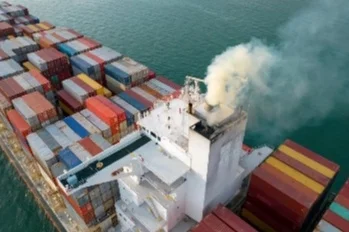
Reliable rail and maritime connections depend on coordinated services, workable border procedures, and information that remains usable across the route.
By Shota Gelashvili
https://www.linkedin.com/in/shota-gelashvili/
Founder & Business Architect, ARQITEQTURA GLOBAL | Formerly with Georgia’s Ministry of Finance and Revenue Service
My understanding of the Middle Corridor begins with the work of making separate processes function together. For 15 years in Georgia’s Ministry of Finance and Revenue Service environment, I was directly involved in developing, maintaining, and operating customs infrastructure and the technological systems supporting trade and transit.
I learned to look carefully at the connections between facilities, authorities, and transport operators. I have seen the ports ready, the railway ready, and the terminals ready, while cargo still waited for documents, a receiving operator, or a decision from another authority. Identifying the cause required following the shipment through the process and understanding what the next participant needed.
Two routes can have equally modern infrastructure and still perform very differently. Today, routes compete through the way they are managed. Physical capacity remains essential, and the organisation of the journey determines how effectively a company can use it.
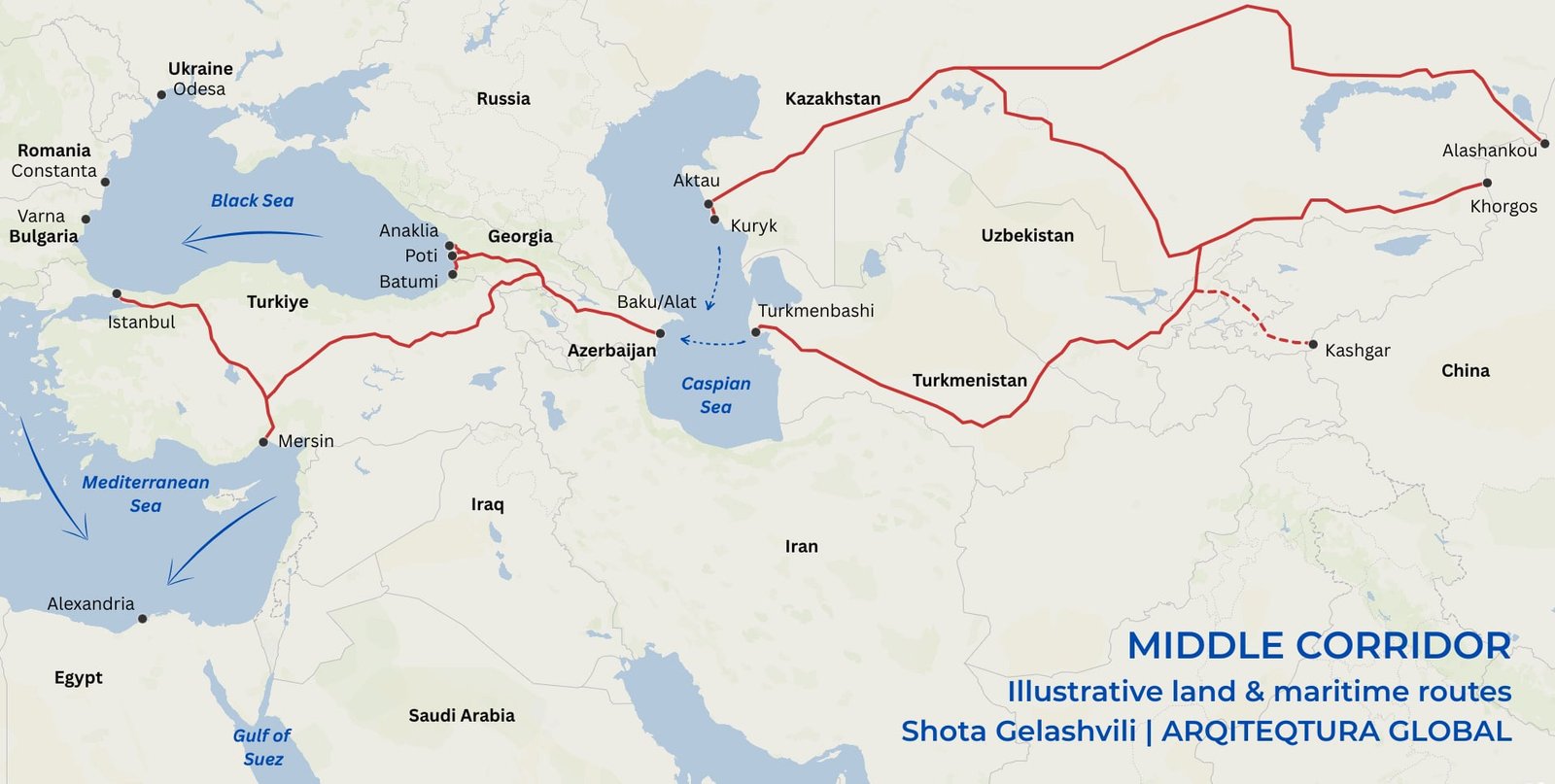
The Middle Corridor brings this problem into an international setting. It links China and Central Asia with the Caspian Sea, Azerbaijan, Georgia, Türkiye and European markets. Cargo can continue through Türkiye by land or through Georgia’s Black Sea ports by sea. Across these branches, shippers depend on several national systems and successive changes of transport mode.
By one operating system, I mean a route whose participants coordinate services and exchange usable information well enough to deliver a dependable shipment. Each authority retains its responsibilities, while each operator can prepare for the cargo it is about to receive.
China and Kazakhstan at the eastern end
Kazakhstan provides a major connection between China’s railway network and the Caspian, with freight moving toward Aktau and Kuryk. The port and vessel arrangements at the end of the rail journey determine when that cargo can continue to Azerbaijan.
China’s engagement is increasingly visible. On 22 September 2026, its Ministry of Transport hosted a high-level Trans-Caspian corridor meeting in Beijing. The ministry reported that the number of China–Europe freight trains using the Trans-Caspian route had risen by more than 60% year on year in the first seven months of 2026. Participants addressed capacity, regulatory coordination, transport efficiency and digitalisation.
Growth in train services increases the importance of the following maritime connection. Cargo arriving in larger or more frequent rail batches requires corresponding vessel space and terminal handling. Coordination needs to begin before the train reaches the coast, when there is still time to plan a workable connection.
The Caspian crossing and Azerbaijan
The Caspian is a critical operating section of the corridor. A rail itinerary must be matched with available shipping capacity, loading arrangements and the onward train on the opposite shore. Vessel availability, weather and port conditions can affect the connection.
Declining Caspian water levels are a regional concern recognised by the five littoral states. Water depth also needs to be considered when planning vessel loading and port access. At a November 2025 CASCA+ ministerial meeting, Uzbekistan’s Ministry of Transport reported reduced vessel loading and port queues, alongside ferry shortages and limitations on some rail and port sections. These concerns show why administrative reform and maritime investment need to advance together.
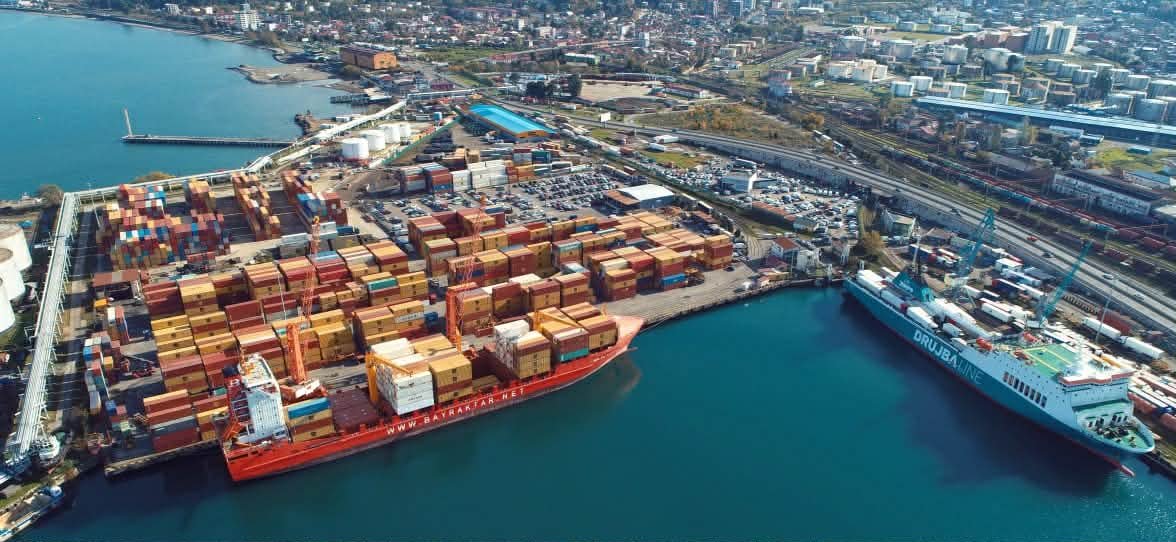
Azerbaijan connects the eastern maritime leg with the westward land route. The Port of Baku at Alat is a key point for receiving Caspian cargo and transferring it into the onward transport network. Arrivals from Kazakhstan and Turkmenistan need to connect with available handling and departures toward Georgia.
For the customer, responsibility at that transfer matters. If an arrival is late, someone needs to identify the affected onward connection, secure the next workable departure, and communicate the revised delivery expectation. A route becomes easier to use when that response is organised in advance.
This is particularly important for cargo continuing through a Georgian Black Sea port, where another maritime departure must be secured. Delay on the Caspian can therefore affect a sailing several transport stages later.
Wider Central Asian access through CASCA Plus
CASCA+ connects the railway administrations of Uzbekistan, Kyrgyzstan, Turkmenistan, Azerbaijan, Georgia and Türkiye in a framework for international multimodal transport. The route was established in December 2019, with Türkiye joining in December 2021. It gives Central Asian economies an additional organised connection toward the Caspian and westward markets.
Uzbekistan’s Ministry of Transport reported that the country’s export and import freight on CASCA+ reached approximately one million tonnes in 2024, five times the 2019 volume. Container block trains serving those flows increased from 25 to 83 over the same period. These figures describe Uzbekistan’s use of the framework.
The practical questions include how the rail and sea sections are priced together, how departures are coordinated, and how additional volume will be accommodated. A through tariff can make a quotation easier to understand; the service behind it must also account for transfer time and available capacity.
Documents that remain usable across borders
Information exchange is another part of the operating problem. Operators and authorities need shipment data in time to prepare their work. When the same information must be entered repeatedly into separate systems, errors and discrepancies can interrupt movement.
On 7 September 2026, TRACECA and UNECE held the 22nd international seminar on the digital multimodal Trans-Caspian corridor in Baku. The discussions addressed digital documents, regulatory convergence, and cybersecurity in data exchange.
The operational aim is to make data available in a form the next participant can use. Customs can prepare for a shipment before arrival, the port can plan handling, and the onward carrier can confirm the booking. That requires compatible data standards, agreed access rights, and procedures for correcting information when something changes.
Information has to move faster than the cargo. Advance data lets a port prepare for a train, and an onward carrier prepare for the maritime arrival. Legal recognition matters alongside technical compatibility: an electronically transmitted document must also be accepted for the relevant procedure in the next jurisdiction.
Related: Shota Gelashvili writes: Georgia’s Ports as Regional Trade Gateways
What the World Bank proposes
The World Bank’s September 2026 assessment estimates that targeted investment and better integration could more than triple trade volumes along the Trans-Caspian corridor and halve travel times by 2040. These are conditional projections.
The report proposes a single digital entry point for transport, transit and trade data, progress toward a Transport, Transit and Trade, or T3, digital document, and closer integration of rail and shipping operations. It also calls for stronger coordination to monitor performance and resolve bottlenecks.
This gives the operating-system idea a concrete institutional meaning. Investment decisions, service arrangements and administrative processes need to be organised around the shipment’s complete journey. A common digital entry point will help only when the organisations using it have workable agreements on their respective responsibilities.
Georgia where several systems meet
Georgia connects several westward options. Cargo arriving from Azerbaijan can move toward Poti and Batumi, continue through the Baku–Tbilisi–Kars railway, or enter inland logistics facilities for onward distribution and other commercial activity.
At Akhalkalaki, the 1520 mm regional railway network meets Türkiye’s 1435 mm standard gauge. The transfer arrangements and onward schedule influence the usefulness of the land route. Cargo moving toward the Black Sea instead depends on port access and a suitable vessel connection.
Anaklia’s first phase is scheduled for completion in 2029, with planned annual capacity of at least 600,000 TEU. That would add an option to Georgia’s maritime network, subject to completion and the services established there.
Georgia’s contribution is therefore closely tied to managing these choices. The appropriate route depends on the cargo, destination, cost, and delivery requirement. Operators need to know which connection they are preparing for and what happens if the shipment misses it.
What the shipper needs to buy
An international shipper buys a delivery promise: a price, a delivery expectation, and a level of certainty. That promise has to support a business decision. A fast advertised transit time has limited commercial value when arrival dates vary widely, or charges emerge during a transfer.
A practical corridor service should explain what the price covers, which departures support the schedule, who manages each handover, and how disruptions will be communicated. Clear arrangements for waiting costs, cargo responsibility and claims also matter to the companies choosing the route.
Performance should be measured across complete shipments. Border dwell time, missed connections and variation in delivery time help identify where reliability is being lost. Those measures allow participants to assess whether an investment or procedural change has improved the service.
From national systems to an international trade system
Railways create the route. Coordination turns it into trade. Across the Middle Corridor, that coordination has to connect the railway with ports, shipping services, and border procedures.
During my professional career, I worked within a system in which many separate processes had to function as one mechanism. That experience taught me to assess performance through the connections between them. A well-equipped facility delivers its full value when the next stage is prepared to receive the cargo and continue the movement.
The same principle applies between countries. If we integrate processes across borders as effectively as we organise them within national systems, the Middle Corridor can become a single operating system for international trade. This requires practical agreements on data, documents, service connections and responsibility, supported by continuing coordination when conditions change.
Related: Batumi Port Cargo Throughput Surges 13%, Reflecting Middle Corridor Trade Expansion
Reliable supply chains also create lasting commercial interests. Companies can invest in facilities, develop joint services and plan longer-term operations when they have confidence in the route. Transport connectivity then supports business activity around the corridor, giving its participants a stronger reason to maintain cooperation.
Georgia sits at a critical stage of that system, where cargo moving from China and Central Asia can reach the Black Sea. From its maritime gateways, those flows can connect with wider Black Sea and Mediterranean shipping networks toward Europe, Africa and global markets, according to the services and onward connections available.
I see Georgia’s role in making those connections commercially workable. Its ports, railway, customs environment and inland logistics need to support the delivery commitments businesses make across the complete route.
The future of the Middle Corridor will be determined by how effectively the countries and operators that share it learn to manage the system together. Georgia’s opportunity is to turn its place in that system into a dependable gateway for international trade.
#Shota Gelashvili #Middle Corridor#Georgian Black Sea port #Akhalkalaki # Azerbaijan #TRACECA #World Bank #Baku–Tbilisi–Kars railway
You Might Also Like
20 April 2026

Recommendation News


Yachts&Cruises
From Galveston : Royal Caribbean to Deploy Icon of the Seas in 2027 13 November 2025
Yachts&Cruises
Jazi Al Mehairbi makes history as first Emirati woman in SSL 47 yacht racing 19 January 2026
Ports
Los Angeles, Long Beach ports partnering for zero-emissions future 10 October 2025
Ports
DP World hits 221,200-TEU monthly record at Saudi Arabia’s Jeddah terminal 27 August 2026