The programme will now be divided into three timeframes. The first phase, which is currently planned to take place between 2026 and 2042
The Navy’s Shipyard Infrastructure Optimization Program (SIOP) will surpass $200 billion and take over 50 more years to execute, based on GAO’s analysis of Navy plans. ( the US Congressional oversight body, on the Shipyard Infrastructure Optimization Program.) Developing the plans and cost estimates to rebuild the Navy’s four public shipyards has taken the Navy years longer—and will cost much more—than originally anticipated due to multiple challenges and changes involved in the program. For example, environmental issues led to additional projects and more extensive work affecting project plans and costs at the shipyards, including Puget Sound Naval Shipyard
An oversight framework to guide SIOP plans
The Navy established an oversight framework to guide SIOP plans and decisions over the duration of the program. The framework includes tools and requirements typically used for major defense acquisition programs—like for missiles, aircraft, or ships. However, the Navy has not outlined steps in the framework to reevaluate program objectives and resources as the program progresses over the next several decades. Without building such reviews into key future decision points, the Navy is limiting its ability to ensure that capabilities in SIOP’s plans today continue to be aligned or adjusted to support future fleet warfighting needs.
The program was launched in 2018 with an estimated cost of at least $21 billion and a duration of approximately 20 years. The goal was to address the infrastructure of Norfolk, Pearl Harbor, Portsmouth, and Puget Sound, which was now significantly obsolete and lacking in capacity.
The Navy provides Congress with reports and briefings on various aspects of SIOP
Further, while the Navy provides Congress with reports and briefings on various aspects of SIOP, the Navy does not provide Congress with consolidated, standardized information on full program costs and risks because there is no requirement to do so. In contrast, major defense acquisitions are required to provide annual program status reports with detailed metrics, including total costs to date, cost and schedule baselines, and risks, to track and monitor progress. Without a full picture of how much has been spent, what remains to be funded, and what risks may affect SIOP progress, Congress could make consequential decisions for SIOP based on incomplete information, thus risking billions in taxpayer dollars and a lack of program oversight for the decades to come.
Created several organizations to manage SIOP projects and challenges
Finally, the Navy created several organizations to manage SIOP projects and challenges. For example, the Navy created organizations for project oversight and program integration teams to coordinate issues with shipyards. However, the Navy has not fully documented the organizations’ roles and responsibilities. Doing so would formalize their new SIOP roles and help to ensure not only their ability to effectively implement SIOP’s essential projects but also the continuity of the critical shipyard operations to maintain and modernize the U.S. naval fleet now and throughout SIOP’s extended timeline.
The four shipyards
The four shipyards play a vital role in the maintenance and modernization of the U.S. Navy's aircraft carriers and nuclear-powered submarines. The program includes the renovation of dry docks, piers, and facilities, as well as the modernization of electrical networks and technical services, transportation infrastructure, and equipment.
The case of Portsmouth
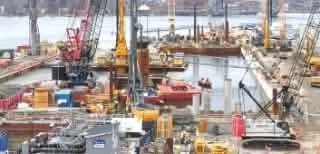
One of the most complex aspects is the need to carry out the work while keeping the shipyards operational. The case of Portsmouth is illustrative: the expansion of a dock is being completed while the site continues to be used for maintenance of Virginia-class submarines. The overlap between construction activities and naval operations increases logistical complexity and can impact time and costs.
Related: Magdy Sadek : American Gorilla Wrestling the Chinese Dragon’
The three major new docks
The three major new docks planned in Portsmouth, Pearl Harbor, and Puget Sound alone represent an estimated investment of approximately $21.7 billion. A new dock is also planned in Puget Sound to accommodate Virginia-class submarines and Ford-class aircraft carriers. The project includes demolition, relocation of existing facilities, and new infrastructure.
The programme will be divided into three timeframes
The programme will now be divided into three timeframes. The first phase, which is currently planned to take place between 2026 and 2042, will focus on the most advanced design interventions, including docks and piers. Subsequent phases will span several decades. The final planned interventions are not expected to be completed before 2080.
According to the GAO, the programme's exceptional duration necessitates a more structured oversight system. The agency recommended that the Navy conduct regular reviews of costs, risks, performance, and future requirements, enabling adjustments to be made to the programme based on the evolution of the fleet and operational needs.
The revised plan also illustrates the complexity of addressing strategic industrial infrastructure that remains fully operational. The challenge for the US Navy is not just the construction of new docks and facilities, but also the gradual rebuilding of the industrial capacity needed to sustain the fleet for decades to come
.# Portsmouth #Pearl Harbor #Puget Sound #GAO # U.S. naval fleet #SIOP projects #Norfolk #shipyards #Puget Sound Naval Shipyard
You Might Also Like

10 December 2025

Recommendation News
Ports
IMO : Advancing digitalization in the port of Dar es Salaam 29 March 2026
Marine News Room
Maksim Barodzka writes : New GNSS Interference Report Released 29 November 2025
Shipping Lines
CMA CGM expands rail network linking Adriatic ports to Central Europe 11 November 2025
Incidents
IMB : Maritime piracy to increase in 2025 18 October 2025
Marine Tech
BIMCO adopts FuelEU Maritime and ETS clauses for ship sale contracts 13 December 2025