DFC stated that it will collaborate with insurance partners to determine jointly which vessels are eligible for reinsurance.
The commitment of the United States to provide reinsurance for ships transiting the Strait of Hormuz has been doubled to $40 billion and new insurance partners have been added, including American International Group and Berkshire Hathaway. Last month, the U.S. International Development Finance Corporation (DFC) announced a $20 billion reinsurance plan. The agency stated that Travelers Insurance, Liberty Mutual Insurance, Berkshire Hathaway, American International Group, Starr and CNA, as well as Chubb Insurance, would provide an additional $20 billion to support its maritime facilities.
Terms and conditions for ship insurance procedures.
In a statement, Adam Boehler, CEO of DFC, said: 'These leading US insurers have extensive experience in marine insurance and war risk, which will enhance our efforts to restore confidence in maritime commerce.' The agency also stated that it will collaborate with insurance partners to determine jointly which vessels are eligible for reinsurance. Applicants must provide information including the vessel's departure and destination, the primary beneficiary and its location, the cargo owner and its location, and details of the financier providing financing for the vessel.
Related : A $20 billion US DFC plan for maritime reinsurance in the Gulf has been announced.
The insurance gap
However, American media outlets emphasise that, to date, there is little evidence that this insurance structure, which is intended to protect maritime traffic, is actually being used. According to industry sources, there have been no confirmed sign-ups for the DFC-supported insurance programme so far. One of the main reasons for this is that the insurance gap that the programme was designed to fill has, at least partially, been filled. Despite being significantly more expensive, war risk coverage has returned to the market on a voyage basis, enabling shipowners to obtain insurance independently of federal support. More than a month after the start of the war in Iran, ship operators appear to be more concerned about the physical risk to their vessels than about financial or insurance coverage.
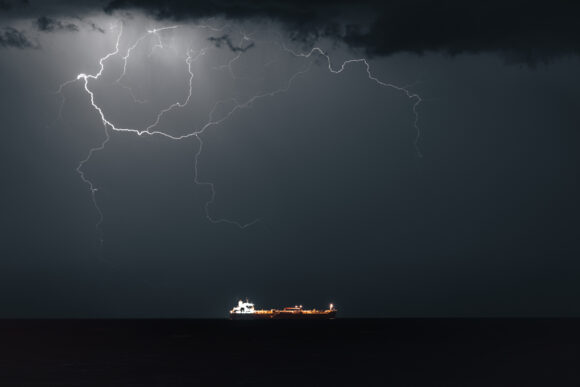
Photograph: Lightning occurs while an oil products tanker sails into Muscat Anchorage on March 21, 2026 at Sultan Qaboos Port in Muscat, Oman. (Photo by Elke Scholiers/Getty Images)
Decision-making
Decision-making continues to be impacted by missile and drone attacks, electronic interference and unpredictable transit conditions, with many shipowners reluctant to expose their crews and vessels to high risks, even when insured. The lack of naval escorts has further exacerbated this situation. Although US officials have suggested the possibility of providing military support, no escort programme has yet been established, leaving commercial vessels to independently assess the risk environment. Without significant improvements in security conditions or the introduction of naval escorts, shipowners may continue to be sidelined, regardless of the insurance capacity offered
Related : Global insurance companies have Cancelled covering war risks in the Gulf,
Decrease in the number of ships passing through Hormuz
.The number of ships passing through the Strait of Hormuz has fallen dramatically compared to normal levels. Before the crisis, there were about 120–130 ships per day, but during this period, the number has dropped to less than 10 (-90–95%). On some days, very few ships transit, and these are almost always bound for Iran or 'neutral' countries. While traffic is not completely halted, it is effectively controlled and limited.
The strait has been navigated by a number of vessels, including oil tankers, LNG tankers, and container ships from India, Japan, France, and Oman
Insurance rates will only fall
However, Bob McNally, president of the Washington-based consultancy firm Rapidan Energy Group, told Bloomberg News that insurance rates will only fall and commercial operators will only be willing to insure and send cargoes through the Strait after Iran's military capabilities have been degraded.
About : DFC
U.S. International Development Finance Corporation (DFC) is the U.S. Government's development finance institution. DFC partners with the private sector to finance solutions to the most critical challenges facing the developing world today. DFC invests in projects that create jobs in emerging markets in sectors including energy, healthcare, critical infrastructure, telecommunications and financing for small businesses and women entrepreneurs. DFC investments adhere to high standards and respect the environment, human rights and worker rights.
source : Shipping Italy + Agencies
#United States #insurance rates #DFC #Strait of Hormuz #Bob McNally #Bloomberg #Rapidan Energy Group # Adam Boehler #insurance guarantee
You Might Also Like

Recommendation News
Marine Tech
US Marines join the war against Iran to clear the Strait of Hormuz of planted mines. 16 March 2026
Marine Tech
Canadian Coast Guard’s Offshore Oceanographic Science Vessel 10 May 2026
Ports
Port of Fujairah Resumes Oil Loadings After Drone Attack 15 March 2026
Shipping Lines
Xeneta 's report this week update shipping rates 14 February 2026
Shipping Lines
Hapag-Lloyd uses StormGeo systems for FuelEU Maritime 05 June 2026