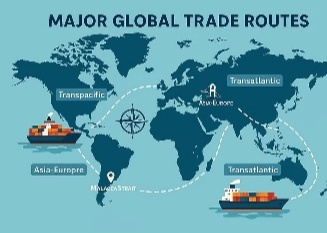
The latest PLSCI data, when taken together, show that carriers are no longer simply reacting to crisis conditions, emphasizing "a definitive network recalibration"
A recent and grave report, observed by numerous concerned organizations and bodies, has exposed a significant shift in Straits hub connectivity, as container lines have reduced their operations. In this context, the 2026 Q2 Port Liner Shipping Connectivity Index reveals carriers' strategic realignment of capacity, with a shift towards regional relay ports and selected export gateways, and a concurrent reduction in routes previously centred around major transshipment hubs. Meanwhile, container shipping networks around the world are changing. The largest hubs in Asia are being used less by carriers, who are instead using secondary regional gateways. According to UNCTAD, container lines are reducing connectivity at the Straits' largest transshipment hubs, as changes to the network made during the crisis become a more permanent operating model.
The crises in the Red Sea and the Strait of Hormuz
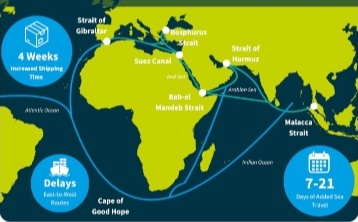
It also shows that the network adjustments triggered by the crises in the Red Sea and the Strait of Hormuz have now solidified into long-term operating baselines. Emergency rerouting has evolved into a decisive shift in how carriers design and deploy their global service structures, with connectivity increasingly being redistributed away from traditional mega hubs towards a more dispersed regional architecture
The SeaIntelligence consultancy index
The index, compiled by the consultancy SeaIntelligence, provides a single score reflecting a port's strength of connection to the global container network by measuring the number of services, shipping lines, vessel sizes, direct connections, and sailing frequencies linking it to other ports.
The situation in the Middle East
The Middle East remains the most visible catalyst. Rather than being fully restored, connectivity patterns are being rebuilt around specific nodes as carriers navigate prolonged instability in the Red Sea and Middle East Gulf corridors. For example, Jeddah posted a 14.9% increase in its container connectivity score for the latest quarter, while UAE ports such as Khor Fakkan and Sharjah recorded sharp gains as carriers sought secure alternatives outside of zones under immediate threat. Fujairah, which had not been included in the index for some time, re-entered the PLSCI as lines used the UAE port as a temporary waypoint to ensure cargo coverage in the MEG. This meant that specialized hubs were temporarily repurposed as ad-hoc relay points.
The absorption in East Africa
The absorption in East Africa has been more uneven. While Djibouti and Dar es Salaam in Tanzania have attracted diverted volumes, connectivity in Mombasa, Kenya, has stalled after peaking in late 2025. This highlights the highly localized nature of the spillover.
A similar pattern is found in the Indian subcontinent
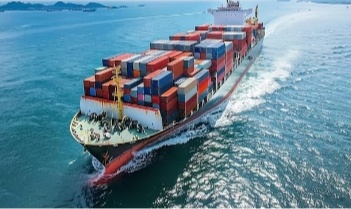
A similar pattern is emerging across the Indian subcontinent that is comparable to patterns that have emerged in other regions. Major hubs such as Mundra, Nhava Sheva/Jawaharlal Nehru Port and Colombo have experienced reduced connectivity, with carriers responding to the latest escalation in the Strait of Hormuz by dispersing volumes to secondary gateways. Instead, volumes are being dispersed to secondary Indian gateways such as Pipavav, Ennore, Hazira and Visakhapatnam. All of these gateways posted strong quarter-on-quarter gains. This indicates that carriers are circumventing overloaded primary nodes in favour of a more extensive domestic network that can accommodate relay cargo more adaptably.
The decentralization trend is now evident across the Straits.
SeaIntelligence has stated that this decentralization trend is now evident across the Straits. Singapore, which experienced a peak at the end of 2025, has seen a slight decline in its 2Q26 PLSCI score. Port Klang fell by 5% over the same period and Tanjung Pelepas by 7.1%, as carriers removed redundant routes and rebalanced networks following two years of crisis-driven surges. However, even China’s largest gateways are losing connectivity. SeaIntelligence noted that Shanghai and Ningbo posted declines of 2% and 2.2% respectively.
As shipping lines reallocate capacity
As shipping lines reallocate capacity to support this manufacturing diversification, the resulting gains within these alternative markets are highly uneven," SeaIntelligence noted. Take Ho Chi Minh, for example, where connectivity has plateaued despite Vietnam's manufacturing boom. In contrast, Haiphong has surged past it, gaining 5.1% in the latest quarter alone."Its geographic proximity to South China's manufacturing clusters translates directly into cross-border supply chain integration, making it the primary maritime beneficiary of new service strings," SeaIntelligence said. A similar level of resilience is shown by Thailand's Laem Chabang, with its long-term baseline being expanded and an addition of 4% being made quarter on quarter. Indonesia’s data meanwhile shows a bifurcated pattern.
Related: Saadé (CMA CGM): “Hormuz is an ongoing crisis. Prepare for alternative routes.”
A clear distinction between domestic corridors and ecosystems
SeaIntelligence said that this highlights 'a clear distinction between domestic manufacturing corridors and regional feeder ecosystems'. Semarang, which serves Central Java’s industrial corridor, has grown by 46.6% in the long term, while Batam, which has been integrated into short-sea feeder networks, has seen its index score surge by more than 300% from its baseline
Penang offers a stark counterpoint
Penang, however, offers a stark counterpoint. Despite significant investment in manufacturing, SeaIntelligence explained that its connectivity has contracted by 18.2% as carriers reduce the number of ports per string, pushing its export volumes into feeder networks rather than mainline calls.
A definitive network recalibration
The latest PLSCI data, when taken together, shows that carriers are no longer simply reacting to crisis conditions, emphasizing "a definitive network recalibration".SeaIntelligence stated that as primary transshipment nodes reach their connectivity limits, shipping lines are actively reducing excess capacity at mega-hubs in favour of secondary regional relays and specific gateways that directly support cross-border supply chain diversification
#PLSCI data #SeaIntelligence #Penang,#Port Liner Shipping Connectivity Index #UNCTAD #Strairs #Middle East #Red Sea #Strait of Hormuz
You Might Also Like

15 October 2025

26 November 2025
Recommendation News

Marine News Room
Exclusive -Capt.Abdel-Galil :Reintegrate Syria into the global maritime community 2026 13 December 2025
Marine News Room
The Crucial Role of the Suez Canal from an American Perspective 21 October 2025
Shipping Lines
Floating container terminal: DNV approves in principle for new Swedish project 10 November 2025
More
EU fishing fleet’s size shrinks, struggles with resource imbalances 29 April 2026
Incidents
US Coast Guard, Navy Seize Nearly 1,300 Pounds of Cocaine 18 October 2025