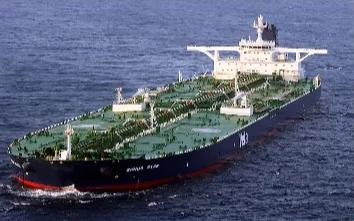
A new VLCC costs around $130 million; brokers estimate the value of a second-hand vessel at between $135 million and $170 million.
Around 60 VLCCs are due for delivery in 2027; close to 130 in 2028; and more than 120 in 2029
The second-hand oil tanker market has reached record levels, with large vessels causing a surge in prices not seen since 2008. Geopolitical tensions are primarily responsible for bolstering the sector, as they are altering crude oil trade routes and significantly increasing the distances ships must travel. A prime example is the 15-year-old VLCC Olympic Leopard, which was recently purchased by Adnoc L&S for $115 million. This price is a record for a VLCC of that age, and is only 10% less than the cost of a newbuild in China today.
The second-hand market
The second-hand market is so strong that immediately available vessels are fetching higher prices than new-builds. While a new VLCC costs around $130 million, brokers estimate the value of a second-hand vessel at between $135 million and $170 million. The same trend can be seen in the Suezmax segment, where a five-year-old vessel is valued at around $110 million, compared to the $90 million needed to build a new one.
Adnoc is one of the most active players in the market
Adnoc is one of the most active players in the market. It has launched a $1.3 billion acquisition programme for Very Large Crude Carriers (VLCCs) and large gas carriers. The objective is to augment the volume of exports handled directly — including through the Fujairah terminal connected to the West-East pipeline, which facilitates circumventing the Strait of Hormuz and is scheduled to witness a twofold increase in capacity beginning in 2027.
The Athens-based United Overseas Group
The Athens-based United Overseas Group, which is controlled by Peter Georgiopoulos and Leo Vrondissis, has ordered six VLCCs with an option for a further four from Wison New Energies. Meanwhile, Emanuele Lauro's Scorpio Tankers has taken a stake in a joint venture that recently ordered eight VLCCs. And the list goes on.
Maritime Strategies International's statistics
Maritime Strategies International's statistics show that around 60 VLCCs are due for delivery in 2027; close to 130 in 2028; and more than 120 in 2029. Poten & Partners' recent analysis noted the recent decline in OPEC's influence over tanker trades. The company stated that recent hostilities in the Middle East have created a powerful incentive for growth in non-OPEC production.
Crude oil production in Canada, the US, and South America.
Concurrently, the production of crude oil in Canada, the US, and South America – encompassing Guyana, Brazil, and Argentina – has undergone a substantial expansion over the past decade. The US remains a key exporter – new trans-Pacific business is being underwritten by Canada's Trans Mountain trade, one FPSO is being commissioned after another in Guyana, and offshore output is being expanded in Brazil.
Related: Greek tanker manager Maran takes fourth of eight LNG dual-fuel Suezmaxes
OPEC will face a challenge in the future.
.However, Poten & Partners contends that market strength is not solely driven by current tensions. The global map of crude oil production is changing, with non-OPEC countries becoming more and more important. Over the past decade, production in the United States, Canada, and South America has increased substantially. The US remains a major exporter, Canada is developing new trans-Pacific trade routes via the Trans Mountain pipeline, and both Guyana and Brazil are rapidly ramping up offshore production
The surge in values can be attributed to the increase in tonne-miles.
The increase in tonne-miles is the main driver of this surge in values. Crude oil is being forced to travel much greater distances because of conflicts and supply chain fragmentation. This has also led to an increase in orders for new VLCCs and Suezmaxes. Dynacom, for example, has ordered 20 VLCCs and nine Suezmaxes in China, and other operators have also announced further orders. According to Maritime Strategies International, around 60 VLCCs are scheduled for delivery in 2027, almost 130 in 2028, and over 120 in 2029.
Asian markets,
A significant portion of these extra volumes is earmarked for export, especially to Asian markets, thereby driving up demand for large oil tankers. According to Poten, OPEC could also face a structural challenge from the growing importance of the Americas, as Asian buyers seek to diversify their supply sources by favouring regions considered more stable than the Middle East.
#Poten & Partners #Asian markets#secondhand tanker market #Wison New Energies# FPSO #OPIC#VLCC #Canada#US #South America #Suezmaxes #Argentina#Adnoc L&S #Athens
You Might Also Like

Recommendation News
Shipping Lines
“K” LINE Newbuilding LNG Vessel for Toho Gas Named TOHO EMERALD 18 September 2026
Incidents
Captain of Scot Bremen Catches Five Crew Smuggling Drugs 17 October 2025
Marine News Room
Pablo Rodas-Martini writes : A penguin and (ALS) system 27 October 2025
Marine Tech
OEG Takes Delivery of CTV Fulmar for Scottish Offshore Wind 04 March 2026
Seafarers
ITF condemns forced disembarkation of fishers being held in Bushehr, Iran. 13 November 2025