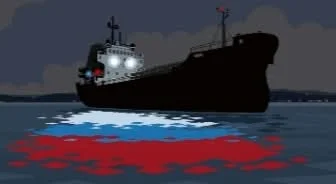
The Treasury Department's Office of Foreign Assets Control (OFAC) may review individual vessel purchases and the subsequent commercial reintegration of these vessels.
The U.S. government is setting up a system that will allow some oil tankers from the so-called 'shadow fleet' to return to the regular shipping market. These tankers were previously used to transport crude oil in trades affected by international sanctions. The initiative was confirmed by Energy Secretary Chris Wright, who spoke at a Citadel Securities event in New York on Monday, October 19. According to Mr Wright, some investors have offered to purchase ships idled by sanctions, restore them to operational condition, and use them to transport oil that is not subject to U.S. restrictions.
Moving some ships from the bad guys' fleet to the good guys' fleet,
"We will be moving some ships from what I call the bad guys' fleet to the good guys' fleet," the secretary stated, specifying that these vessels will no longer carry sanctioned crude oil. Washington, therefore, does not intend to present the initiative as a general lifting of punitive measures against Russia and Iran, but rather as a path to returning certain ships to recognized ownership and management.
Related: Magdy Sadek: Map of shadow financial networks for shipping
The project is part of a search for solutions to increase the availability of oil tankers at a time of severe tension in the energy transport market, exacerbated by the crisis in the Strait of Hormuz and the surge in insurance costs related to war risk. On October 15, Reuters reported that the United States was evaluating the possibility of authorizing, on a case-by-case basis, the use of previously sanctioned vessels to transport legal cargoes.
The subsequent commercial reintegration of these vessels.
Bloomberg reports that the Treasury Department's Office of Foreign Assets Control (OFAC) may review individual vessel purchases and their subsequent commercial reintegration. However, any authorisation would not automatically allow the transport of Russian or Iranian oil, which is still subject to U.S. restrictions.
Kpler: only 24 could realistically be eligible for a return to conventional trade,
However, the full extent of the operation remains uncertain. Kpler estimates that only 24 of the approximately 160 supertankers sanctioned by OFAC could realistically return to conventional trade, given the vessels' age and ownership constraints. According to estimates reported by Splash247, Braemar further narrows the potential pool to 19 VLCCs once vessels affected by European sanctions and restrictions related to Iran are excluded.
Significant obstacles
It is important to note that simply changing ownership or obtaining US authorisation does not make an oil tanker immediately available for international use. Significant obstacles include technical conditions, maintenance, inspection documentation, insurance coverage, and access to compliant maritime services. Sanctions imposed by the European Union and the United Kingdom also present an additional challenge for vessels affected by these jurisdictions' restrictive measures.
A warning from Intertanko regarding safety issues.
The issue of safety is yet another problem to add to the list. Intertanko, the international association of oil tanker owners, has warned of the risks associated with salvaging vessels with opaque maintenance histories and inadequate insurance coverage. The association argues that any increase in capacity should prioritise the fleet that already complies with international standards.
This initiative was taken by the US administration despite it being found that at least 14 Shadow Fleet vessels — ships sailing under false flags to skirt sanctions — had been seized, detained or boarded by U.S., Indian and European Union authorities since December 2025. According to marine traffic data,
The impact on freight rates could prove limited.
The impact on freight rates could also be limited. Many of the sanctioned tankers are already being used for unconventional trades, and transit difficulties in the Gulf region, as well as war risk insurance premiums, are impacting actual cargo capacity. Kpler itself has warned that easing restrictions could offer limited commercial benefits while reducing the geopolitical leverage represented by sanctions.
The aim of the American initiative
The US administration took this initiative even though, according to marine traffic data, at least 14 Shadow Fleet vessels — ships sailing under false flags to skirt sanctions — had been seized, detained, or boarded by US, Indian, and European Union authorities since December 2025. However, the American initiative therefore aims to recover a share of existing capacity without waiting for new constructions, but the number of ships that can actually be reintegrated and the time needed to bring them back to the market remain to be verified.
Source : Agencies
#US administration # Shadw Fleet #The initiative #Kpler #OFAC#Rusiian oil tankers # Chris Wright#Strait of Hormuz#Gulf region #Intertanko,
You Might Also Like

24 November 2025
27 December 2025
Recommendation News

Marine Tech
N-Sea starts construction on the offshore support vessel Dominus. 11 March 2026
Ports
Port Houston reports a 2% TEU growth as the Bayport berth 20 March 2026
Incidents
Report: South Korean vessel HMM Namu on Fire in the Strait of Hormuz 11 May 2026
Shipping Lines
Latin America is facing a new logistics era 26 May 2026
Marine Cultures
"The Storm over Evpatoria” oil painting by Ivan Aivazovsky 29 October 2025