The increased destabilisation of liner services has negative knock-on effects for both cargo owners and maritime infrastructure
Cancelled sailings, services initiated and terminated, vessels postponing port arrivals by more than a week, and supplementary calls. Overall, irregularities in container shipping have increased significantly since the pandemic. Further confirmation of this comes from an analysis by Sea Intelligence, which found that services from Asia to Europe were the most unstable.
The standard deviation in the number of services offered per week
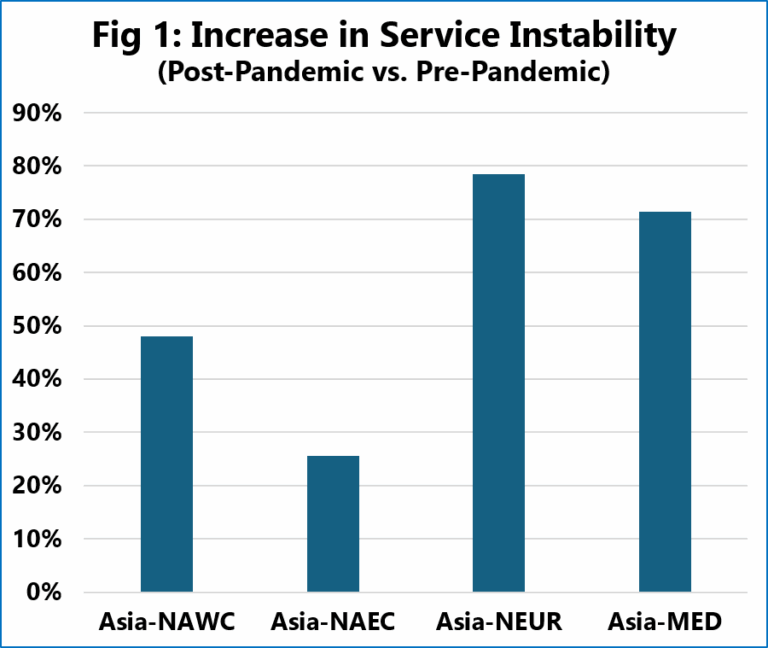
'Sea Intelligence's consideration of the standard deviation in the number of services offered per week (compared to the average of the same weekly services, thus obtaining a coefficient of variation) was for the purpose of doing so. When the post-pandemic data (i.e., the years from 2020 to 2026) was compared with the pre-pandemic data (the years between 2013 and 2019), exports from Asia increased on all routes. Specifically, instability increased by 26% towards the East Coast of the US and by 48% towards the West Coast. Even greater increases were seen in connections from Asia to the Mediterranean (+71%) and to Northern Europe (+78%).
Related: Sea-Intelligence: Container liner punctuality at its highest in April
The constant weekly fluctuations
Sea Intelligence commented on these data, noting: 'The increased destabilisation of liner services has negative knock-on effects for both cargo owners and maritime infrastructure.' For shippers and forwarders, the constant weekly fluctuations in available capacity make supply chain planning extremely challenging. Furthermore, these unexpected changes create severe bottlenecks at destination ports.' Constant fluctuations in ship arrivals significantly increase the risk of sudden congestion, which can lead to longer waiting times and poor scheduling reliability, resulting in lengthened transit times.
Correction to October 2026 schedule reliability report

Since the release of the latest Global Liner Performance (GLP) report on October 27th, 2026, we have been notified of an error in which a small subset of vessel arrivals had been double-counted in the calculation of aggregated alliance schedule reliability figures. This error dates back to the first alliance section in the April 2015 GLP report and went unnoticed for 11 years, both by our team and by alliance carriers receiving copies of the underlying raw data. The error does not impact any carrier or trade scores, only the aggregated alliance scores.
The error occurred because the aggregate East-West alliance scores
The error occurred because aggregate East-West alliance scores were calculated as weighted averages of schedule reliability across individual trades, without correcting for a small number of vessel calls in destination regions appearing on two separate trade lanes. These calls were then counted twice when aggregating results. For example, on a service calling at Shanghai, Algeciras, and New York, the New York call would appear on both the Asia–North America East Coast and Transatlantic Westbound trade lanes, resulting in double counting.
Since the launch of the current alliance networks in February 2025 (incl. treating MSC as an alliance), 461 calls were affected, representing 2.28% of all alliance calls in February 2025 to September 2026. The affected calls have been removed from the GLP database, and we have republished the October 2026 report.
Ptess Release
#MSC # Sea Intelligence #Global Liner Performance (GLP) #Asia-Med container traffic #Mediterranean
You Might Also Like


Recommendation News

Incidents
Panama-flagged ATA 1 towed to safe anchorage after engine failure in Çanakkale Strait 09 December 2025
Shipping Lines
GEODIS to work with the NAOS Group in decarbonizing its supply chain 24 February 2026
Ports
Zeebrugge breaks records – giant container ships in the port 23 November 2025
Shipping Lines
Gulftainer Expands into Thailand with Strategic Investment in Suksawat Terminal 10 September 2026
Marine News Room
Kikilias: Ten Greek ships with 85 Greek seafarers in the Persian Gulf 03 March 2026