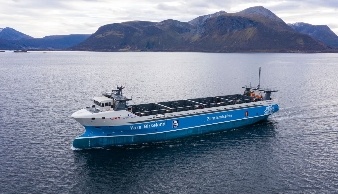
MASS Code was entered to come into force on 1 July 2026 as a voluntary instrument, and it is this that will be implemented.
The International Maritime Organisation (IMO) has adopted the first global regulatory framework dedicated to Maritime Autonomous Surface Ships (MASS), following years of discussion on autonomous vessels, and in May 2026, it adopted a new International Code of Safety for Maritime Autonomous Surface Ships (MASS Code), which marks a major regulatory milestone for autonomous shipping. The Code will take effect on 1 July 2026.
The emergence of autonomous ships
MASS Code.was entered to come into force on 1 July 2026 as a voluntary instrument, and it is this that will be implemented. The next step is the 'Experience Building Phase', during which testing and data collection will take place. The mandatory version is set to be introduced by 2030 and come into force in 2032, following changes to the SOLAS Convention. The maritime industry is seeing rapid technological advancements, leading to the emergence of autonomous ships that could be controlled remotely or even operate independently. Such changes require robust regulation to ensure the safety of life, cargo and vessels at sea.
Integrate new and advancing technologies into its regulatory framework
IMO aims to integrate new and advancing technologies in its regulatory framework - balancing the benefits derived from new and advancing technologies against safety and security concerns, the impact on the environment and on international trade facilitation, the potential costs to the industry, and their impact on personnel, both on board and ashore. IMO wants to ensure that the regulatory framework for Maritime Autonomous Surface Ships (MASS) keeps pace with technological developments that are rapidly evolving.
A Regulatory scoping exercise on Maritime Autonomous Surface Ships
In 2021, IMO conducted a regulatory scoping exercise on Maritime Autonomous Surface Ships that was designed to assess existing IMO instruments to see how they might apply to ships that utilise varying degrees of automation. The regulatory scoping exercise (RSE) for safety treaties was finalised at the 103rd Session of the MSC in May 2021, and for treaties under the purview of the Legal Committee, at its 108th session in July 2021. The FAL Committee approved the outcome of the RSE of treaties under its remit at FAL 46 in May 2022.
The code only applies to cargo ships.
For now, the code only applies to cargo ships. The rollout of this technology to passenger ships has been delayed due to the challenges posed by safety and liability concerns. The regulatory framework encompasses four levels of autonomy: Level 1: Crew on board assisted by automatic systems. Level 2: Remote control with crew still present.Level 3: Remote control without crew on board.Level 4: Fully autonomous vessel, capable of making decisions without human intervention. The significance of the regulation is that it governs the entire range of solutions currently being developed, not only the extreme case of a fully autonomous vessel.
Related: IMO treaty on hazardous and noxious cargo to enter into force in 2027
A goal-based approach has been chosen by the IMO
A goal-based approach has been chosen by the IMO. Instead of specific technologies being prescribed, safety, environmental protection and reliability objectives are defined. This enables the code to adapt to emerging technologies, such as artificial intelligence, advanced sensors, satellite telecommunications and remote control centres. A fundamental principle is equivalence: autonomous vessels must guarantee the same levels of safety, security and environmental protection as traditional vessels. The absence of personnel on board will not result in lower standards.
The issue of liability
The issue of liability is also addressed by the code. In the event of an accident, collision or pollution, there must always be an identifiable commander who can intervene effectively, even if they are operating from land via a Remote Operations Centre. These control centres will also be subject to certification by the flag state.
Subjects covered include systems design
Subjects covered include systems design, software, communications, navigation, alarm management, remote operations, firefighting, cargo handling, cybersecurity, search and rescue, onboard systems, certification and risk assessment. The adoption of the Mass Code finally introduces a stable regulatory framework within which shipowners, investors, shipyards, classification societies and insurers can plan investments and develop new technologies. However, classification societies will require a range of new skills, particularly in the verification of software, AI systems, and remote control functions.
The realm of maritime endeavours
The realm of maritime endeavours is poised to undergo a period of profound transformation. The code's predictions for seafarers are not all about a rapid disappearance. It also predicts a growing importance of skills in managing automated systems and future onshore operations centres. The coming years will be dedicated to defining new professional roles and certification pathways.
The trial phase, planned until 2032
The trial phase, planned until 2032, will enable us to pinpoint technical and regulatory concerns that are yet to be identified. However, the direction is now clear: traditional ships will continue to dominate maritime traffic for a long time to come, but autonomous ships have achieved legal recognition within the international regulatory system for the first time. This is no longer a simple technological project; it is a new operational category that is going to have a long-lasting influence on ship design, management, ownership and insurance.
#IMO # Legal Committee#FAL 46 # MASS Code # SOLAS Convention#regulatory framework# autonomous vessels #automatic systems #The maritime industry
You Might Also Like
16 September 2026
Recommendation News

Marine Tech
At the ABS North America Regional Committee Meeting : The Revitalization of US Shipbuilding 01 November 2025
Incidents
A Gambian-flagged tanker has caught fire in the Black Sea off Turkey’s coast 28 November 2025
Yachts&Cruises
Stena Line to discontinue the Halmstad–Grenaa ferry route 03 February 2026
Marine Tech
UK P&I Club and TT Club announce merger discussions 26 November 2025
Shipping Lines
The French ship CMA CGM Kribi has left the Strait of Hormuz 04 April 2026