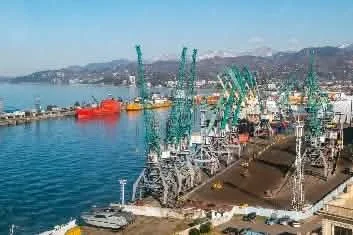
From January to September 2026, Batumi Sea Port in Georgia handled cargo volumes totalling 6.25 million tonnes, with a surge in ferry traffic accounting for a 54% increase.
A total of 6.25 million tonnes of cargo were handled by Batumi Sea Port in Georgia during the initial nine months of 2026. This signifies a 13 percent year-on-year surge, propelled by a substantial escalation in container and ferry traffic along the pivotal Black Sea route.
The continued growth indicates a growing reliance on the Trans-Caspian International Transport Route, also known as the Middle Corridor. This is because Central Asian countries, especially Kazakhstan, are speeding up their efforts to diversify their export routes away from traditional northern networks. The port is managed by Batumi Oil Terminal LLC, a subsidiary of Kazakhstan's national oil transporter, KazTransOil. The facility is a vital logistics hub, connecting resources from the Caspian Sea and manufactured goods from Asia to European markets.
Cargo Breakdown and Performance
.The positive trend was consistent across almost all major cargo categories during the reporting period from January to September. Containerised cargo recorded the most robust growth in absolute terms, reaching 2.984 million tonnes — a 17 per cent increase compared to the same period in 2025. Meanwhile, dry bulk cargo throughput totalled 1.434 million tonnes, marking a 7 percent increase.
Ferry cargo volumes experienced the highest relative surge, jumping 54 percent to 402,000 tonnes. Port operators attributed this sharp increase largely to the introduction of an additional weekly ferry service operating between Batumi and the Romanian port of Constanța.
This enhanced roll-on/roll-off (ro-ro) capacity has significantly smoothed the transfer of wheeled freight across the Black Sea, bypassing congested overland border crossings. The Constanța-Batumi route essentially acts as a maritime bridge connecting the South Caucasus directly to the European Union's transport network. Seamless ferry connections allow commercial trucks and rail cars to roll directly off the ship and onto the European highway system, sharply reducing transit times.
Liquid bulk cargo, primarily comprising petroleum products, saw a steady 5 percent year-on-year increase, bringing the total to 1.429 million tonnes.
| CARGO CATEGORY | VOLUME (MILLION TONNES) | YEAR-ON-YEAR GROWTH |
|---|---|---|
| Container | 2.984 | +17% |
| Liquid Bulk | 1.429 | +5% |
| Dry Bulk | 1.434 | +7% |
| Ferry Cargo | 0.402 | +54% |
| Total | 6.250 | +13% |
Related: Shota Gelashvili writes: Georgia’s Ports as Regional Trade Gateways
Strategic Infrastructure and Capacity
Batumi Sea Port boasts 11 berths, a state-of-the-art offshore loading complex, 11 portal cranes and a dedicated fleet of 12 port vessels. This infrastructure enables the port to transfer goods seamlessly from the Georgian railway network onto bulk carriers and container ships.
As part of the broader Batumi Oil Terminal, the facility is recognized as one of the largest specialized oil and gas terminals in the Black Sea region. It features an annual handling capacity of up to 11 million tonnes of liquid cargo, supported by 132 storage tanks holding more than 585,000 cubic meters, alongside extensive railway loading racks and process pipelines.
The terminal has been under the operational control of KazTransOil since the late 2000s, serving as a cornerstone of Kazakhstan's strategy to guarantee sovereign access to international waters. By controlling a critical node on the Black Sea coast, Kazakh exporters can maintain a steady flow of hydrocarbons and raw materials even amid shifting geopolitical alliances.
Kazakhstan’s Export Strategy
The performance in Batumi reflects a wider macroeconomic shift orchestrated by Astana. In the face of geopolitical volatility and sanctions affecting traditional transit routes through Russia, Kazakhstan has made the Middle Corridor a top priority. This multimodal transport route carries goods from China and Central Asia across the Caspian Sea to Azerbaijan, through Georgia by rail, and onwards to Europe via the Black Sea.
The International Monetary Fund ( IMF ) recently projected that Kazakhstan’s economy would grow by 3.6 percent by 2031. This forecast relies in part on the successful implementation of its infrastructure and export diversification strategies.
Limitations and Future Prospects
Although the 13 percent growth in Batumi demonstrates the viability of the Middle Corridor, the route still faces distinct physical and administrative constraints. Transporting goods across two seas and through multiple customs jurisdictions requires complex coordination. The limited availability of specialised Caspian Sea vessels can also create bottlenecks at the ports of Aktau and Baku.
Despite the impressive throughput figures, logistics experts note that the Trans-Caspian route remains more expensive and time-consuming than the overland rail routes through Russia. Harmonizing tariffs, digitizing customs procedures across Azerbaijan, Georgia, and Kazakhstan, and dredging shallow approach channels in the Caspian Sea are necessary steps to sustain this growth trajectory.
The continued expansion of ferry services and port handling capacity in Batumi represents a critical step in overcoming these logistical hurdles. As European demand for Central Asian energy and Asian consumer goods persists, the port is poised to remain a central node in the shifting map of Eurasian trade.
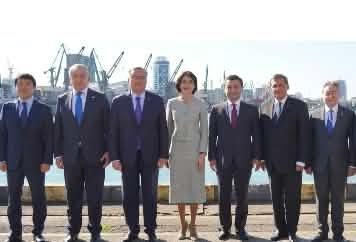
Visit a group of ministers and diplomats from various countries.
In another development, on 23 October 2026, a group of ministers and diplomats from various countries visited Batumi Sea Port, an overseas asset of KazTransOil JSC. The group included Maka Botchorishvili (Georgia's Vice Prime Minister and Minister of Foreign Affairs), Rashid Meredov (Turkmenistan's Deputy Chairman of the Cabinet of Ministers and Minister of Foreign Affairs), and the foreign ministers of Kazakhstan (Mukhtar Tileuberdi), Uzbekistan (Bakhtiyor Saidov), Tajikistan (Sirojiddin Muhriddin), and Kyrgyzstan (Jeenbek Kulubaev). Also present was Talgat Aduov, Ambassador Extraordinary and Plenipotentiary of the Republic of Kazakhstan to Georgia.
During the visit
During the visit, the delegation observed cargo handling operations involving companies with Kazakhstani participation. Three tankers were being serviced simultaneously at the port’s berths: two were loading liquefied petroleum gas (LPG), with a cargo volume of up to 4,650 tonnes, and crude oil, with a cargo volume of up to 85,000 tonnes, respectively; the third was discharging up to 5,000 tonnes of gasoline. The total volume of cargo scheduled for transshipment as part of these operations amounted to up to 94,650 tonnes
Batumi Sea Port
Batumi Sea Port plays an important role in connecting the transport and logistics networks of Central Asia and the Caspian region with the Black Sea basin and European markets. The port provides comprehensive handling services for dry bulk, containerised, ferry and liquid bulk cargoes, including petroleum products.
Source: Streamline + Press-release
#Batumi Sea Port # KazTransOil# Middle Corridor#Batumi Oil Terminal LLC #IMF#Middle Corridor Trade Expansion #Maka Botchorishvili#Rashid Meredov
You Might Also Like
Recommendation News

Shipping Lines
Sallaum Lines took delivery of two LNG-fuelled PCTCs in a simultaneous handover ceremony. 09 June 2026
Marine Tech
RINA successfully tests line pipe hydrogen suitability for Jindal 15 October 2025
Ports
ABP breaks ground on major Humber industrial and logistics scheme 15 December 2025
Incidents
A ship carrying oil was hit in the Strait of Hormuz 02 March 2026
Marine Tech
LR awards its first submarine AiP to Hanwha Ocean 16 May 2026